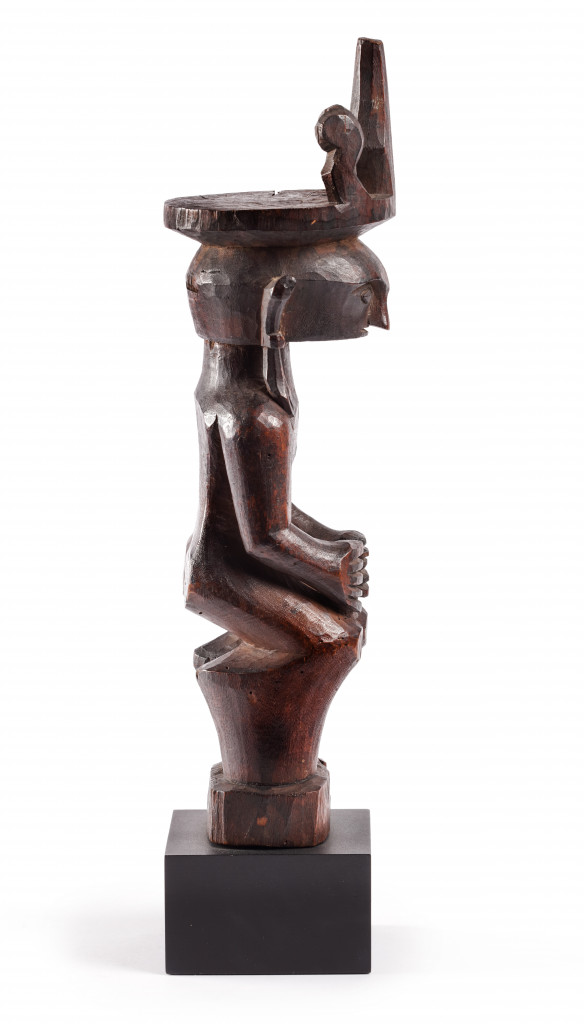
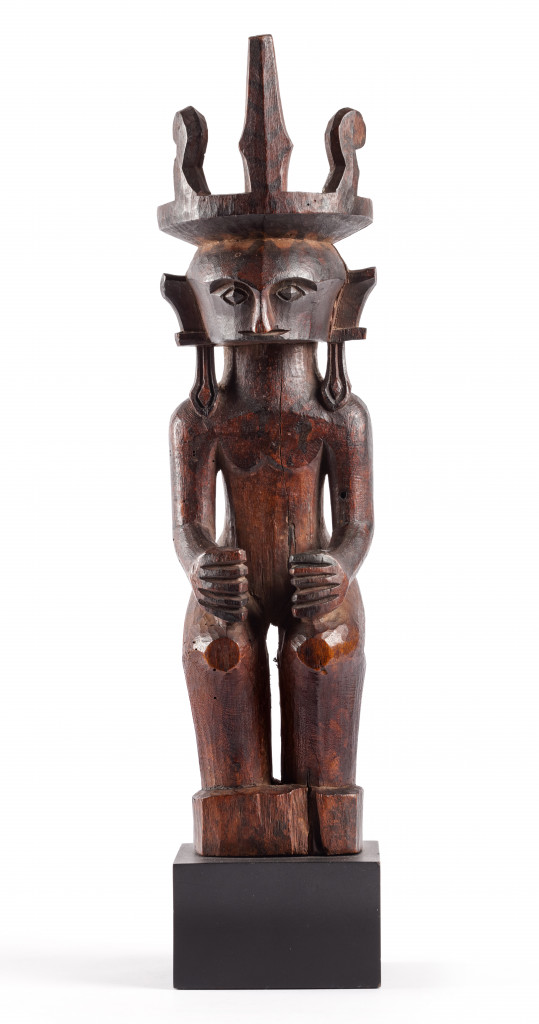
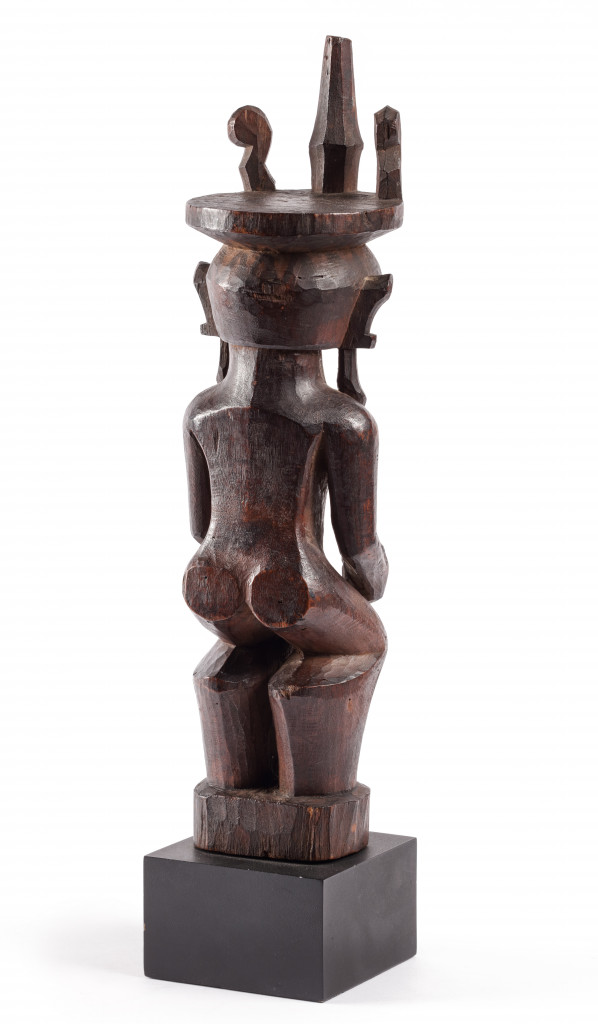
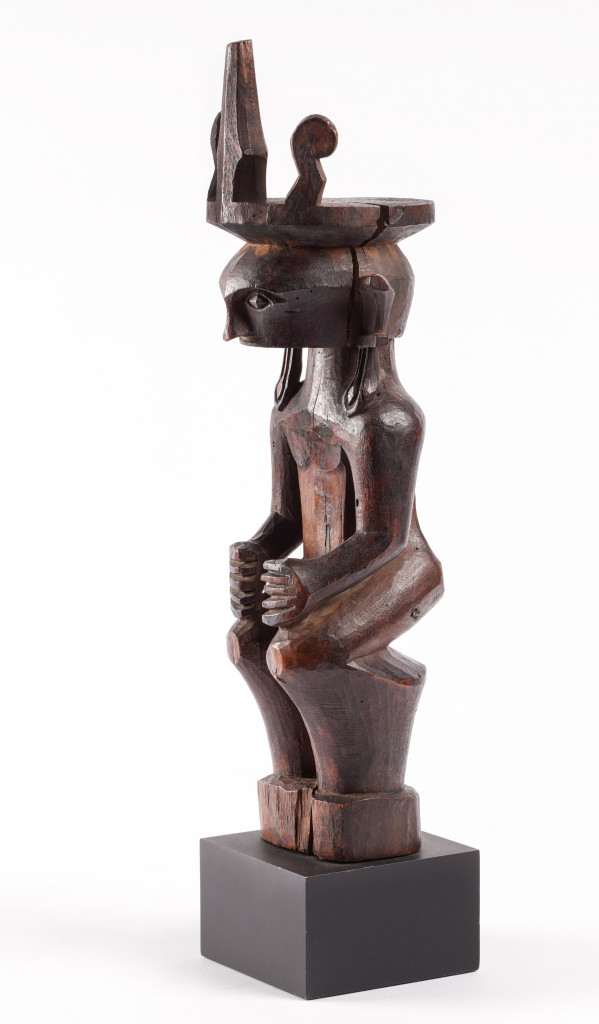
A Nias 'Adu Zatua' wooden ancestor sculpture
Indonesia, Nias, 19th century
H. 37.5 x W. 10 cm
Sculptures like the one present are not only decorative items but are believed to be vessels that house the spirits of ancestors and are used to communicate with them.
After the death of a person a wooden image or Adu Zatua was made to mediate between the human world and the spiritual realm. These kinds of figures were commissioned by noble Nias families, whereas simple and lesser quality carvings generally were found among lower class families.
In this particularly fine example, the sculptor has paid careful attention to the proportions of the different parts of the body, dividing it into three main sections – the head, the torso, and the legs. The shapes are sometimes flat, round, or have notches, but all are perfectly in balance creating a certain divine tranquillity. This Adua Zatua’s ears are decorated with earrings, and it is wearing a headdress, pointing towards a chiefly provenance.
In 1914 the Dutch gained complete control of the island of Nias and started spreading Protestant Christianity. Many ancestor statues were destroyed during the ‘Great Penitence’ religious movement in 1916. As symbols of the old religion of ancestor worship they were seen as blasphemous idols. The Dutch painter Rudolf Bonnet (1895-1976) joined his friend Jaap Kunst in March 1930 for a visit to Nias, where Kunst studied the indigenous music. Impressed by the island which remained unspoiled, Bonnet stayd there for almost a year, living with a Nias servant and making many drawings of the people of South Nias. What shocked him, however, was how the Christian mission, in his opinion, was destroying the culture and many of the traditional practices and the heritage of Nias. For a mesmerizing portrait of a Nias warrior by Bonnet, made during his stay on Nias, see: Uit Verre Streken, November 2022, no. 37 (ill.).
Provenance:
Henk Kouw, Amsterdam (1970s)
Collection Peter van Drumpt, Amsterdam
Collection Tijs Goldschmidt, Amsterdam
Private collection, the Hague (1993)
H. 37.5 x W. 10 cm
Sculptures like the one present are not only decorative items but are believed to be vessels that house the spirits of ancestors and are used to communicate with them.
After the death of a person a wooden image or Adu Zatua was made to mediate between the human world and the spiritual realm. These kinds of figures were commissioned by noble Nias families, whereas simple and lesser quality carvings generally were found among lower class families.
In this particularly fine example, the sculptor has paid careful attention to the proportions of the different parts of the body, dividing it into three main sections – the head, the torso, and the legs. The shapes are sometimes flat, round, or have notches, but all are perfectly in balance creating a certain divine tranquillity. This Adua Zatua’s ears are decorated with earrings, and it is wearing a headdress, pointing towards a chiefly provenance.
In 1914 the Dutch gained complete control of the island of Nias and started spreading Protestant Christianity. Many ancestor statues were destroyed during the ‘Great Penitence’ religious movement in 1916. As symbols of the old religion of ancestor worship they were seen as blasphemous idols. The Dutch painter Rudolf Bonnet (1895-1976) joined his friend Jaap Kunst in March 1930 for a visit to Nias, where Kunst studied the indigenous music. Impressed by the island which remained unspoiled, Bonnet stayd there for almost a year, living with a Nias servant and making many drawings of the people of South Nias. What shocked him, however, was how the Christian mission, in his opinion, was destroying the culture and many of the traditional practices and the heritage of Nias. For a mesmerizing portrait of a Nias warrior by Bonnet, made during his stay on Nias, see: Uit Verre Streken, November 2022, no. 37 (ill.).
Provenance:
Henk Kouw, Amsterdam (1970s)
Collection Peter van Drumpt, Amsterdam
Collection Tijs Goldschmidt, Amsterdam
Private collection, the Hague (1993)
Part of the Indonesian Archipelago collection.
Related objects
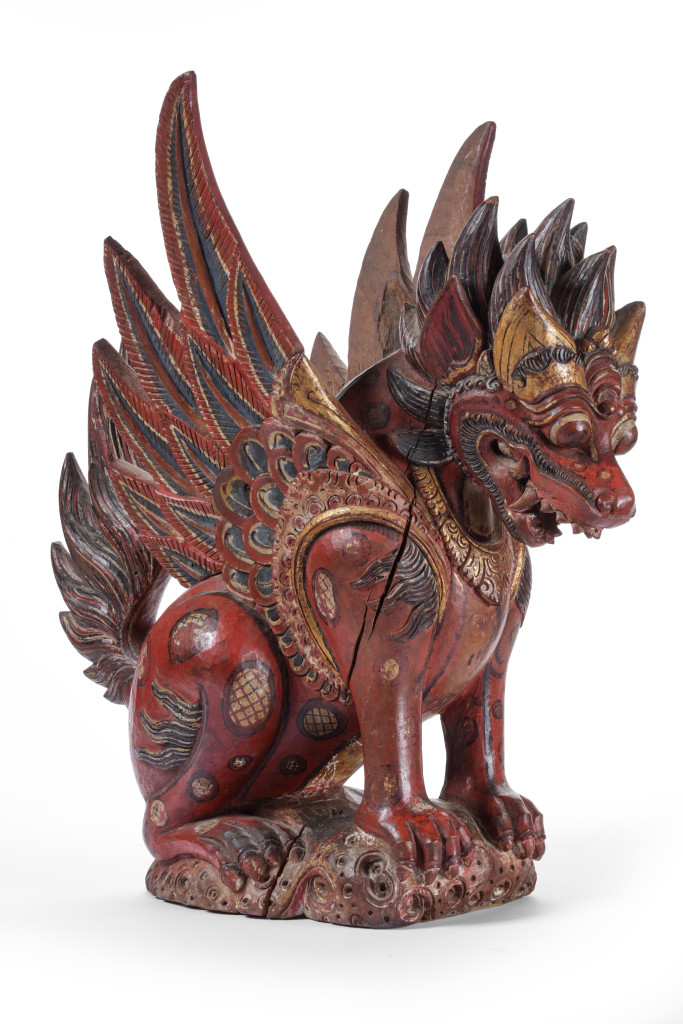
A Balinese polychrome and gilt wood sculpture of a winged lion, Singa Bersayap
Northeast Bali, Singaraja, Buleleng Regency, circa 1900-1930
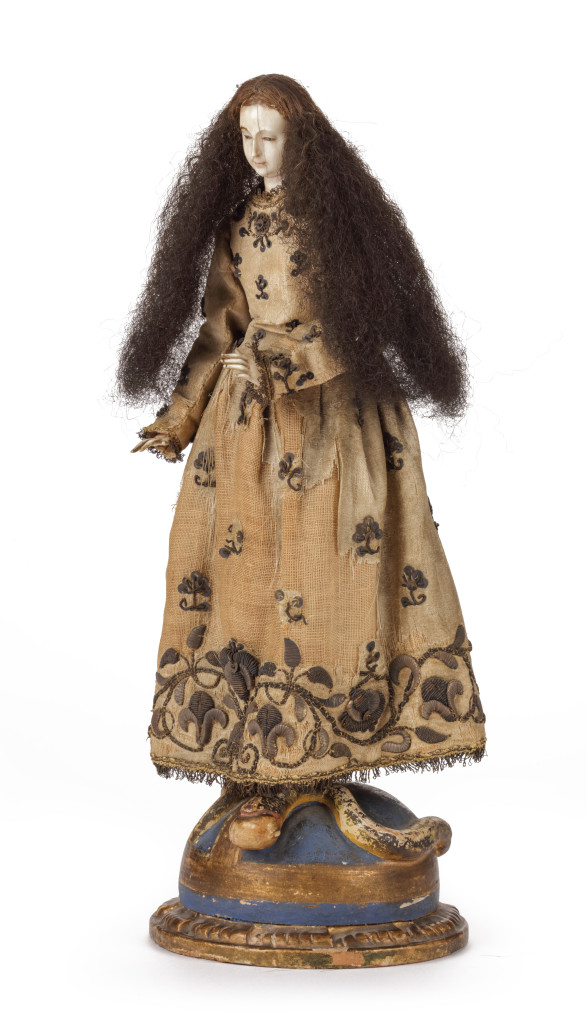
A Spanish-colonial Filipino wood, ivory, human hair and textile sculpture of the Virgin trampling the snake
The face and hands of the Virgin are carved ivory, the body consists of a simple wooden frame dressed in textile and on her head, she has real hair. She is standing on a blue and gilt base with a snake holding an apple in its mouth. In Christianity, this statue symbolises the victory of the Virgin, the chaste mother of Jesus, over sin and death brought into the world by Eva, who fell for the devilish temptations of sex and knowledge.
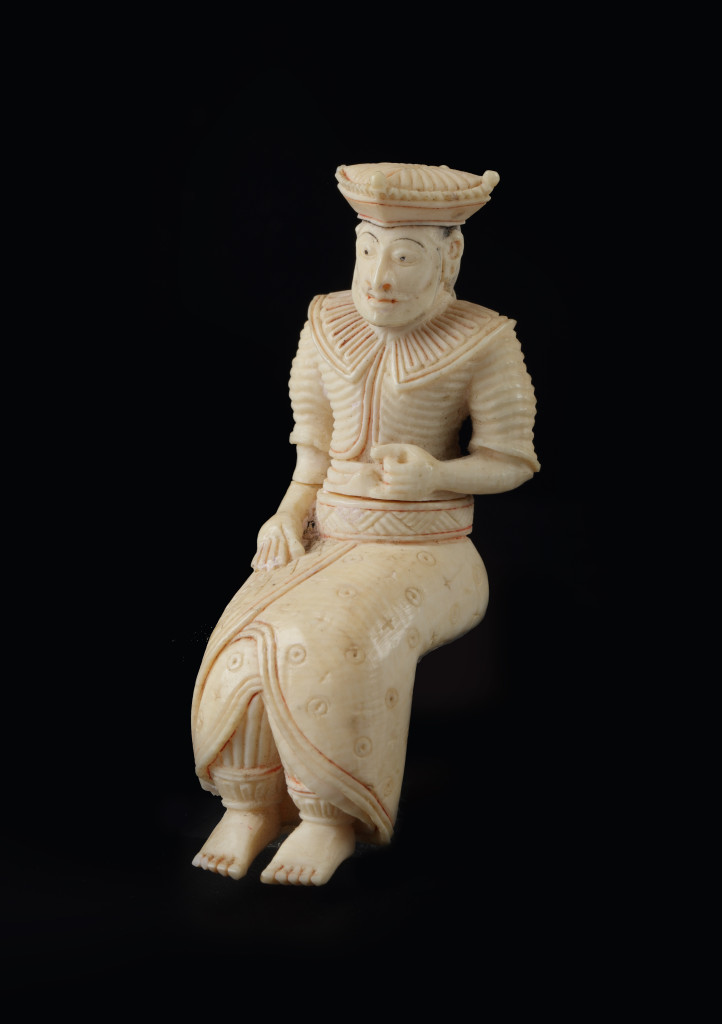
A small ivory sculpture of a seated Sri Lankan king
Extremely rare ebony carved child's chair