Nanjangud Srinivasa Rao Subbakrishna (1914–1993)
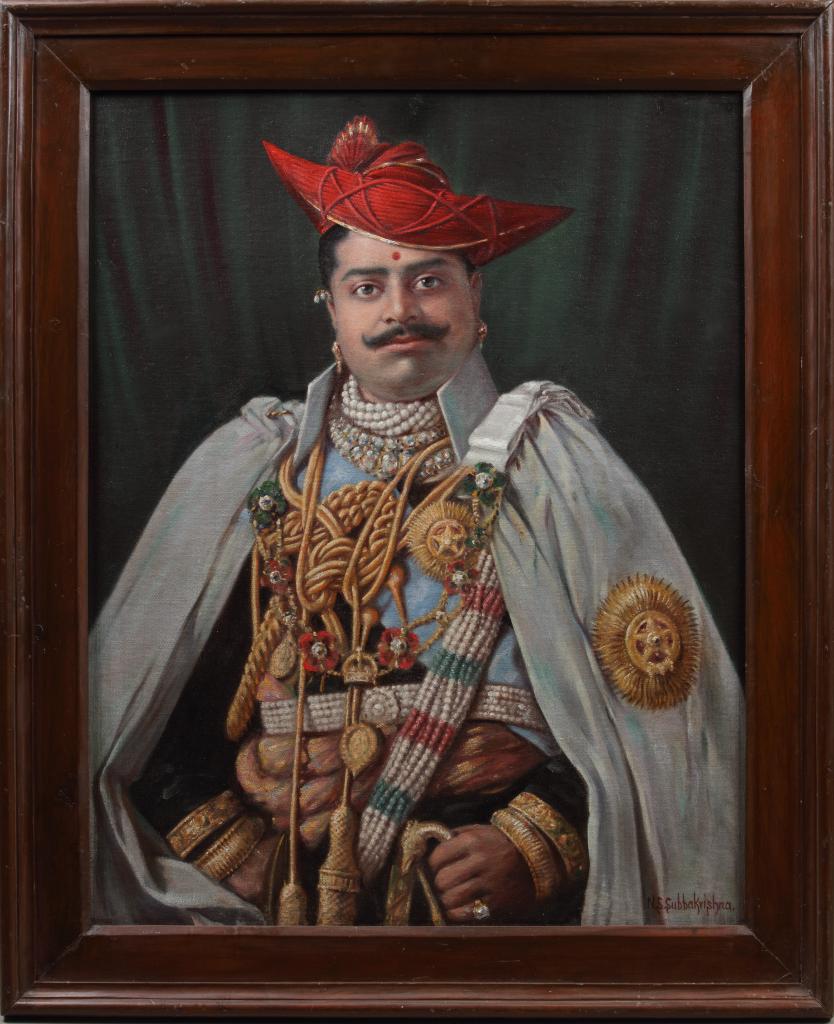
Maharaja Madh Rao Scindia I of Gwalior (1876-1925)
Signed ’N.S. Subbakrishra’ lower right
Oil on canvas, H. 99 x W. 81 cm
Nanjangud Srinivasa Rao Subbakrishna or 'NSS'
Born in Nanjangud in May 1914, Nanjangud Srinivasa Rao Subbakrishna was the only son of Srinivasa Rao and Padmavathi. From early childhood, he demonstrated a passion for drawing. An initial setback in the lower secondary examination ultimately allowed him to devote himself fully to art.
In 1927 he joined the Chamaraja Technical Institute, Mysore, under Principal Alderton, where he studied under K. Keshavaiah and N.G. Pavanje for five years. During this period, he also trained in violin under Nanjangud Ramaswamy and later, in Chamarajanagar, under his neighbour Ponnuswamy, demonstrating the same discipline he brought to his visual work.
By 1932, Subbakrishna was exhibiting his work widely at annual shows in Kodaikanal, Madras, and Kollur, frequently earning first prizes. His paintings, largely in oil and watercolour, focused on rural life, with meticulous attention to the effects of light and shadow. For example, a painting of the Ghats of Varanasi required him to wait two hours to capture the exact play of shadows, achieving an almost photographic realism.
Even after his father’s transfer to Malavalli, he continued to paint, producing a prize-winning depiction of Malavalli Fort. The Municipal President Srinivasan acquired this work and commissioned a portrait of his wife, which also received first prize. Another work, Herdsman Herding Sheep, was purchased by the industrialist Gyan Shyam Das Birla and remains in the Birla collection.
In 1940, Subbakrishna joined the Mysore Porcelain Factory, Bangalore, where he executed designs on plates, cups, and other porcelain items. He accompanied Srinivasan to Gwalior Potteries, working there until 1971 on a monthly salary of Rs. 200, further expanding his repertoire as a commercial and decorative artist.
Maharajdhiraja Maharaja Sir George Jivaji Rao Scindia
After taking the throne in 1886, Madho Rao remained in power until his passing in 1925. The British government recognized him as a forward-thinking princely state leader. Despite being married twice, he only produced a son and a daughter with his second wife in 1913, whom King George V and Queen Mary sponsored. His son, Maharajdhiraja Maharaja Sir George Jivaji Rao Scindia, 7th Maharaja Scindia of Gwalior, succeeded him.
The United Kingdom and other Indian states bestowed various honors and decorations upon the Maharaja. For his assistance during the Boxer Rebellion in China, he was named Honorary Aide-de-camp to King Edward VII in 1901. He was awarded the honorary degree of LL.D. by the University of Cambridge in May of the following year. On February 2, 1903, the Duke and Duchess of Connaught invested him as a Knight Grand Cross of the Royal Victorian Order (GCVO) while he was visiting British India, which included Gwalior.
H.H. the Madho Rao Scindia, the Maharaja of Gwalior, was a far-sighted statesman, soldier, and engineer. He had separated the judicial from the executive. He also separated his privy purse from state revenue and fixed it at a mere two percent of the state revenue. He would often disguise himself as a commoner and walk the streets of Gwalior unrecognised, in order to observe the functioning of the administration firsthand.
The Dinner at Laxmi Villas Palas
Historian Neha Vermani, who specializes in Mughal South Asian History, has offered a window into nearly 130 years of culinary history. She discovered a menu from January 31, 1897, for a dinner held by the Maharaja of Baroda in honor of the Maharaja Scindia of Gwalior while searching through archives to learn about food customs and material culture. The dinner was hosted in the lavish Laxmi Villas Palace in Gujarat and the menu consisted of various French dishes executed in a traditional Indian manner.
A French menu was common practice during the colonial banquets of the British in India. This menu shows that the Maharajah of Baroda picked up on that practice and try to implement it in their manner as a way to impress their guests.
Provenance:
Gwalior Palace, India
Private collection, France
Signed ’N.S. Subbakrishra’ lower right
Oil on canvas, H. 99 x W. 81 cm
Nanjangud Srinivasa Rao Subbakrishna or 'NSS'
Born in Nanjangud in May 1914, Nanjangud Srinivasa Rao Subbakrishna was the only son of Srinivasa Rao and Padmavathi. From early childhood, he demonstrated a passion for drawing. An initial setback in the lower secondary examination ultimately allowed him to devote himself fully to art.
In 1927 he joined the Chamaraja Technical Institute, Mysore, under Principal Alderton, where he studied under K. Keshavaiah and N.G. Pavanje for five years. During this period, he also trained in violin under Nanjangud Ramaswamy and later, in Chamarajanagar, under his neighbour Ponnuswamy, demonstrating the same discipline he brought to his visual work.
By 1932, Subbakrishna was exhibiting his work widely at annual shows in Kodaikanal, Madras, and Kollur, frequently earning first prizes. His paintings, largely in oil and watercolour, focused on rural life, with meticulous attention to the effects of light and shadow. For example, a painting of the Ghats of Varanasi required him to wait two hours to capture the exact play of shadows, achieving an almost photographic realism.
Even after his father’s transfer to Malavalli, he continued to paint, producing a prize-winning depiction of Malavalli Fort. The Municipal President Srinivasan acquired this work and commissioned a portrait of his wife, which also received first prize. Another work, Herdsman Herding Sheep, was purchased by the industrialist Gyan Shyam Das Birla and remains in the Birla collection.
In 1940, Subbakrishna joined the Mysore Porcelain Factory, Bangalore, where he executed designs on plates, cups, and other porcelain items. He accompanied Srinivasan to Gwalior Potteries, working there until 1971 on a monthly salary of Rs. 200, further expanding his repertoire as a commercial and decorative artist.
Maharajdhiraja Maharaja Sir George Jivaji Rao Scindia
After taking the throne in 1886, Madho Rao remained in power until his passing in 1925. The British government recognized him as a forward-thinking princely state leader. Despite being married twice, he only produced a son and a daughter with his second wife in 1913, whom King George V and Queen Mary sponsored. His son, Maharajdhiraja Maharaja Sir George Jivaji Rao Scindia, 7th Maharaja Scindia of Gwalior, succeeded him.
The United Kingdom and other Indian states bestowed various honors and decorations upon the Maharaja. For his assistance during the Boxer Rebellion in China, he was named Honorary Aide-de-camp to King Edward VII in 1901. He was awarded the honorary degree of LL.D. by the University of Cambridge in May of the following year. On February 2, 1903, the Duke and Duchess of Connaught invested him as a Knight Grand Cross of the Royal Victorian Order (GCVO) while he was visiting British India, which included Gwalior.
H.H. the Madho Rao Scindia, the Maharaja of Gwalior, was a far-sighted statesman, soldier, and engineer. He had separated the judicial from the executive. He also separated his privy purse from state revenue and fixed it at a mere two percent of the state revenue. He would often disguise himself as a commoner and walk the streets of Gwalior unrecognised, in order to observe the functioning of the administration firsthand.
The Dinner at Laxmi Villas Palas
Historian Neha Vermani, who specializes in Mughal South Asian History, has offered a window into nearly 130 years of culinary history. She discovered a menu from January 31, 1897, for a dinner held by the Maharaja of Baroda in honor of the Maharaja Scindia of Gwalior while searching through archives to learn about food customs and material culture. The dinner was hosted in the lavish Laxmi Villas Palace in Gujarat and the menu consisted of various French dishes executed in a traditional Indian manner.
A French menu was common practice during the colonial banquets of the British in India. This menu shows that the Maharajah of Baroda picked up on that practice and try to implement it in their manner as a way to impress their guests.
Provenance:
Gwalior Palace, India
Private collection, France
Part of the Indian Ocean collection.