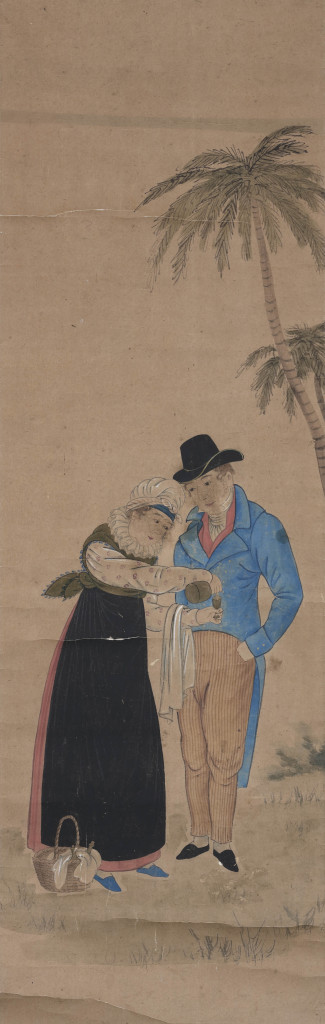
A woman pouring a Dutchman a glass of Dutch gin
Watercolour on paper, with printed paper surround
Painting: 80 x 25.6 cm
Scroll: 115 x 32.5 cm
Exhibited:
Exposorium Vrije Universiteit Amsterdam, Kõmõ-Jin, Roodharige Vreemdelingen Op Deshima, Nagasaki prenten en schilderingen uit de 18e en 19e eeuw, 1 - 31 March 1983
Literature:
Illustrated in the exhibition catalogue, no. 37
Provenance:
Private collection, the Netherlands
Part of the Japan collection.
Related objects
18th century engraved commemorative glass
"Glass to commemorate and to celebrate"A major advancement in the making of glass was George Ravenscroft's usage of lead oxide in the chemical makeup of glass in 1674. This meant glass got a more transparent, clearer and sparkling appearance as well as increased strength. This also meant that the engravings on glass became more elaborate, which can be seen in the glasses present. The engravings were done in two techniques. First the diamond-point technique, with a tiny diamond on a pen, which allowed free decorations. Second, the wheel-cut technique; in which the glass is held against a rotating copper wheel, which gives a fine matte decoration against the lustrous background.
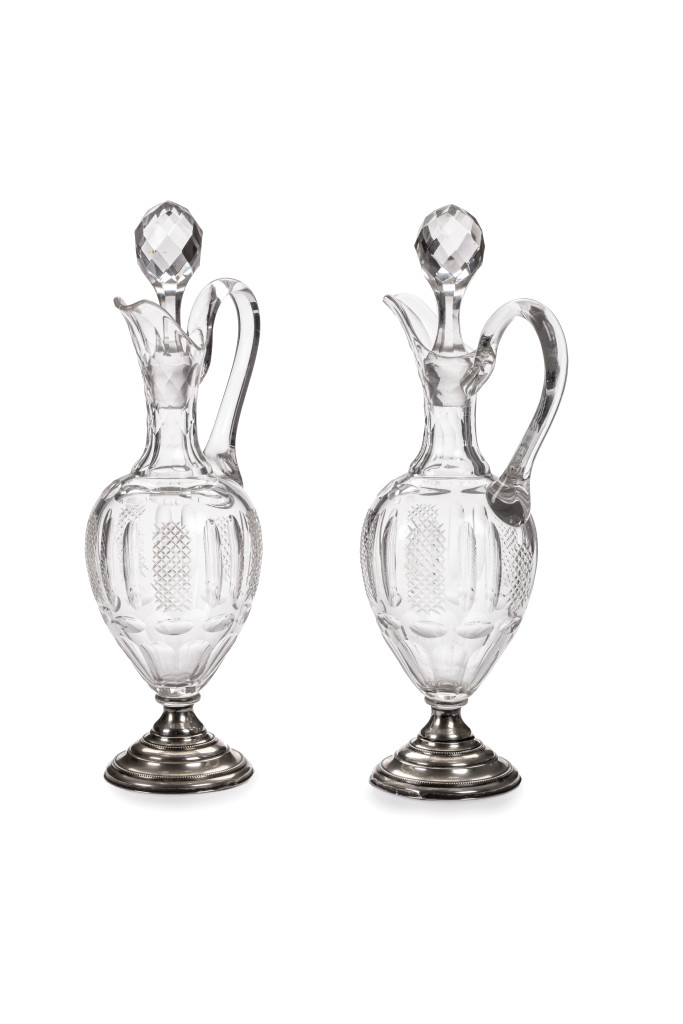
A pair of 'Van Arcken’ lead glass decanters
Circa 1900, the glass Germany, the silver feet Batavia (Jakarta), marked Van Arcken (V-crown-A)
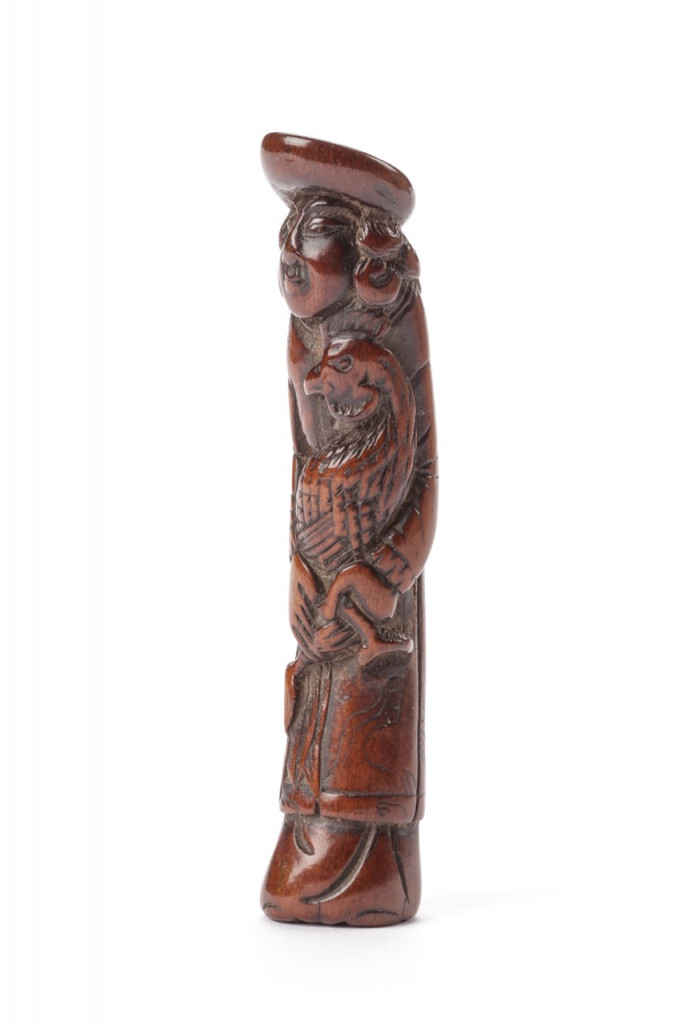
A rare bone netsuke of a Dutchman with a cockerel
Carved from a slender section of bone, most likely a walrus baculum, the Dutchman, with two asymmetrical himotoshi to the back, has an elongated body following the natural orientation of the material and is dressed in a Chinese robe with wave border.