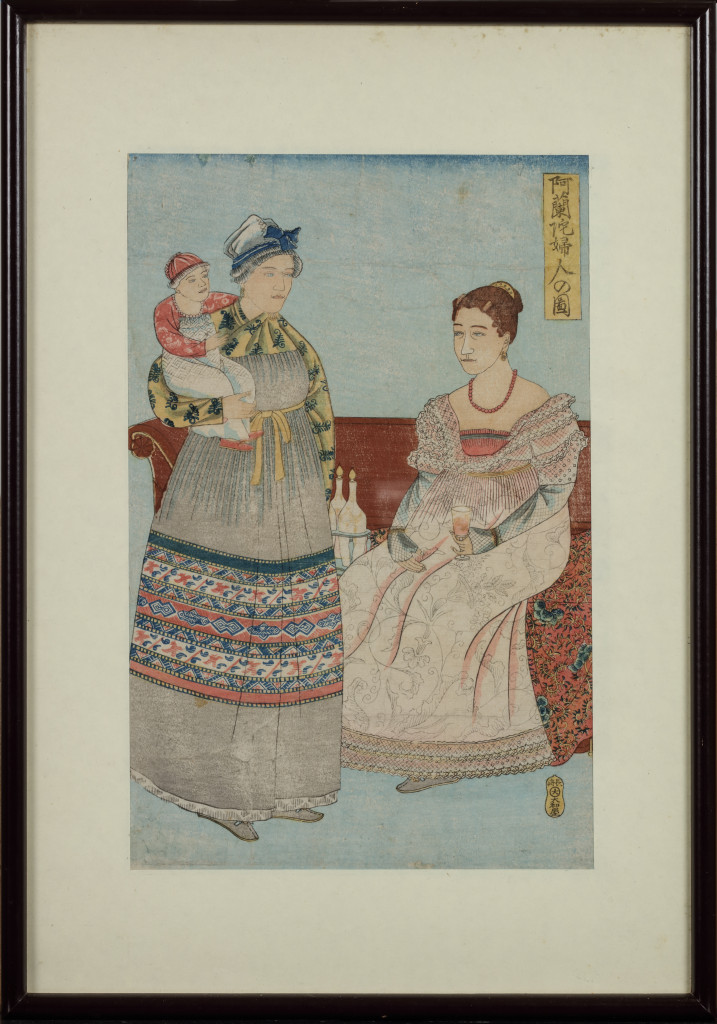
A Japanese colour woodblock print, Nagaski-e, titled 'Oranda fujin no zu' (Dutch ladies)
H. 35.6 x W. 3.5 cm (slightly reduced in width)
Depicted are, Titia, the wife of Opperhoofd of Deshima, Jan Cock Blomhoff, and the nurse Petronella Munts holding the child Johannes in her arms.
In 1639 the third Tokugawa Shogun, Iemitsu (reigned 1623-1651), proclaimed a policy of total isolation, sakoku. This policy implied that no foreign women were permitted to stay on the small island of Deshima where the Dutch traders in Japan were restricted to. The strict regulations concerning the access to Deshima by women explicitly stipulated that only prostitute from the Maruyama quarters in Nagasaki were permitted to stay on the island. These 'openbare juffers’ (public damsels) enjoyed the special privilege of being allowed to stay on the island at night. Before long, they became familiar with European customs and these Oranda-yuki, 'women that go to the Dutch’, were an important source of information on the lifestyle of the Dutch on Deshima. They receive little attention in the art of the Nagasaki prints, except in the now very rare erotic prints, shunga (see for example Zebregs&Röell, Kawahara Keiga, Studio Paintings, Maastricht, June 2020). It was after all the exotic Dutch that were the subject of Nagasaki-e prints.
In July 1817, the Japanese were able to behold Dutch women in the flesh for the first time. In that year, Jan Cock Blomhoff took over the management of the Dutch settlement from Hendrik Doeff. To the great consternation of the Japanese authorities, he came to Deshima in the company of his wife Titia, their sick little son Johannes, and the Dutch nurse Petronella Munts. However, the women and the child had to return with the same ship that would sail back to Batavia (Jakarta) in autumn. Mrs. Cock Blomhoff and her company stayed for five months on Deshima, long enough for artists, like Kawahara Keiga, and publishers of Nagasaki prints to throw themselves onto the task of illustrating the red hair, blue eye, barbaric females. The newly arrived Dutch women were carefully observed. In the present colour woodblock print, after a design by Kawahara Keiga, much attention is given to the correct rendering of the clothing of both women. Titia’s five months stay in Japan might never have been preserved for history hadn’t she been the first western women in Japan, provoking much artistic activity by Japanese artists into reproducing Titia’s image in painting, woodblock prints, woodcarvings, and clay.
Part of the Japan collection.
Related objects
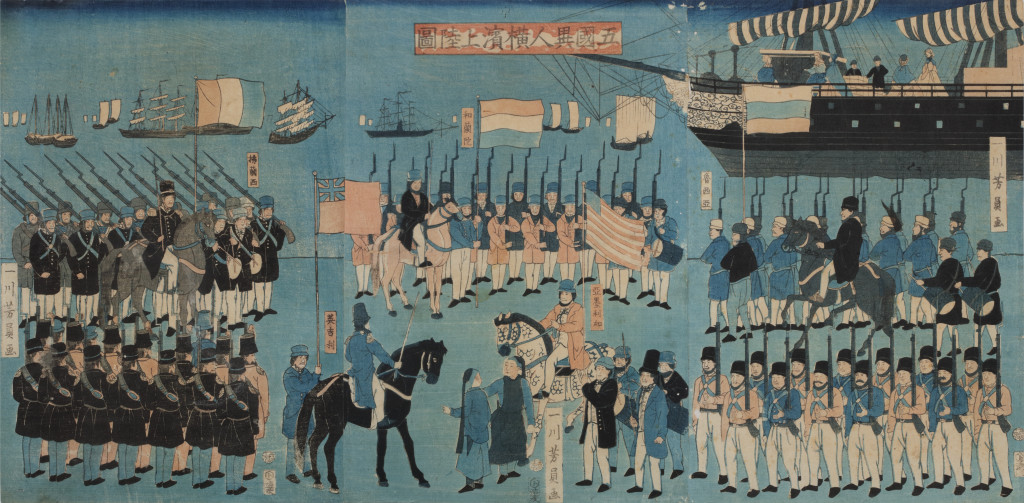
A woodblock print by Yoshikazu, titled 'Picture of the Landing of Foreigners of the Five Nations in Yokohama’, Gokakoku ijin Yokohama jõriku no zu
A woodblock print by Yoshikazu, titled 'Picture of the Landing of Foreigners of the Five Nations in Yokohama’, Gokakoku ijin Yokohama jõriku no zu Published by Enshũya Hikobei, 1861
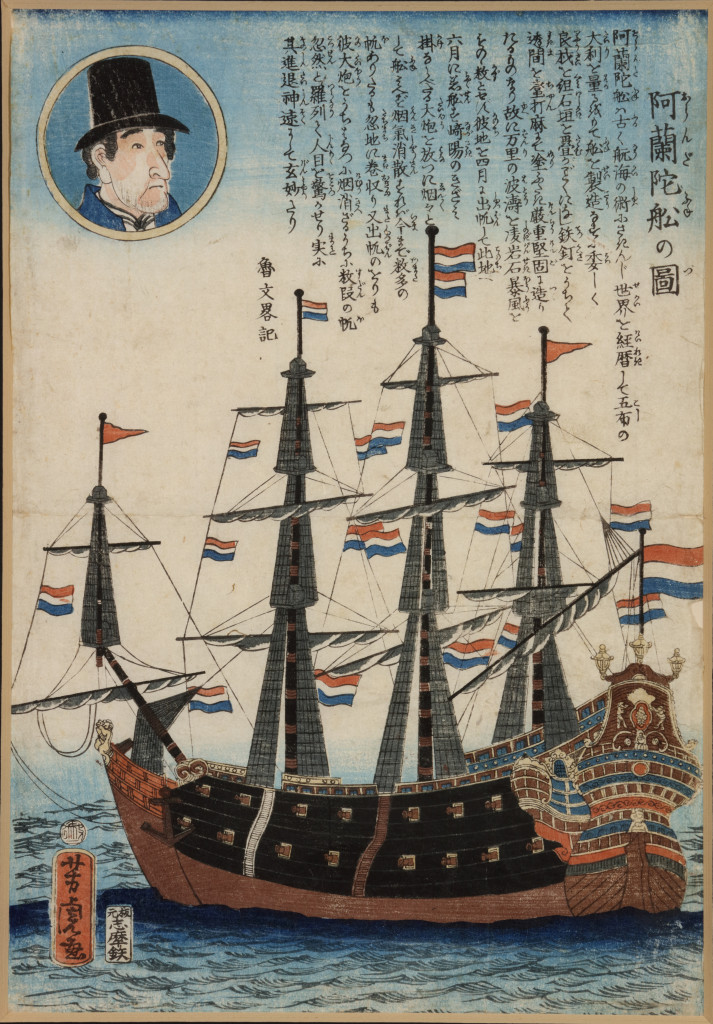
A Yokohama-e woodblock print depicting a Dutch ship by Utagawa Yoshitora (act. 1846-1880)
Yoshitora was active from about 1850 till about 1880. In 1849 he produced a print the censors interpreted as criticism of the Shogunate and Yoshitora was manacled for fifty days and afterwards moved from Edo to Yokohama where he continued to produce illustrations prolifically, particularly of foreigners who arrived in Yokohama after Japan had been forced to open its ports to foreign trade in 1868.
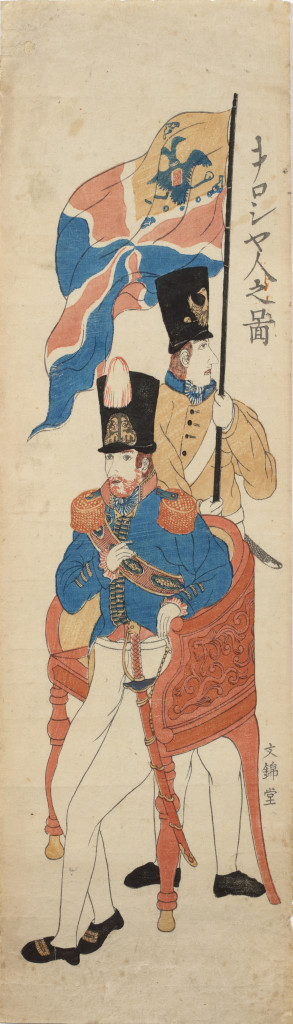
A Nagasaki-e print depicting a Russian officer, probably Admiral Yevfimiy Vasilyevich Putyatin (1803-1883), with a standard bearer
A Nagasaki-e print depicting a Russian officer, probably Admiral Yevfimiy Vasilyevich Putyatin (1803-1883), with a standard bearer Circa 1853, published in Nagasaki by Bunkindô