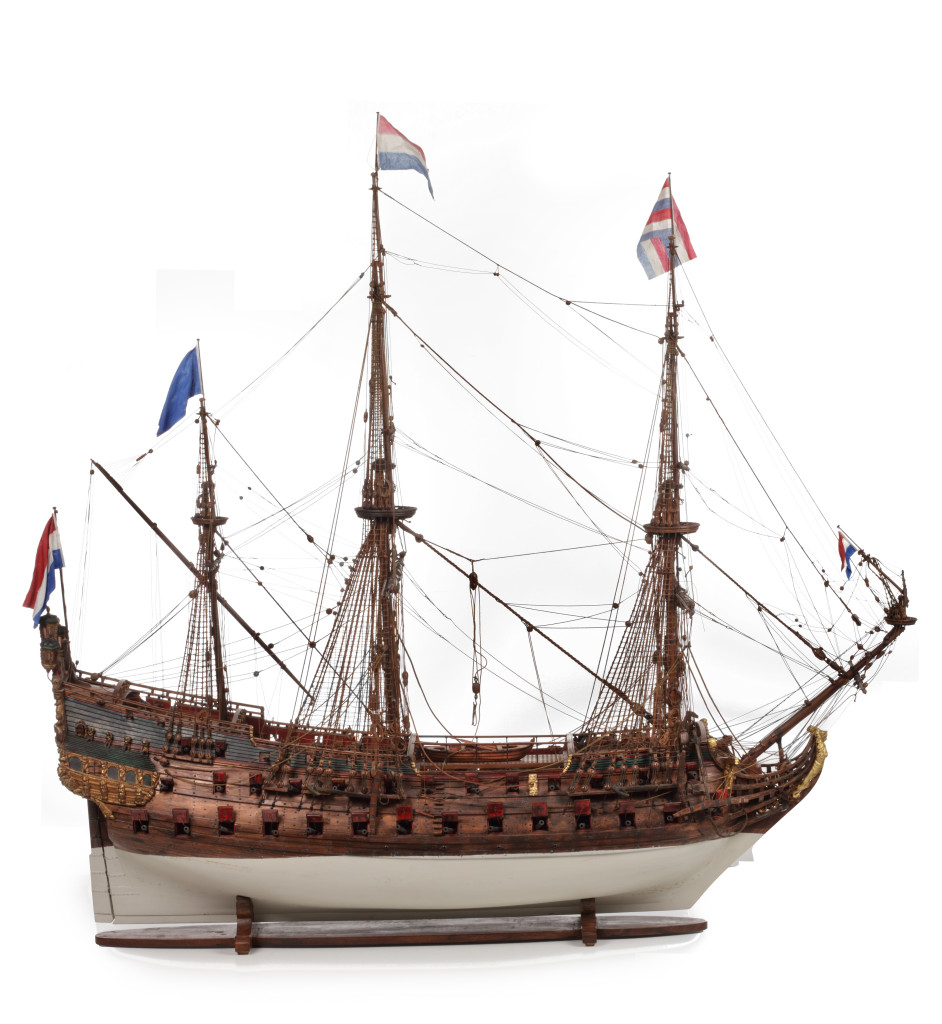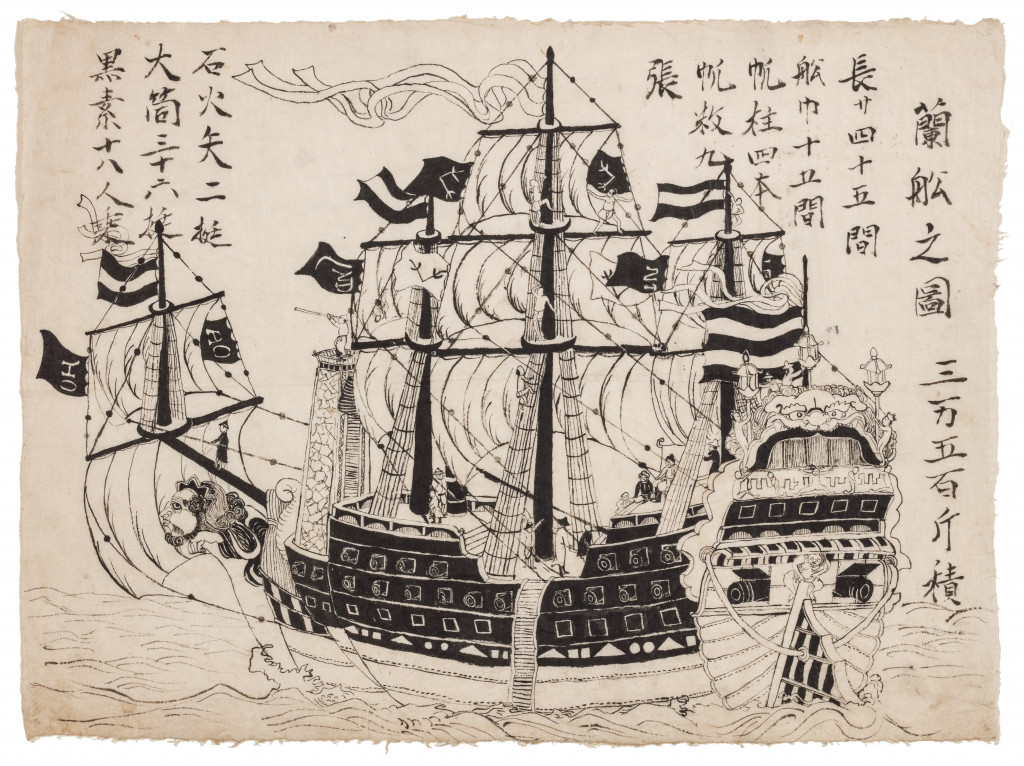
An anonymous Japanese, Kawaraban, illustration of a Dutch ship, 'Ransen no zu'
Circa 1854
The text upper right indicates distances from Nagasaki to such places as Nanjing, Korea, Holland, Java, New Holland (Australia), England and North America. The text upper left reads: “Capacity of loading 30500 kin (18.3 mt); forty-five ken in L. (81 m); twelve ken in W. (22 m); four masts; nine sails; two breech-loading guns, sekkaya; thirty-six large guns.”
H. 30.5 x W. 41.5 cm
At the beginning of the 17th century Japanese newspapers, known as yomiuri (literally “to read and sell”) or kawaraban (literally “tile-block printing” referring to the use of clay printing blocks), were printed handbills sold in major cities to commemorate major social gatherings or events such as natural disasters, religious happenings, murders, and less commonly, political satire. Throughout the Edo period the Shogunate repeatedly restricted printing for mass audiences, particularly seeking to avoid political commentary. Therefore, these sheets were often printed anonymously. By the time the 'Black Ships’ (i.e., Perry’s fleet) arrived, at the end of the Edo period, the system of censorship could no longer keep up with the large number of prints in circulation. The kawaraban publishers served as a crucial vector for the transmission of information about Commodore Mathew Perry’s opening of Japan. That time was characterized by great social upheaval, and intense public interest in the agents of the outside world arriving in Japan. Depictions of Perry’s Black Ship, as on the folding- screen, are based on kawaraban prints like the present one. The present kawaraban print is a very early one. It is still titled Ransen no zu (Dutch ship), although it rather depicts a Ikokusen no zu (foreign ship) but does not yet show a coal-burning paddle-wheel ship with which Commodore Perry arrived in Japan, as depicted in many slightly later kawaraban prints.
The text upper right indicates distances from Nagasaki to such places as Nanjing, Korea, Holland, Java, New Holland (Australia), England and North America. The text upper left reads: “Capacity of loading 30500 kin (18.3 mt); forty-five ken in L. (81 m); twelve ken in W. (22 m); four masts; nine sails; two breech-loading guns, sekkaya; thirty-six large guns.”
H. 30.5 x W. 41.5 cm
At the beginning of the 17th century Japanese newspapers, known as yomiuri (literally “to read and sell”) or kawaraban (literally “tile-block printing” referring to the use of clay printing blocks), were printed handbills sold in major cities to commemorate major social gatherings or events such as natural disasters, religious happenings, murders, and less commonly, political satire. Throughout the Edo period the Shogunate repeatedly restricted printing for mass audiences, particularly seeking to avoid political commentary. Therefore, these sheets were often printed anonymously. By the time the 'Black Ships’ (i.e., Perry’s fleet) arrived, at the end of the Edo period, the system of censorship could no longer keep up with the large number of prints in circulation. The kawaraban publishers served as a crucial vector for the transmission of information about Commodore Mathew Perry’s opening of Japan. That time was characterized by great social upheaval, and intense public interest in the agents of the outside world arriving in Japan. Depictions of Perry’s Black Ship, as on the folding- screen, are based on kawaraban prints like the present one. The present kawaraban print is a very early one. It is still titled Ransen no zu (Dutch ship), although it rather depicts a Ikokusen no zu (foreign ship) but does not yet show a coal-burning paddle-wheel ship with which Commodore Perry arrived in Japan, as depicted in many slightly later kawaraban prints.
Part of the Japan collection.
Related objects
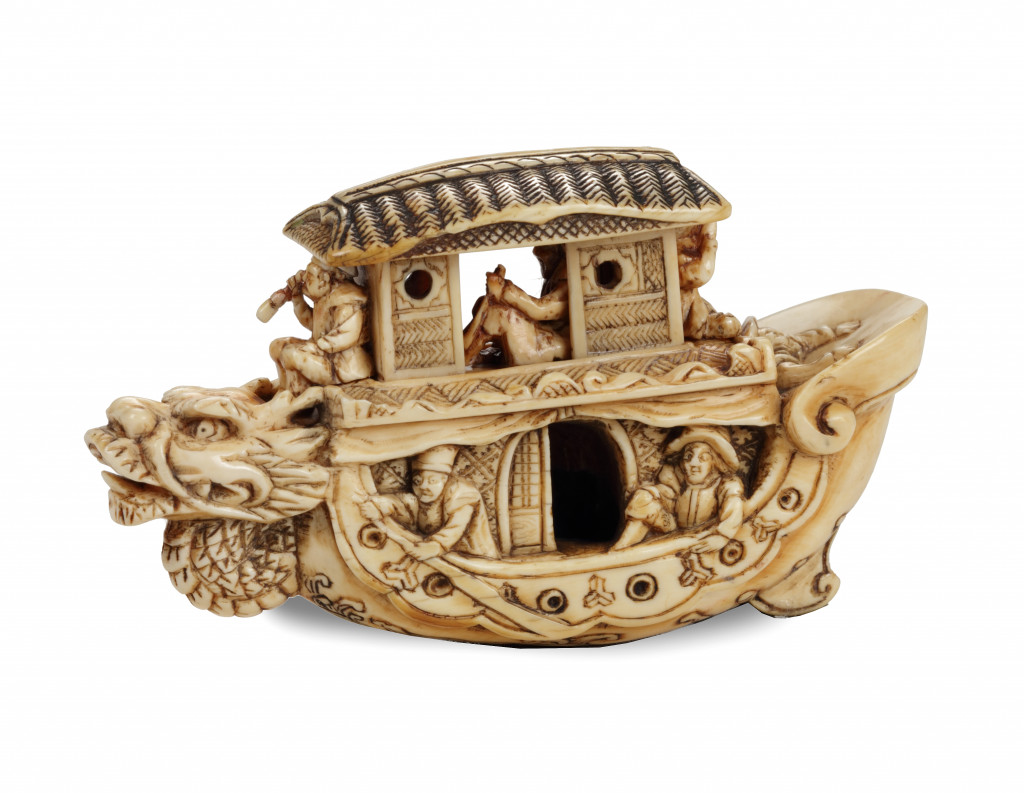
A large netsuke/okimono of a ship with Dutchmen
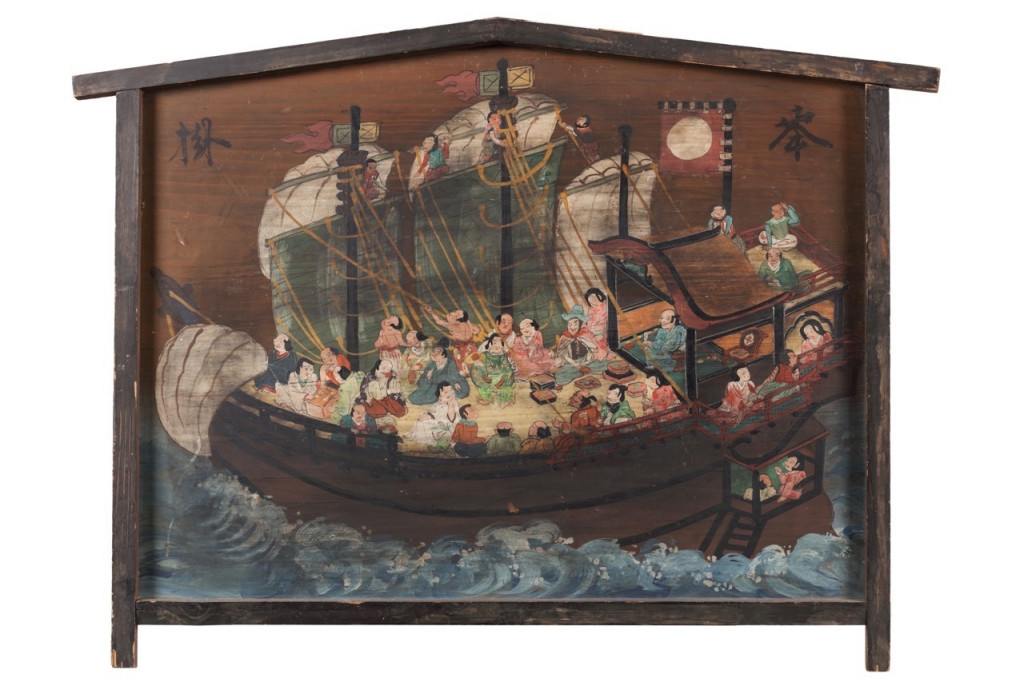
A large exceptional Japanese ema, or painted wood wishing board, depicting a ship
An ema is a votive plaque people hang in a 'dedication area’, at a Shinto shrine, with their wish to the gods. Wishes usually would revolve around health, love, career, prosperity, and academic achievement, but in this case a wish for a safe sea voyage.