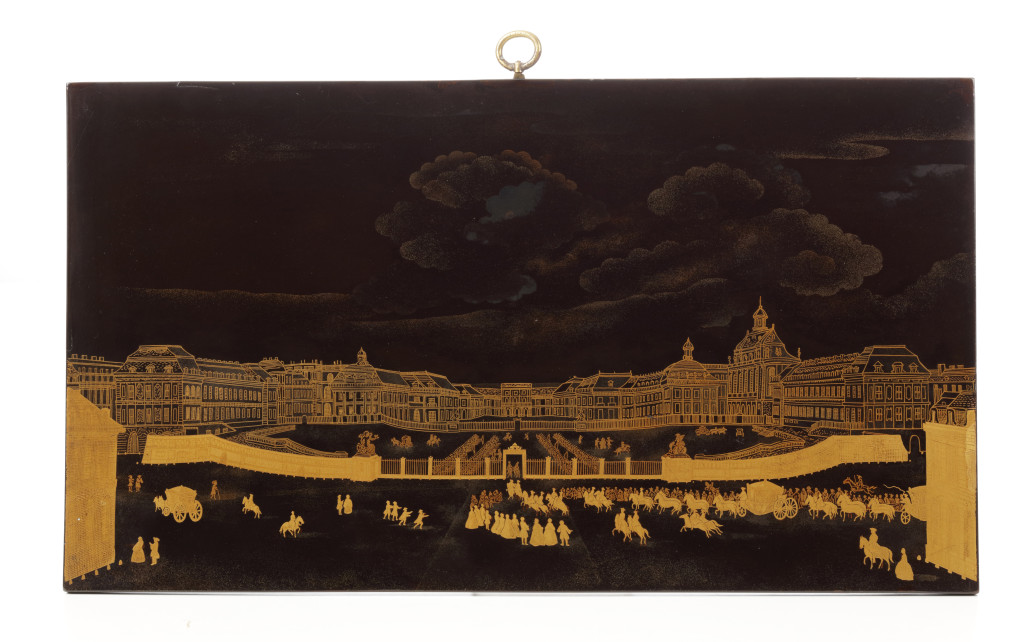
A Japanese export lacquer plaque depicting the Palace of Versailles attributed to the Sasaya Workshop
Nagasaki, circa 1788
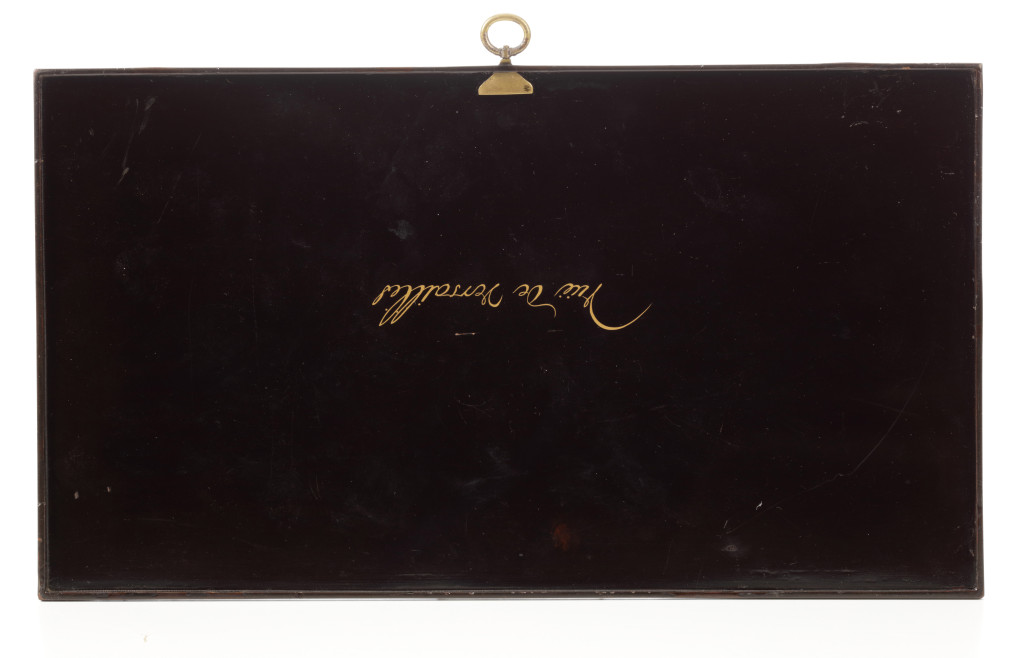
Lacquered on copper ground, decorated in gold hiramaki-e and silver togidashi-e, inscribed to the reverse 'Vue de Versailles'.
H. 16 x W. 28.5 cm
Provenance:
\- By repute\, commissioned by Johan Frederik\, Baron van Reede tot de Parkeler \(1757\-1802\) in circa 1788
\- With Barend Groen Antiquaire\, Amsterdam (1966)
\- With G\. de Boer\, Amsterdam
\- Purchased by the previous owner from a dealer in London
On the back of the small painting frame in which this plaque was framed, the name of Baron Van Reede tot de Parkeler was inscribed. In the archives of the Freemasons, this man is recorded as a frequenter of prostitutes. In the lodge archive, it states:
'Ziende men hem in de Bijbel leezen, en bidden, in het midden van een dozijn Maccassarasche en Javaansche hoeren die hem tot wulpsheid aanlokten.'
Which translates to: 'We saw him reading the Bible and praying, in the midst of a dozen Maccassara and Javanese whores who tempted him to lasciviousness.'
Japanese lacquer panels featuring European prints and drawings began to emerge in the late 18th century. Many were produced in Nagasaki, commissioned by directors of the Dutch East India Company (VOC), including Commander Isaac Titsingh, who served as Opperhoofd (the chief commercial representative of the VOC in Japan) in 1780 and again from 1782 to 1784, and Johan Frederik Baron van Reede tot de Parkeler (1757–1802), who held the same position in 1786 and 1788–89. Due to Japan’s strict isolationist policy (Sakoku) under the Tokugawa shogunate, the VOC operated under special exemption within the confines of their trading post in Deshima, giving them the exclusive ability to commission Japanese artworks such as these lacquer panels. In 1793, Baron van Reede tot de Parkeler sent a collection of Japanese objects to his father in the Netherlands, including, as described in a detailed list and accompanying letter, “two oval portraits or busts of Frederick the Great, one lacquered in colors and the other inlaid…”.
Beyond portrait plaques, topographical views of European and Oriental subjects were also produced, often based on printed engravings. These included landscapes, naval battles, and marine scenes. A notable series commissioned by Baron Reede in 1788 featured views of Rome, including St. Peter’s Basilica, the Trevi Fountain, the Spanish Steps, and various palaces and churches. These panels were inscribed on the reverse with place names in script, similar to the present view of Versailles (illustrated in O. Impey & C. Jörg, Japanese Export Lacquer 1580-1850, Amsterdam, 2005, pp. 52-54, figs. 67-78). One example depicting the Palazzo Corsini, is now housed in the Tokyo National Museum.
A set of four large lacquer panels (each approx. 37 × 53 cm), depicting the Battle of Dogger Bank (5 August 1781), was based on a series of engravings by Frederik Murat and Matthias Sallieth published in 1782. These panels were produced in 1792, signed 'Sasaya', and are now part of the Rijksmuseum collection in Amsterdam (NG-NM-6308, 6309, 6310, 6311). Two additional panels in the Rijksmuseum, also signed 'Sasaya' and dated 1792, depict Ancient Rome, each inscribed with “ROME in its Original Splendour” and “ROME DANS Sa Splendeur Ancienne” (BK-1960-29-A and B). Based on these examples, the Versailles panel can likely be attributed to the lacquer producer Sasaya. Rather than a lacquer artist himself, Sasaya was believed to be a businessman or workshop manager, overseeing commissions from Dutch clients such as van Reede and subcontracting woodworkers, lacquer artisans, and inlay specialists to complete the intricate joinery, lacquering, and pearl inlay work. Initially based in Kyoto, he later possibly relocated most of his operations to Nagasaki.
While many of these lacquer panels were made for Dutch clients, some were likely intended as diplomatic gifts. One such example, depicting a view of the River Neva, St. Petersburg, featuring the Winter Palace and the Academy of Sciences, was presented to Catherine the Great by J.A. Stutzer, a Swedish physician who served with the VOC in Deshima in 1787–88, of which one is in our collection (see inv.no. >>>>>?????????? and Impey & Jörg, 2005, p. 52). For a broader discussion on similar lacquer plaques, see C. Jörg, “Japanese Lacquerwork Decorated After European Prints”, in: Collection of Essays in Commemoration of the 30th Anniversary of the Institute of Oriental and Occidental Studies, Kansai University, Osaka, 1981, and C. Jörg, “Japanese Export Lacquer, Trade and Imitation,” in: Imitation and Inspiration: Japanese Influence on Dutch Art, Amsterdam, 1989, pl. 9.
Prints depicting Versailles were widely circulated in the 18th century, particularly those by topographical artists like Jacques Rigaud (1680–1754). Given the composition of this panel, it is likely derived from a print by Jan Caspar Philips (1690–1775), titled Het Koninklyk Paleis van Versailles, van voren, van het Plein te zien (The Royal Palace of Versailles, seen from the front of the square), printed in Amsterdam in 1756.
Jan Caspar Philips was a German-born draughtsman and engraver who later settled in Amsterdam. His works include views of Versailles, the Bastille, Ovid’s Metamorphoses, and portraits of Dutch Mennonite ministers. His engravings appeared in Jan Wagenaar’s Hedendaagse Historie and Kornelis de Wit’s Verzaameling van Afbeeldingen van Doopsgezinde Leeraaren. He also trained other engravers, including Simon Fokke (1712–1784) and Caspar Jacobsz Philips (1732–1789), the latter being his nephew. A 1754 copperplate engraving by Caspar Jacobsz Philips, depicting two views of London, was later replicated in Japanese lacquer using the same technique as the Versailles panel. This lacquer panel, inscribed on the reverse with “Gezigt langs de rivier de Theems op de brug van London” and “Gezigt langs de Theems op de brug van Westmunster”, was previously sold by us (inv.no. >?>>>???)
Lacquered on copper ground, decorated in gold hiramaki-e and silver togidashi-e, inscribed to the reverse 'Vue de Versailles'.
H. 16 x W. 28.5 cm
Provenance:
\- By repute\, commissioned by Johan Frederik\, Baron van Reede tot de Parkeler \(1757\-1802\) in circa 1788
\- With Barend Groen Antiquaire\, Amsterdam (1966)
\- With G\. de Boer\, Amsterdam
\- Purchased by the previous owner from a dealer in London
On the back of the small painting frame in which this plaque was framed, the name of Baron Van Reede tot de Parkeler was inscribed. In the archives of the Freemasons, this man is recorded as a frequenter of prostitutes. In the lodge archive, it states:
'Ziende men hem in de Bijbel leezen, en bidden, in het midden van een dozijn Maccassarasche en Javaansche hoeren die hem tot wulpsheid aanlokten.'
Which translates to: 'We saw him reading the Bible and praying, in the midst of a dozen Maccassara and Javanese whores who tempted him to lasciviousness.'
Japanese lacquer panels featuring European prints and drawings began to emerge in the late 18th century. Many were produced in Nagasaki, commissioned by directors of the Dutch East India Company (VOC), including Commander Isaac Titsingh, who served as Opperhoofd (the chief commercial representative of the VOC in Japan) in 1780 and again from 1782 to 1784, and Johan Frederik Baron van Reede tot de Parkeler (1757–1802), who held the same position in 1786 and 1788–89. Due to Japan’s strict isolationist policy (Sakoku) under the Tokugawa shogunate, the VOC operated under special exemption within the confines of their trading post in Deshima, giving them the exclusive ability to commission Japanese artworks such as these lacquer panels. In 1793, Baron van Reede tot de Parkeler sent a collection of Japanese objects to his father in the Netherlands, including, as described in a detailed list and accompanying letter, “two oval portraits or busts of Frederick the Great, one lacquered in colors and the other inlaid…”.
Beyond portrait plaques, topographical views of European and Oriental subjects were also produced, often based on printed engravings. These included landscapes, naval battles, and marine scenes. A notable series commissioned by Baron Reede in 1788 featured views of Rome, including St. Peter’s Basilica, the Trevi Fountain, the Spanish Steps, and various palaces and churches. These panels were inscribed on the reverse with place names in script, similar to the present view of Versailles (illustrated in O. Impey & C. Jörg, Japanese Export Lacquer 1580-1850, Amsterdam, 2005, pp. 52-54, figs. 67-78). One example depicting the Palazzo Corsini, is now housed in the Tokyo National Museum.
A set of four large lacquer panels (each approx. 37 × 53 cm), depicting the Battle of Dogger Bank (5 August 1781), was based on a series of engravings by Frederik Murat and Matthias Sallieth published in 1782. These panels were produced in 1792, signed 'Sasaya', and are now part of the Rijksmuseum collection in Amsterdam (NG-NM-6308, 6309, 6310, 6311). Two additional panels in the Rijksmuseum, also signed 'Sasaya' and dated 1792, depict Ancient Rome, each inscribed with “ROME in its Original Splendour” and “ROME DANS Sa Splendeur Ancienne” (BK-1960-29-A and B). Based on these examples, the Versailles panel can likely be attributed to the lacquer producer Sasaya. Rather than a lacquer artist himself, Sasaya was believed to be a businessman or workshop manager, overseeing commissions from Dutch clients such as van Reede and subcontracting woodworkers, lacquer artisans, and inlay specialists to complete the intricate joinery, lacquering, and pearl inlay work. Initially based in Kyoto, he later possibly relocated most of his operations to Nagasaki.
While many of these lacquer panels were made for Dutch clients, some were likely intended as diplomatic gifts. One such example, depicting a view of the River Neva, St. Petersburg, featuring the Winter Palace and the Academy of Sciences, was presented to Catherine the Great by J.A. Stutzer, a Swedish physician who served with the VOC in Deshima in 1787–88, of which one is in our collection (see inv.no. >>>>>?????????? and Impey & Jörg, 2005, p. 52). For a broader discussion on similar lacquer plaques, see C. Jörg, “Japanese Lacquerwork Decorated After European Prints”, in: Collection of Essays in Commemoration of the 30th Anniversary of the Institute of Oriental and Occidental Studies, Kansai University, Osaka, 1981, and C. Jörg, “Japanese Export Lacquer, Trade and Imitation,” in: Imitation and Inspiration: Japanese Influence on Dutch Art, Amsterdam, 1989, pl. 9.
Prints depicting Versailles were widely circulated in the 18th century, particularly those by topographical artists like Jacques Rigaud (1680–1754). Given the composition of this panel, it is likely derived from a print by Jan Caspar Philips (1690–1775), titled Het Koninklyk Paleis van Versailles, van voren, van het Plein te zien (The Royal Palace of Versailles, seen from the front of the square), printed in Amsterdam in 1756.
Jan Caspar Philips was a German-born draughtsman and engraver who later settled in Amsterdam. His works include views of Versailles, the Bastille, Ovid’s Metamorphoses, and portraits of Dutch Mennonite ministers. His engravings appeared in Jan Wagenaar’s Hedendaagse Historie and Kornelis de Wit’s Verzaameling van Afbeeldingen van Doopsgezinde Leeraaren. He also trained other engravers, including Simon Fokke (1712–1784) and Caspar Jacobsz Philips (1732–1789), the latter being his nephew. A 1754 copperplate engraving by Caspar Jacobsz Philips, depicting two views of London, was later replicated in Japanese lacquer using the same technique as the Versailles panel. This lacquer panel, inscribed on the reverse with “Gezigt langs de rivier de Theems op de brug van London” and “Gezigt langs de Theems op de brug van Westmunster”, was previously sold by us (inv.no. >?>>>???)
Part of the Japan collection.
Related objects
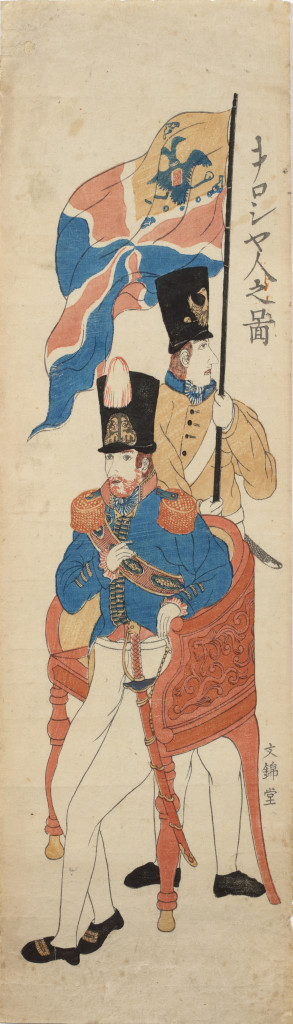
A Nagasaki-e print depicting a Russian officer, probably Admiral Yevfimiy Vasilyevich Putyatin (1803-1883), with a standard bearer
A Nagasaki-e print depicting a Russian officer, probably Admiral Yevfimiy Vasilyevich Putyatin (1803-1883), with a standard bearer Circa 1853, published in Nagasaki by Bunkindô
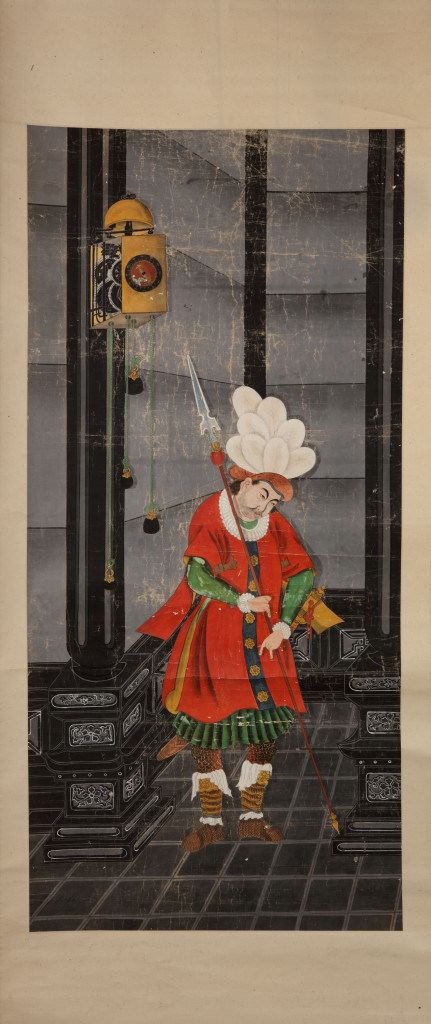
Attributed to Shiba Kokan (1747-1818)
Shiba Kokan (1747-1818) - Dutchman
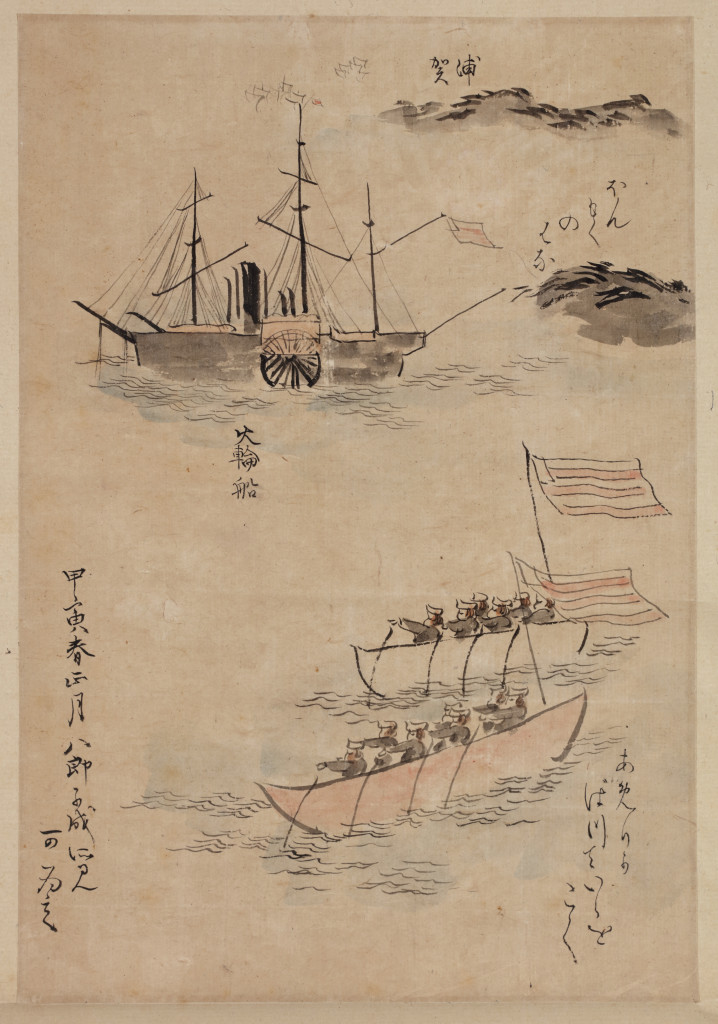
Attributed to Ukita Ikkei (1795-1859)
Ukita Ikkei - Arrival of Comm. Perry