A large Dutch-colonial Sri Lankan coromandel bureau-cabinet
Sri Lanka (Ceylon), Galle district, circa 1750
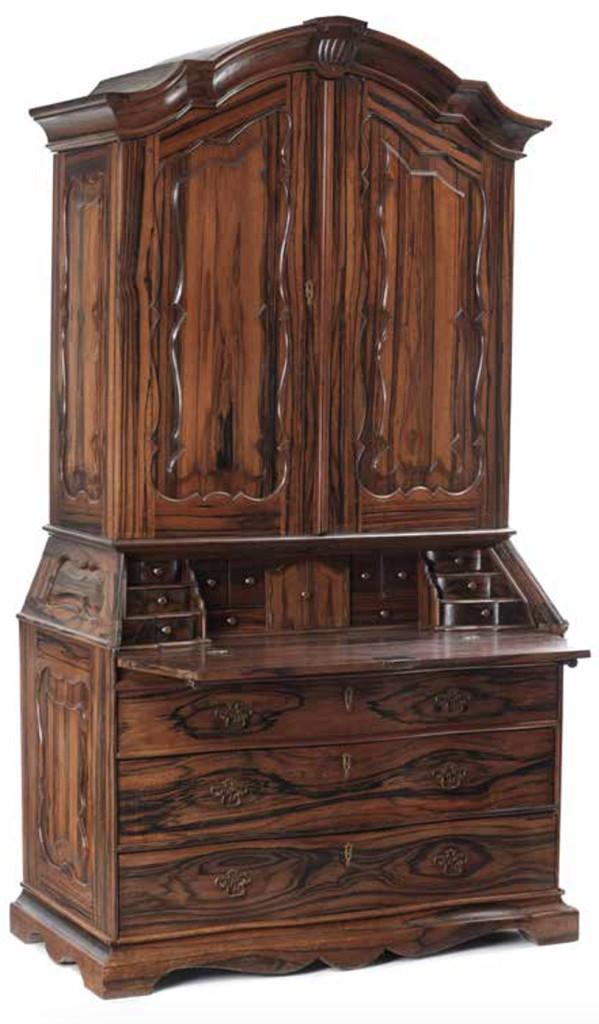
Executed in massive coromandel and nedun wood, with a fall front desk revealing several small and secret drawers, above which two large doors revealing shelves and beneath three drawers.
H. 230 x W. 125 x D. 65 cm
Coromandel (or calamander) wood is called the king of timbers. It is a heavy, beautifully figured type of wood. Light brown with black stripes of varying widths. The wood is usually brown with black stripes and less frequently black with brown stripes. The tree that provides the wood is the Diospyros quaesita, closely related to ebony, Diospyros ebenum. The Dutch discovered the attractive wood in the early 18th century. Initially it was used for local use only but later in the 18th century it was exported as well. In the early 19th century there was such an increase in demand, particularly in England and France that mature tree became rare and trees were felled too young. Therefore large pieces of wood soon were not available anymore and pieces like this bureau cabinet could not be made any longer. True coromandel wood furniture was principally made in and around Galle where the wood was abundant till early 19th century. By then all mature trees had been felled.
Originally this bureau cabinet probably would have had silver mounts in accordance with the precious wood.
Executed in massive coromandel and nedun wood, with a fall front desk revealing several small and secret drawers, above which two large doors revealing shelves and beneath three drawers.
H. 230 x W. 125 x D. 65 cm
Coromandel (or calamander) wood is called the king of timbers. It is a heavy, beautifully figured type of wood. Light brown with black stripes of varying widths. The wood is usually brown with black stripes and less frequently black with brown stripes. The tree that provides the wood is the Diospyros quaesita, closely related to ebony, Diospyros ebenum. The Dutch discovered the attractive wood in the early 18th century. Initially it was used for local use only but later in the 18th century it was exported as well. In the early 19th century there was such an increase in demand, particularly in England and France that mature tree became rare and trees were felled too young. Therefore large pieces of wood soon were not available anymore and pieces like this bureau cabinet could not be made any longer. True coromandel wood furniture was principally made in and around Galle where the wood was abundant till early 19th century. By then all mature trees had been felled.
Originally this bureau cabinet probably would have had silver mounts in accordance with the precious wood.