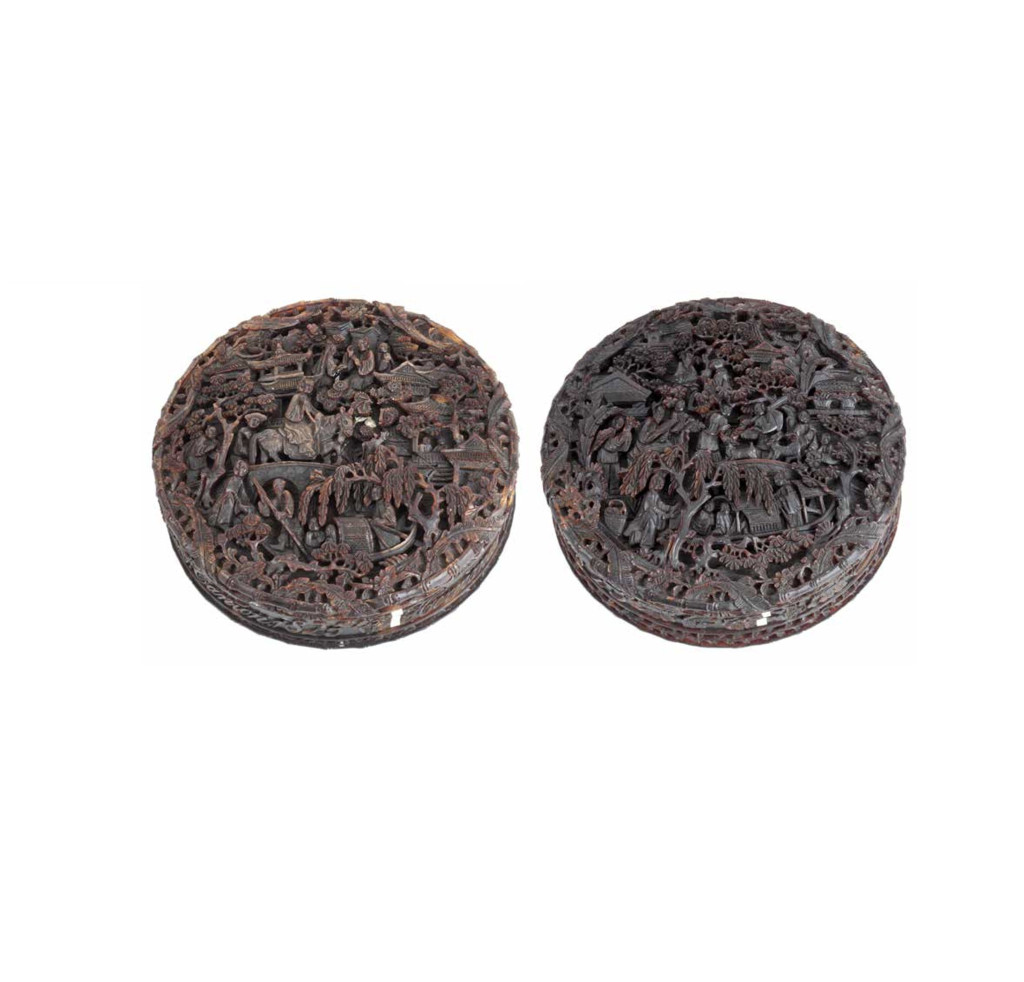
A pair of Chinese elaborately carved tortoiseshell round boxes
Canton, circa 1825
The top and bottom of both boxes are finely carved with figures in Chinese landscapes. Around the side of one box the following text is carved Marinus Aalbertus van den Abeelen, Canton 1825 and around the other Hermanus van den Abeelen, Broederlijk aandenken van MAVDA Canton 1825.
H. 2.6 x Diam. 9.5 cm
Marinus (1799-1870) and Hermanus (1801-1837) van den Abeelen ran a linen business in Rotterdam. Apparently, the business was not very successful because Marinus already left the shop probably before 1825, and Hermanus, in 1836, became a clerk in the poor relief.
Marinus married Dorothea Elizabeth de Vliegh from Rotterdam in 1822, and they had twelve children together. Hermanus in 1831 married Josephine Charlotte Depasse from Brussels. Their only child died just over half a year of age; thirteen days later, his wife died, and within two years, in 1837, Hermanus himself died. In 1824 the Nederlandsche Handel-Maatschappij (NHM), the successor of the VOC, decided to send its very first expedition of four ships, two from Amsterdam, one from Rotterdam and one from Middelburg, straight to Canton to buy tea. Marinus was appointed “supercarga”, responsible for the whole cargo, and J.P. Loots was his assistant as tea-taster. Marinus really knew how to sell himself because he negotiated for himself the same salary as the director of the NHM. Marinus also had to restore the Dutch Factory in Canton, of which little was left after the years Holland had been occupied by the French and after the death of “Opperhoofd” Rabinel in 1816 and his successor Zeeman in 1821. On the 19th of April 1825, Marinus sailed in the “Vijf Gezusters” from Rotterdam to Canton. There, he bought these two tortoiseshell boxes for himself and his brother Hermanus.
In May 1826, Marinus returned to Rotterdam on board the “Vijf Gezusters”. The whole expedition was a disaster for the NHM. Marinus had to account himself for illegal private trade (very common in the old VOC days) and was dismissed. The tea was auctioned with a loss of fl. 900,000. In 1841, after the birth of his twelfth child, Marinus and his wife disappeared from Rotterdam, presumably due to debts because in that year his creditors were asked to leave their claims with notary Valeton en van Rijkevorsel in Rotterdam. In 1870, Marinus died in the village of Saint-Josse in the north of France.
The top and bottom of both boxes are finely carved with figures in Chinese landscapes. Around the side of one box the following text is carved Marinus Aalbertus van den Abeelen, Canton 1825 and around the other Hermanus van den Abeelen, Broederlijk aandenken van MAVDA Canton 1825.
H. 2.6 x Diam. 9.5 cm
Marinus (1799-1870) and Hermanus (1801-1837) van den Abeelen ran a linen business in Rotterdam. Apparently, the business was not very successful because Marinus already left the shop probably before 1825, and Hermanus, in 1836, became a clerk in the poor relief.
Marinus married Dorothea Elizabeth de Vliegh from Rotterdam in 1822, and they had twelve children together. Hermanus in 1831 married Josephine Charlotte Depasse from Brussels. Their only child died just over half a year of age; thirteen days later, his wife died, and within two years, in 1837, Hermanus himself died. In 1824 the Nederlandsche Handel-Maatschappij (NHM), the successor of the VOC, decided to send its very first expedition of four ships, two from Amsterdam, one from Rotterdam and one from Middelburg, straight to Canton to buy tea. Marinus was appointed “supercarga”, responsible for the whole cargo, and J.P. Loots was his assistant as tea-taster. Marinus really knew how to sell himself because he negotiated for himself the same salary as the director of the NHM. Marinus also had to restore the Dutch Factory in Canton, of which little was left after the years Holland had been occupied by the French and after the death of “Opperhoofd” Rabinel in 1816 and his successor Zeeman in 1821. On the 19th of April 1825, Marinus sailed in the “Vijf Gezusters” from Rotterdam to Canton. There, he bought these two tortoiseshell boxes for himself and his brother Hermanus.
In May 1826, Marinus returned to Rotterdam on board the “Vijf Gezusters”. The whole expedition was a disaster for the NHM. Marinus had to account himself for illegal private trade (very common in the old VOC days) and was dismissed. The tea was auctioned with a loss of fl. 900,000. In 1841, after the birth of his twelfth child, Marinus and his wife disappeared from Rotterdam, presumably due to debts because in that year his creditors were asked to leave their claims with notary Valeton en van Rijkevorsel in Rotterdam. In 1870, Marinus died in the village of Saint-Josse in the north of France.
Related objects
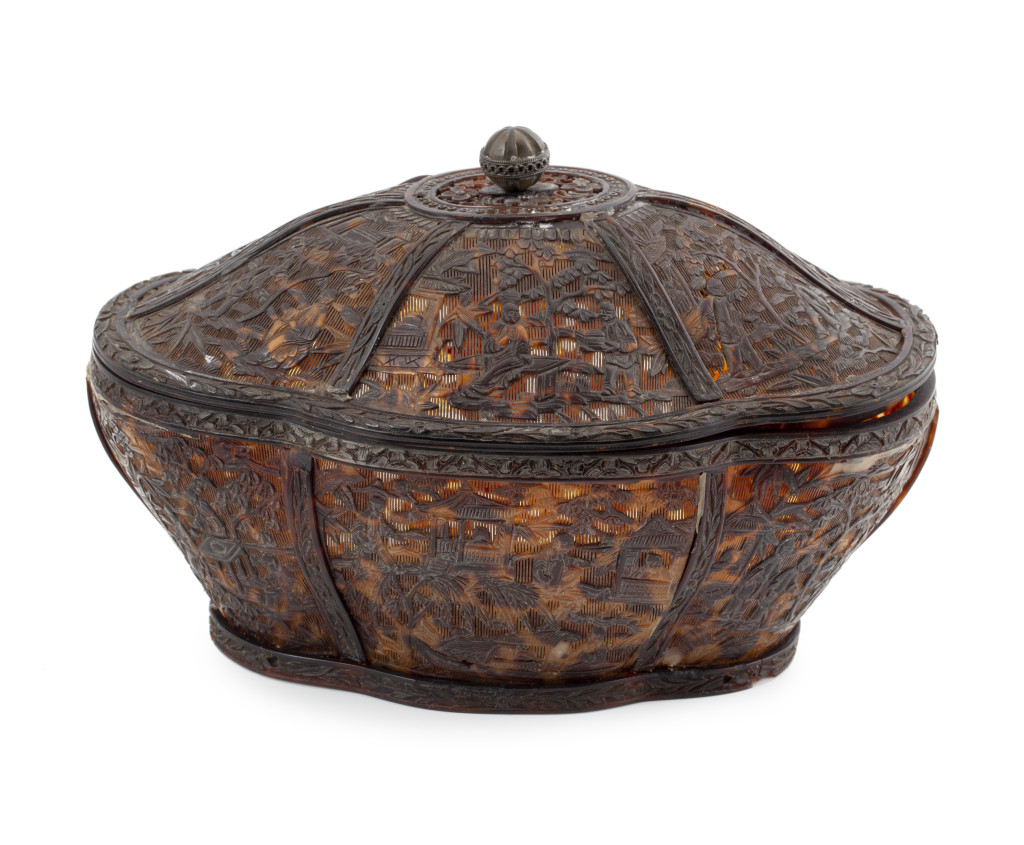
A Chinese refined reticulated tortoise-shell export basket with lid
Canton, late 18th/early 19th century
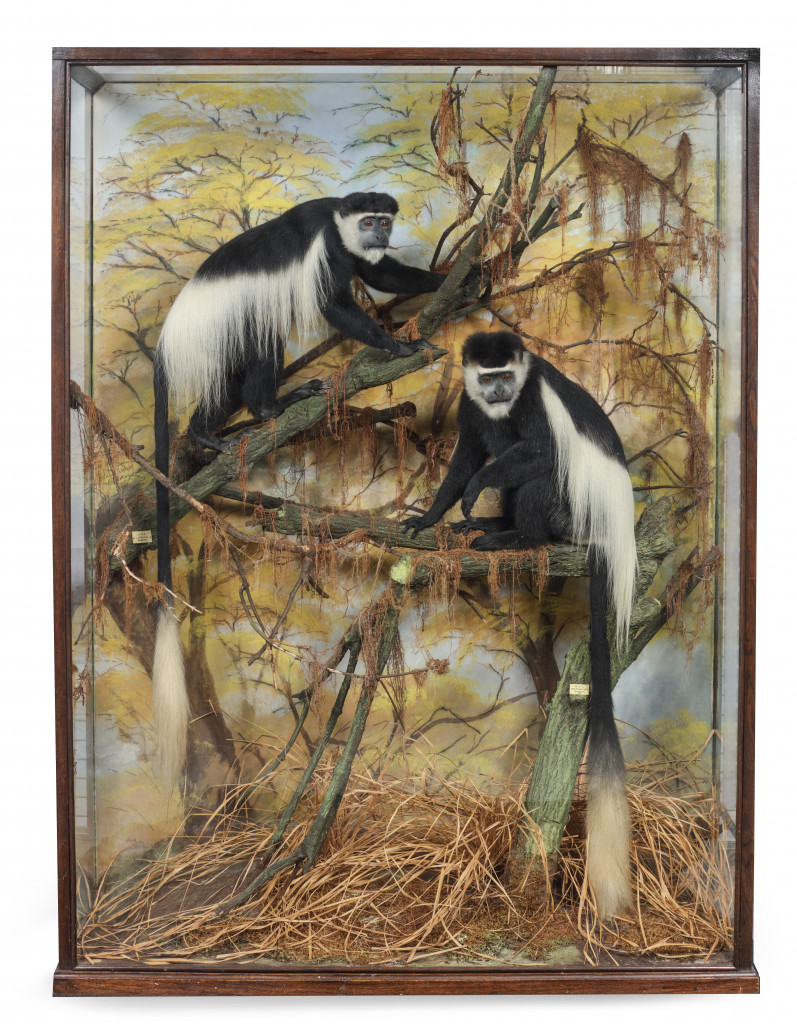
A magnificent pair of cased taxidermy Colobus monkeys (Colobus satanas) by Rowland Ward (1848-1912)
The two monkeys mounted on branches with vegetation and details of the specimens on ivorine plaques, in a glazed and stained oak display case with finely painted background, signed in two places and with a characteristic Rowland Ward trade plaque.
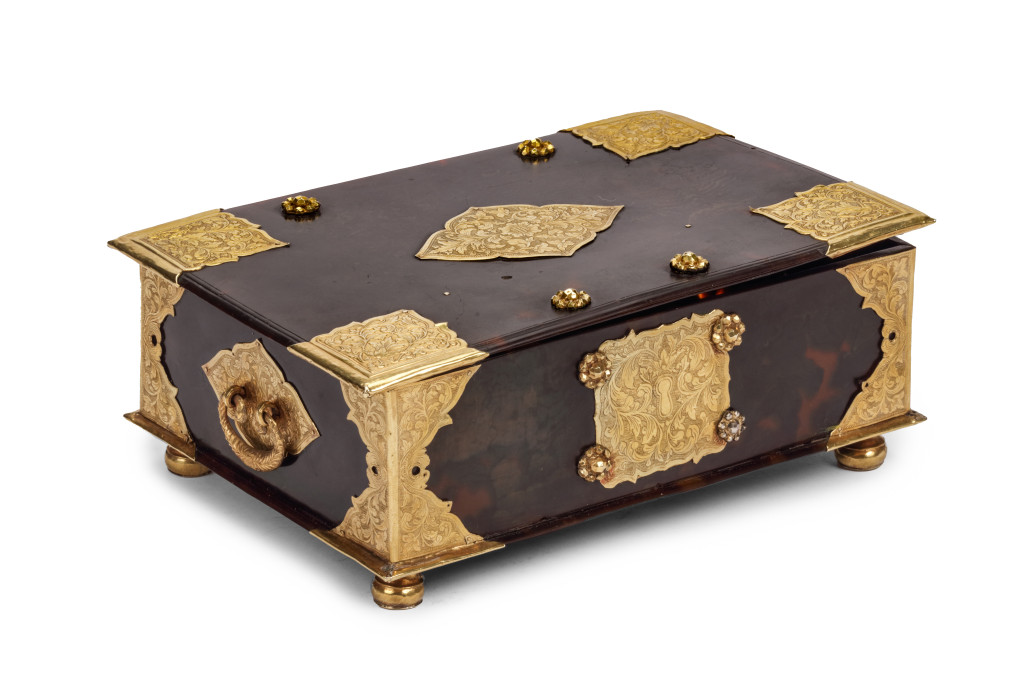
A Dutch-colonial Indonesian tortoiseshell sirih or betel box with gold mounts
_Batavia (Jakarta), early 19th century_ _H. 5 x W. 18 x D. 13 cm_ Provenance: Private collection, the Hague