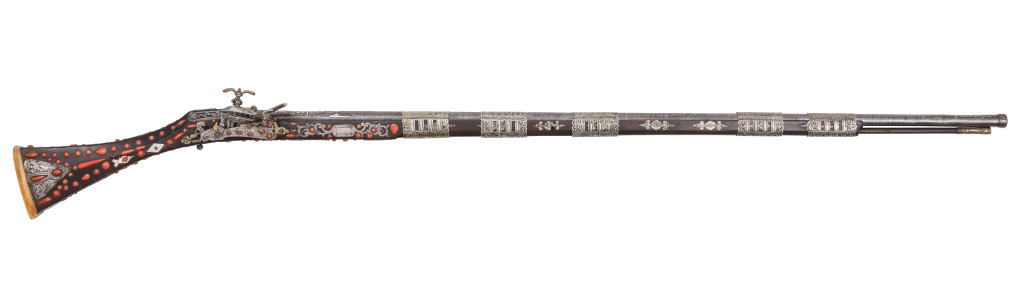
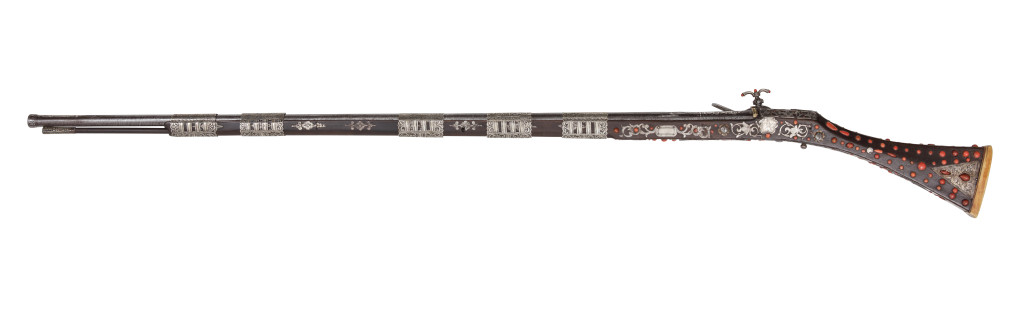
An Ottoman red-coral and silver inlaid snap lock rifle
Ottoman Empire, North Africa, Algeria, 17th century
L. 164 cm
Provenance:
Private collection, Brussels
For a near-identical gun, see the collection of the Dresden Rüstkammer, inv. no. Y 0341.
Augustus the Strong received a typically Algerian rifle inlaid with red coral, nearly identical to the present rifle, as a gift from Tsar Peter I of Russia on the occasion of his coronation as King of Poland. While it is usually not known how the donor came into possession of his present, the inventory notes that the Tsar received the rifle from the Khan of the Crimean Tatars. On August 11, 1699, Augustus the Strong had the gift transferred to the collection. The barrel is inlaid with flower tendrils and tulips in silver and bears a teardrop-shaped to circular master's mark, which is unusual for Ottoman barrels. The barrel is mounted on a shaft carved from plum wood with a walrus ivory cap decorated with red coral and leaf tendrils made of engraved silver. The silver, geometrically decorated brooches are connected to the shaft by braided cords, also made of silver.
Red coral was prized for its rarity and a prominent decorative technique used on arms in the Ottoman Empire, particularly in Algeria. Similar coral-decorated firearms were amongst the gifts offered by the Dey of Algiers to George IV, the Prince Regent of Great Britain, in 1811 and 1819. They can now be found in the Royal Collection in Windsor Castle (inv. no. CH2075) and the Royal Armouries in Leeds. Thomas Jefferson, President of the United States of America, too was presented one by the Tunisian Ambassador Mellimelli on behalf of the Bey of Tunis in 1805-6 and is now in the Smithsonian (inv. no. 2000-6339).
The background to this last presentation was Ambassador Sidi Soliman Mellimelli’s highly colourful diplomatic mission to Washington D.C., of which as a result he successfully averted the impending threat of war between Tunis and the United States. When the USS Constitution captured Tunisian vessels, a crisis ensued. Threatened by war, Tunisian representative Ambassador Mellimelli was sent to the United States to negotiate a diplomatic solution. He told the Americans that coming home without solving the matters wasn’t an option because he would be beheaded upon his return. This way, and perhaps with the splendid guns, he was able to gain the empathy of the Americans, resulting in a peaceful solution.
L. 164 cm
Provenance:
Private collection, Brussels
For a near-identical gun, see the collection of the Dresden Rüstkammer, inv. no. Y 0341.
Augustus the Strong received a typically Algerian rifle inlaid with red coral, nearly identical to the present rifle, as a gift from Tsar Peter I of Russia on the occasion of his coronation as King of Poland. While it is usually not known how the donor came into possession of his present, the inventory notes that the Tsar received the rifle from the Khan of the Crimean Tatars. On August 11, 1699, Augustus the Strong had the gift transferred to the collection. The barrel is inlaid with flower tendrils and tulips in silver and bears a teardrop-shaped to circular master's mark, which is unusual for Ottoman barrels. The barrel is mounted on a shaft carved from plum wood with a walrus ivory cap decorated with red coral and leaf tendrils made of engraved silver. The silver, geometrically decorated brooches are connected to the shaft by braided cords, also made of silver.
Red coral was prized for its rarity and a prominent decorative technique used on arms in the Ottoman Empire, particularly in Algeria. Similar coral-decorated firearms were amongst the gifts offered by the Dey of Algiers to George IV, the Prince Regent of Great Britain, in 1811 and 1819. They can now be found in the Royal Collection in Windsor Castle (inv. no. CH2075) and the Royal Armouries in Leeds. Thomas Jefferson, President of the United States of America, too was presented one by the Tunisian Ambassador Mellimelli on behalf of the Bey of Tunis in 1805-6 and is now in the Smithsonian (inv. no. 2000-6339).
The background to this last presentation was Ambassador Sidi Soliman Mellimelli’s highly colourful diplomatic mission to Washington D.C., of which as a result he successfully averted the impending threat of war between Tunis and the United States. When the USS Constitution captured Tunisian vessels, a crisis ensued. Threatened by war, Tunisian representative Ambassador Mellimelli was sent to the United States to negotiate a diplomatic solution. He told the Americans that coming home without solving the matters wasn’t an option because he would be beheaded upon his return. This way, and perhaps with the splendid guns, he was able to gain the empathy of the Americans, resulting in a peaceful solution.
Part of the Africa and Islamic world collections.
Related objects
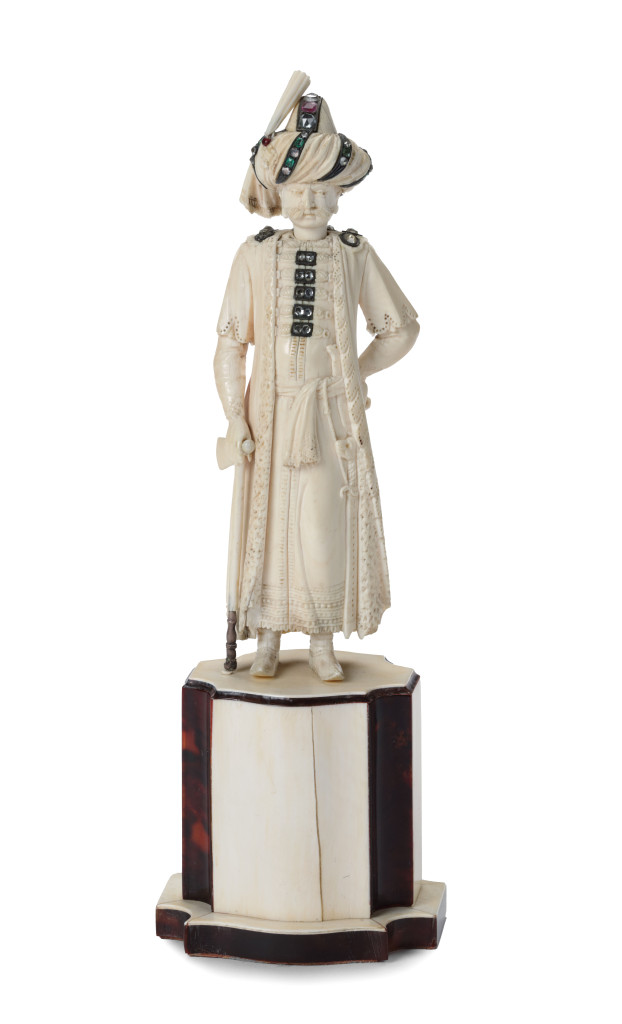
A gem-set ivory sculpture of an Ottoman sultan
Probably Southern Germany or Dieppe, 18th century, the base 19th century _H. 25.5 cm (incl. base)_ Provenance: Private collection, Brussels
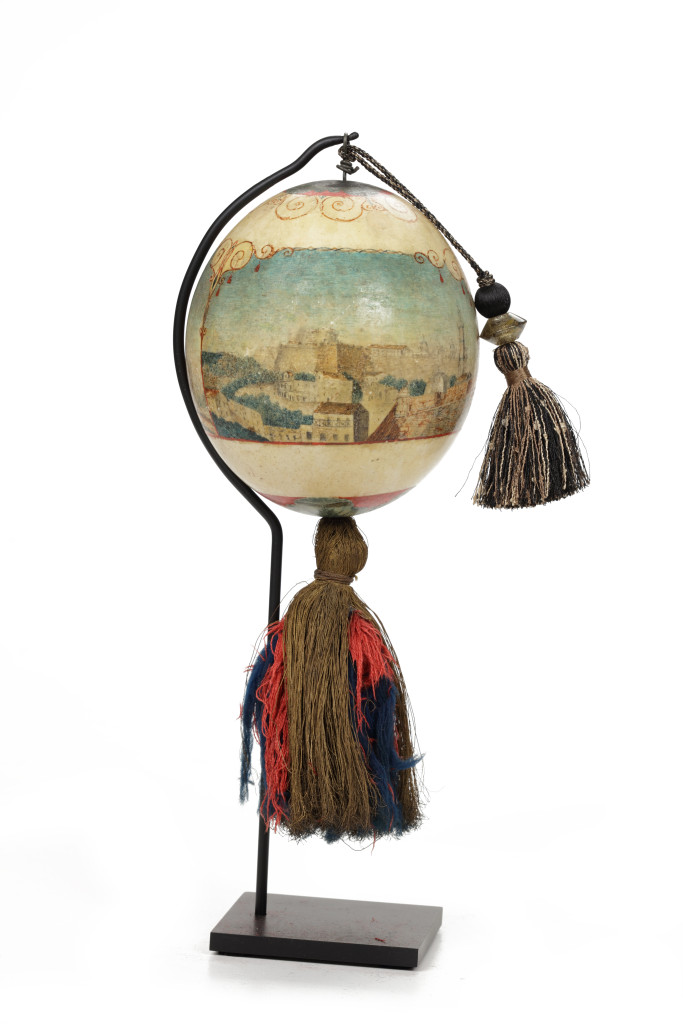
An Ottoman decorative pedant, Top Aski
Ottoman North Africa, 19th century
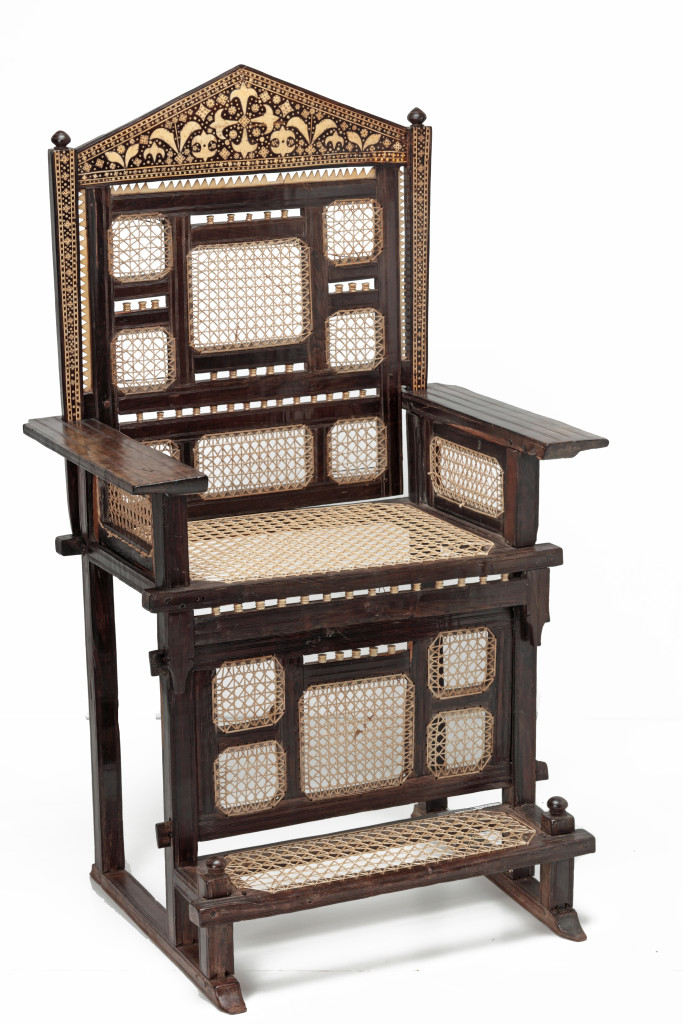
An ivory-and-bone inlaid African ebony 'Lamu' chair (Kita Chaenzi - Chair Of Power)
Lamu/Zanzibar/Mombasa, 17th/18th century