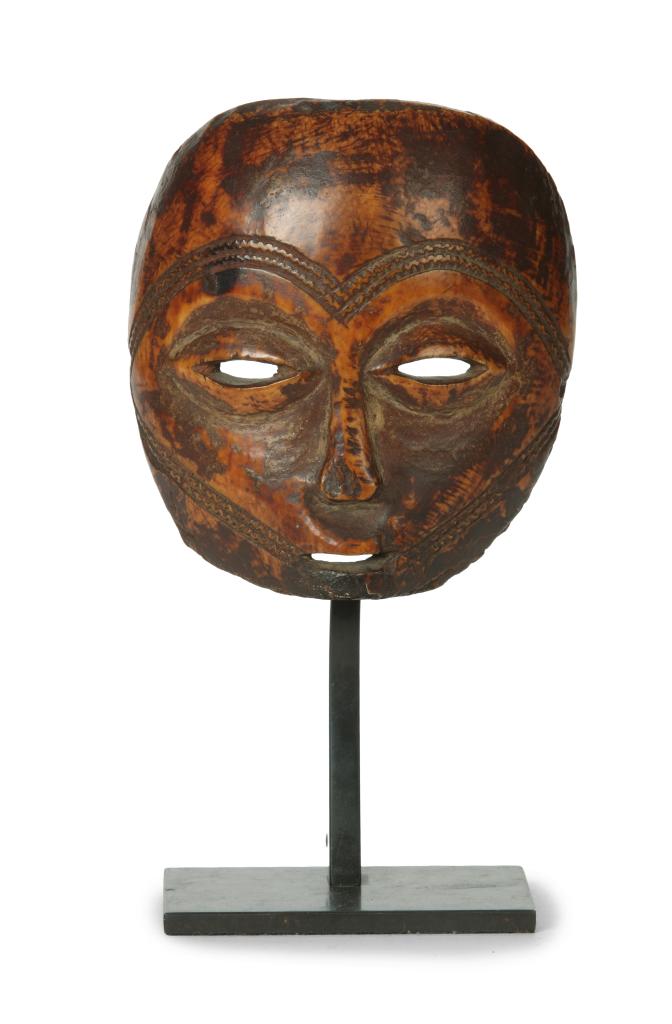
An ivory Lega 'Lukungu' mask
Congo, first half of the 20th century
H. 11 x W. 10 x D. 0.5 cm
Provenance:
Jean-Willy Mestach (1926-2014), Brussels
Aaron Furman, New York, (acquired in 1962)
Collection Howard & Saretta Barnet (acquired in 1973)
Private collection, Belgium
The great significance of this work lies both in the rarity of its type and in the remarkable craftsmanship of the artist who created it. The scale and material - ivory - identify it as a Lukungu mask, the prerogative of Bwami initiates positioned within the highest level of the supreme rank, the lutumbo lwa kindi. This eminent ownership is compounded, as a factor of rarity, by the irregular possession of this emblem within the Lega clans. Their name, lukungu, refers to the skull. Owned on a conditional basis by each initiate, these ivory masks are considered "duplicates, souvenirs,proofs of identity, symbolic ties" uniting the kindi initiate to the deceased he replaced in the rank community. They symbolize "the continuity of a lineage of kindi initiates” (Biebuyck, Lega Culture Art. Initiation and Moral Philosophy among a Central African People, 1973, p. 211).
Within a corpus generally marked by the minimalism of its sculpture, this work is distinctive for its superb intensity of the face and its magnitude. Chevron lines delineate the contours of the "heart-shaped" face and emphasise the impact of the finely modelled features. Its scale and the care taken in its elaborate carving evoke very rare ivory masks that were "a little larger and belonged to a preceptor (or leader of rituals)" (ibid).
According to field surveys conducted by Kellim Brown in Lega country, a "lukungu is ritually interpreted according to its formal qualities [...]; the tapered zigzag linear patterns on the forehead [...] identify the most important masks [...]; the medicinal sampling on the nose attesting to its ritual role" (« Crossing the Lega Ivory Spectrum » in Felix, White Gold, Black Hands, Ivory Sculpture in Congo, vol. 6, pp. 64-66).
Finally, the beauty of its deep patina, varying in brown and orange hues, attests to the frequency and longevity of its use, invariably preceded by the secret Ibonga Masengo ritual during which, by anointing it with pigmented oil, the strength of this sacred initiation object was revived.
H. 11 x W. 10 x D. 0.5 cm
Provenance:
Jean-Willy Mestach (1926-2014), Brussels
Aaron Furman, New York, (acquired in 1962)
Collection Howard & Saretta Barnet (acquired in 1973)
Private collection, Belgium
The great significance of this work lies both in the rarity of its type and in the remarkable craftsmanship of the artist who created it. The scale and material - ivory - identify it as a Lukungu mask, the prerogative of Bwami initiates positioned within the highest level of the supreme rank, the lutumbo lwa kindi. This eminent ownership is compounded, as a factor of rarity, by the irregular possession of this emblem within the Lega clans. Their name, lukungu, refers to the skull. Owned on a conditional basis by each initiate, these ivory masks are considered "duplicates, souvenirs,proofs of identity, symbolic ties" uniting the kindi initiate to the deceased he replaced in the rank community. They symbolize "the continuity of a lineage of kindi initiates” (Biebuyck, Lega Culture Art. Initiation and Moral Philosophy among a Central African People, 1973, p. 211).
Within a corpus generally marked by the minimalism of its sculpture, this work is distinctive for its superb intensity of the face and its magnitude. Chevron lines delineate the contours of the "heart-shaped" face and emphasise the impact of the finely modelled features. Its scale and the care taken in its elaborate carving evoke very rare ivory masks that were "a little larger and belonged to a preceptor (or leader of rituals)" (ibid).
According to field surveys conducted by Kellim Brown in Lega country, a "lukungu is ritually interpreted according to its formal qualities [...]; the tapered zigzag linear patterns on the forehead [...] identify the most important masks [...]; the medicinal sampling on the nose attesting to its ritual role" (« Crossing the Lega Ivory Spectrum » in Felix, White Gold, Black Hands, Ivory Sculpture in Congo, vol. 6, pp. 64-66).
Finally, the beauty of its deep patina, varying in brown and orange hues, attests to the frequency and longevity of its use, invariably preceded by the secret Ibonga Masengo ritual during which, by anointing it with pigmented oil, the strength of this sacred initiation object was revived.
Part of the Africa collection.
Related objects
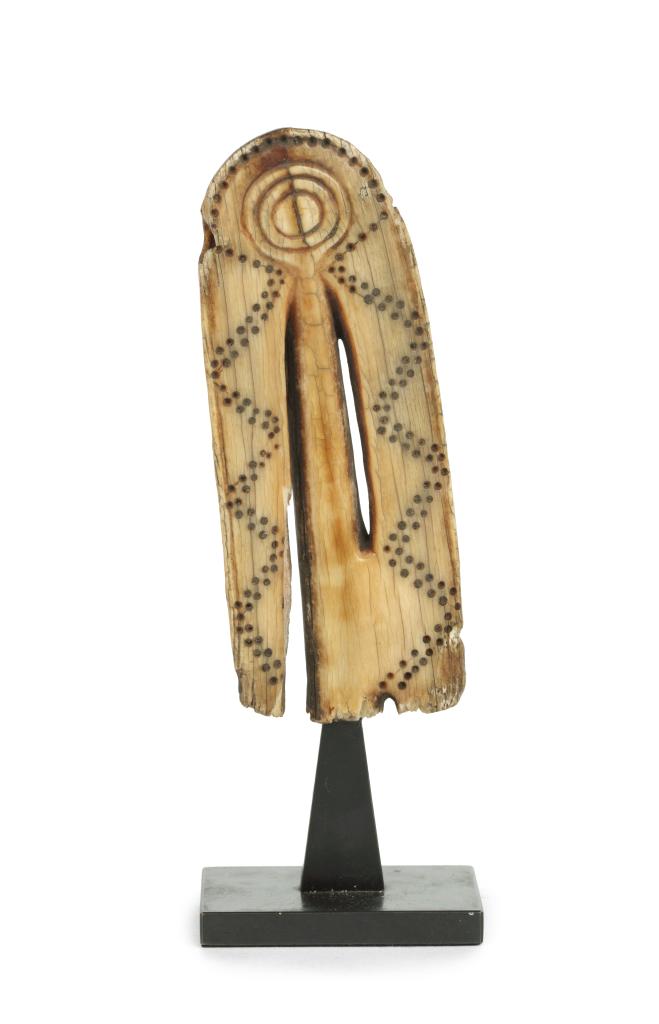
A Pende anthropomorphic ivory whistle
_Democratic Republic of Congo, 19th century_ _H. 12 x W. 7 x D. 1 cm_ Provenance: Private Collection, Germany Private Collection, Belgium
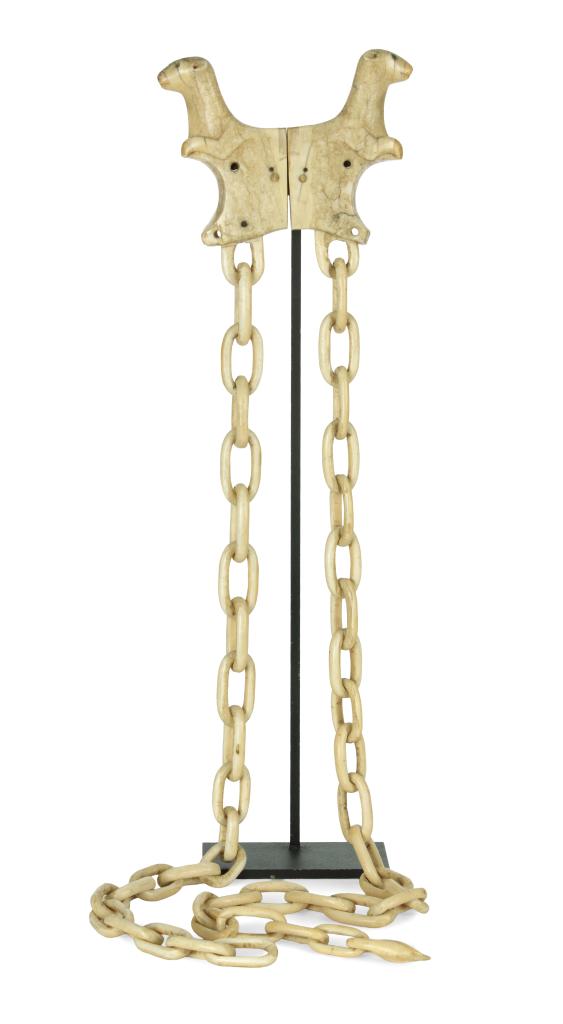
An Inuit walrus ivory kayak harpoon rest
_Bering Strait, Cape Prince of Wales, Alaska, 19th century_ _L. 95 x W. 16 cm_ Provenance: Sherwoods, Beverly Hills (purchased in 25 July 1989); private collection, Brussels
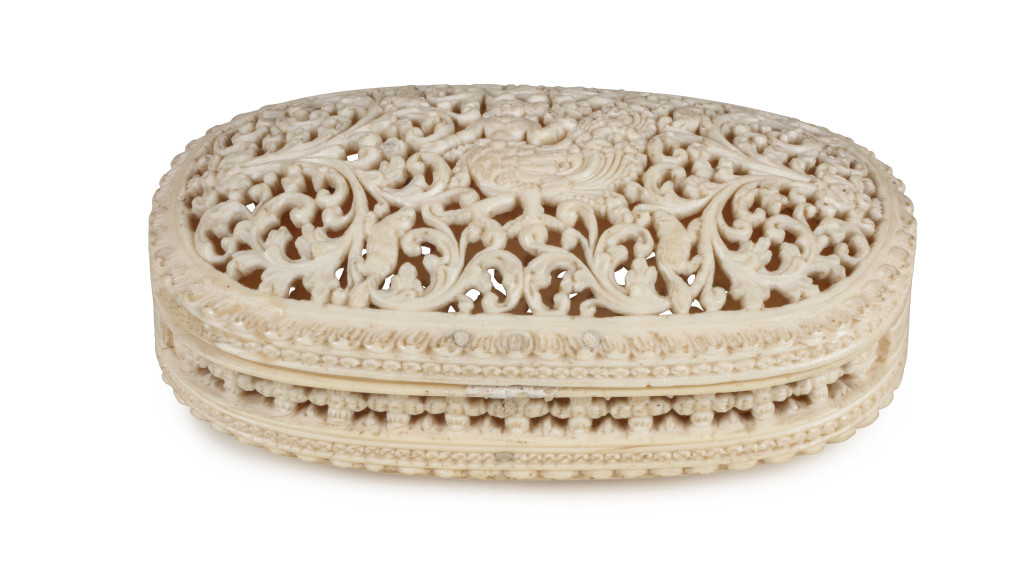
A Sinhalese oval openwork ivory box
Sri Lanka, probably Kingdom of Kandy, 2nd half 17th century _L. 10.1 x H. 4.4 cm_