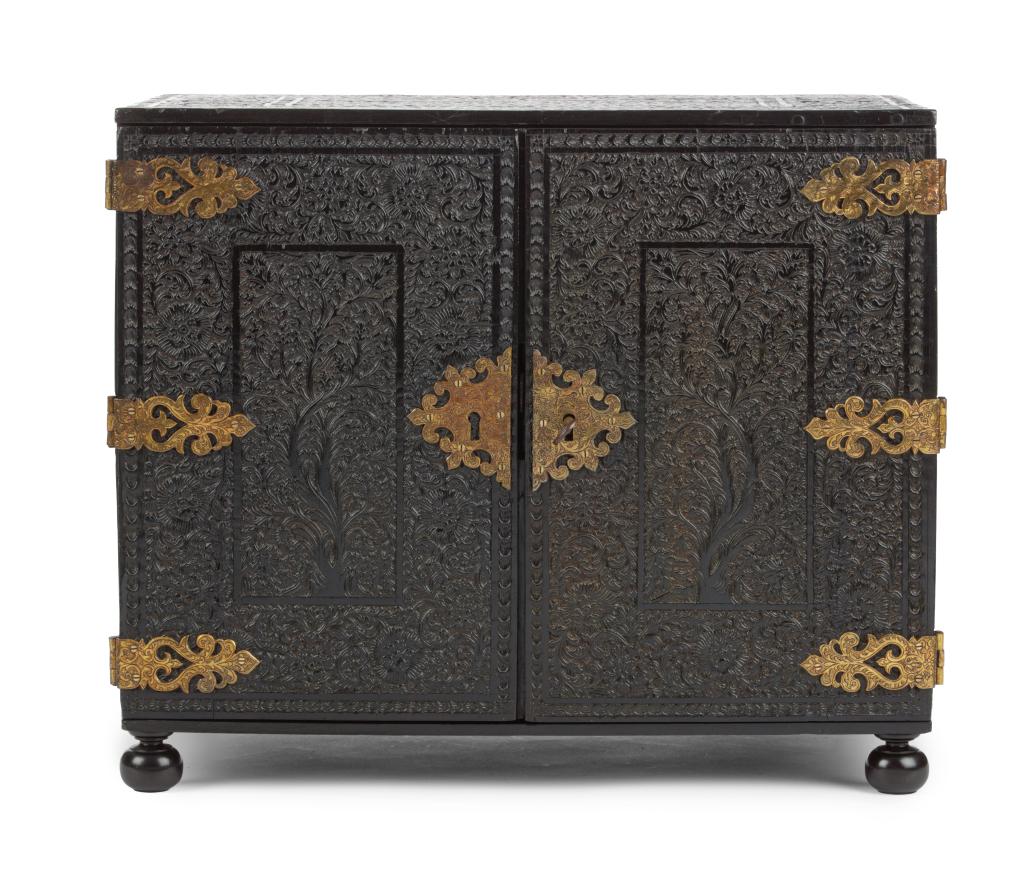
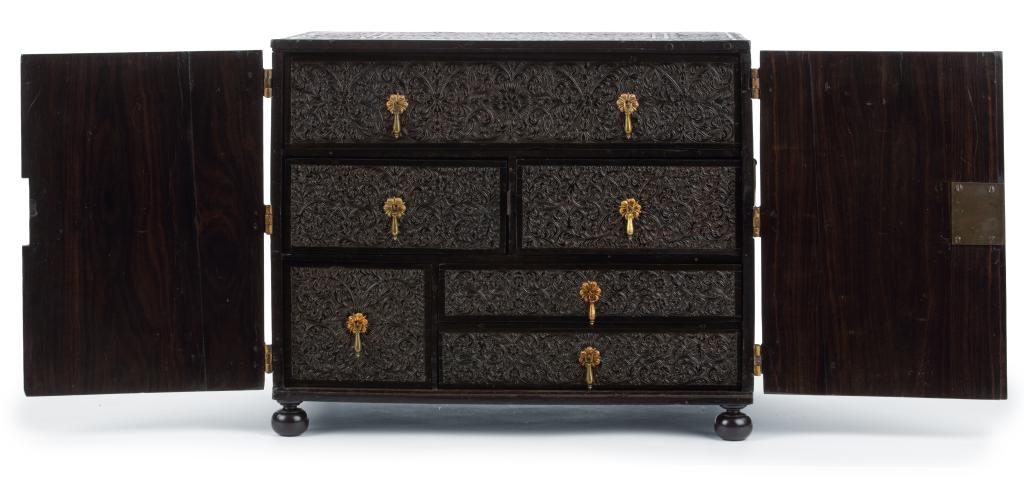
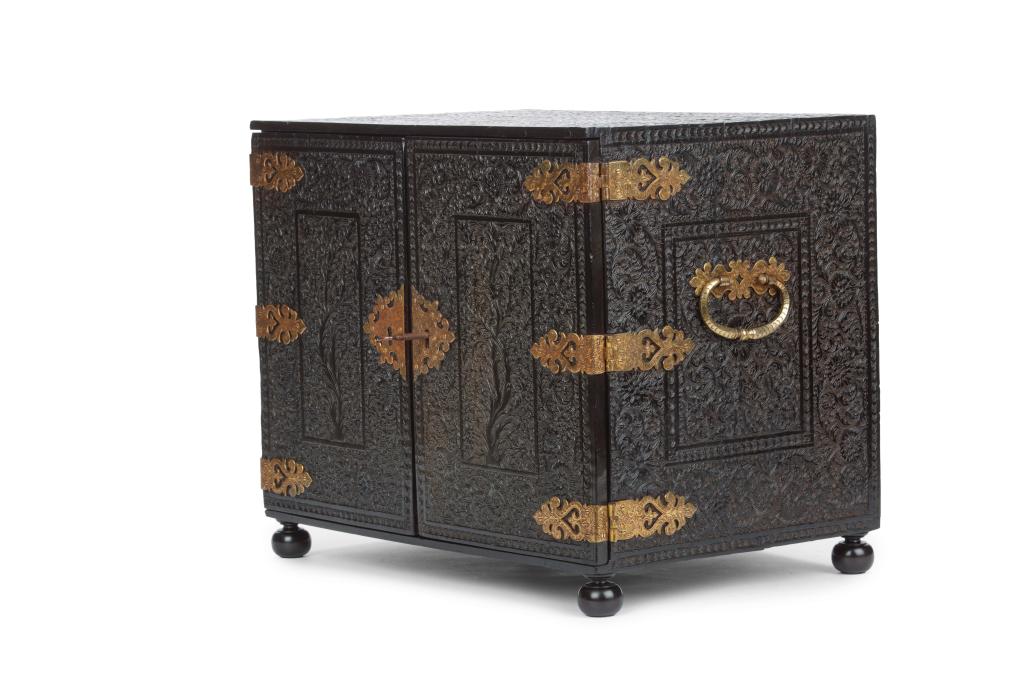
An Indian low-relief carved ebony cabinet with brass mounts
Coromandel Coast, probably Masulipatnam, 1650-1680
H. 37.5 x W. 44.5 x D. 30.5 cm
Provenance:
Private collection, United Kingdom
This cabinet belongs to a group of ebony furniture produced on the Coromandel Coast for the European market in the second half of the seventeenth century. The dense, low-relief carving covering every surface — scrolling foliage, flowering plants, and a symmetrical flowering tree on each door panel — is characteristic of the ebony-carving workshops active in the coastal settlements of southeast India, where indigenous carvers worked solid ebony (Diospyros ebenum) into forms answering to English, Dutch and Portuguese demand.
The table cabinet (or kabinet or contador) is a European form, but the decorative vocabulary is entirely South Asian. The all-over carved ground, executed in shallow relief against a stippled background, follows conventions found in Coromandel coast textile design of the same period, and relates closely to the broader corpus of VOC-era ebony seat furniture and caskets. The engraved and pierced brass mounts — corner brackets, hinges, escutcheon, and drop handle — are consistent with fittings on comparable Coromandel and Ceylonese cabinets and would have been added in India.
Objects of this type were made for the domestic interiors of European merchants and officials in Asia and for export to the Low Countries, where they entered kunstkammer collections as exotica. Comparable ebony cabinets survive in the Rijksmuseum, Amsterdam, and the Victoria and Albert Museum, London.
H. 37.5 x W. 44.5 x D. 30.5 cm
Provenance:
Private collection, United Kingdom
This cabinet belongs to a group of ebony furniture produced on the Coromandel Coast for the European market in the second half of the seventeenth century. The dense, low-relief carving covering every surface — scrolling foliage, flowering plants, and a symmetrical flowering tree on each door panel — is characteristic of the ebony-carving workshops active in the coastal settlements of southeast India, where indigenous carvers worked solid ebony (Diospyros ebenum) into forms answering to English, Dutch and Portuguese demand.
The table cabinet (or kabinet or contador) is a European form, but the decorative vocabulary is entirely South Asian. The all-over carved ground, executed in shallow relief against a stippled background, follows conventions found in Coromandel coast textile design of the same period, and relates closely to the broader corpus of VOC-era ebony seat furniture and caskets. The engraved and pierced brass mounts — corner brackets, hinges, escutcheon, and drop handle — are consistent with fittings on comparable Coromandel and Ceylonese cabinets and would have been added in India.
Objects of this type were made for the domestic interiors of European merchants and officials in Asia and for export to the Low Countries, where they entered kunstkammer collections as exotica. Comparable ebony cabinets survive in the Rijksmuseum, Amsterdam, and the Victoria and Albert Museum, London.
Part of the Indian Ocean collection.
Related objects
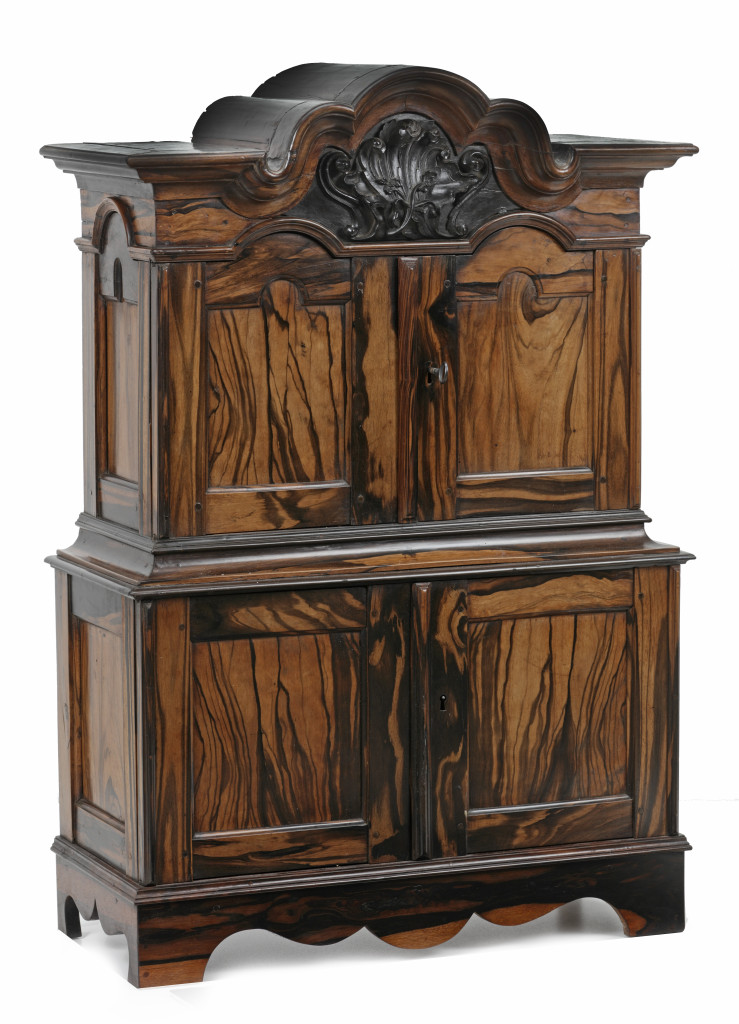
A Sri Lankan Rococo coromandel wood miniature cabinet
A Sri Lankan Rococo miniature cabinet
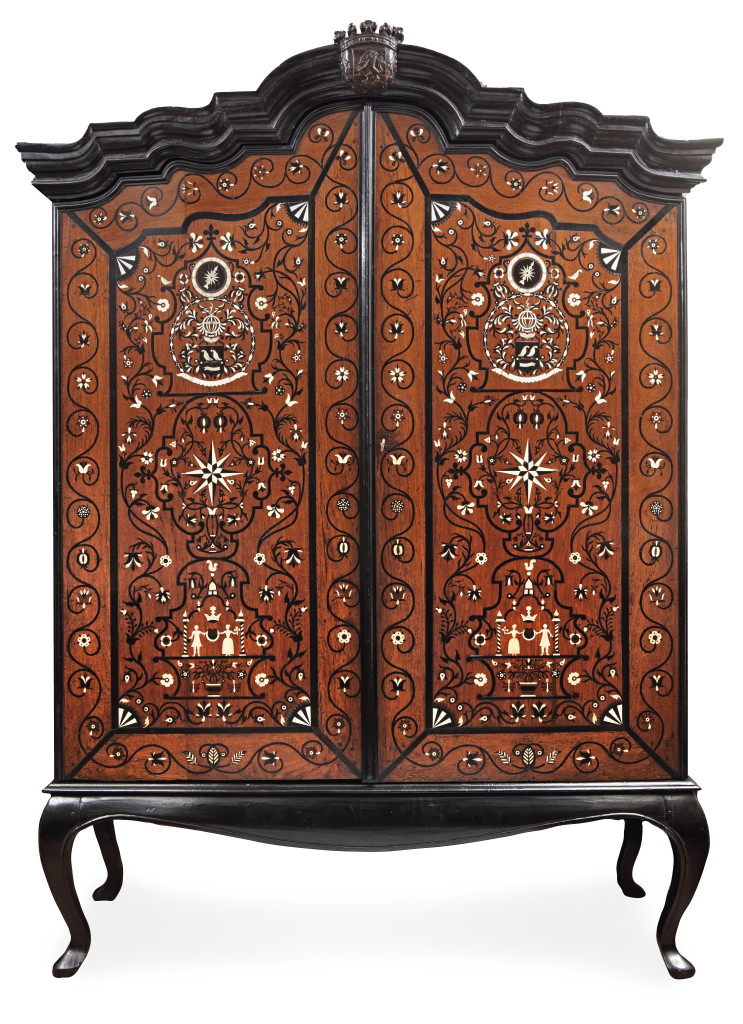
The highly important and unique ebony and pen-engraved marriage cabinet of governor-general Diederik Durven (1676-1740) of the former Dutch East-Indies
Marriage Cabinet Diederik Durven
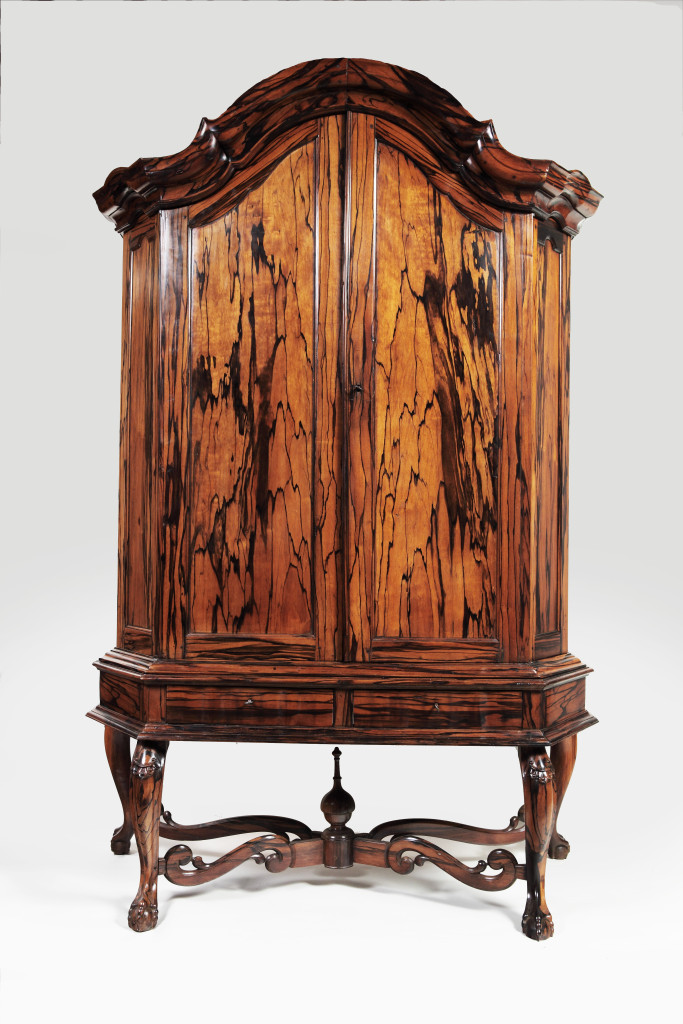
A Sri Lankan Coromandel wood cabinet on stand
Second half 18th century