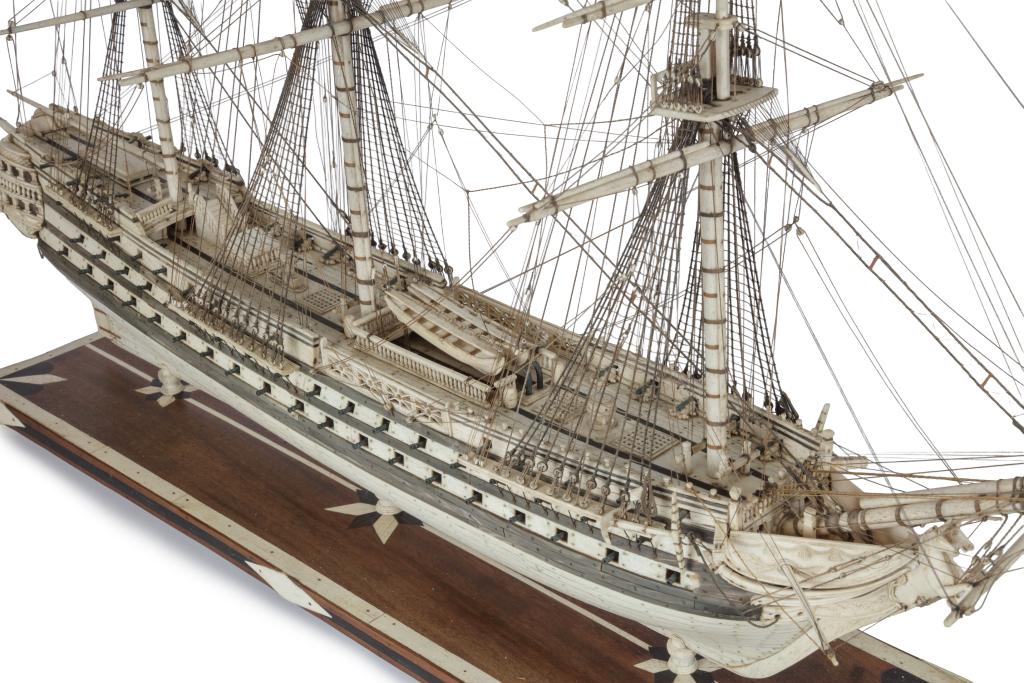
A uniquely large Napoleonic Prisoner-of-War bone ship model of the H.M.S. Unicorn
French prisoner-of-war work, early 19th century
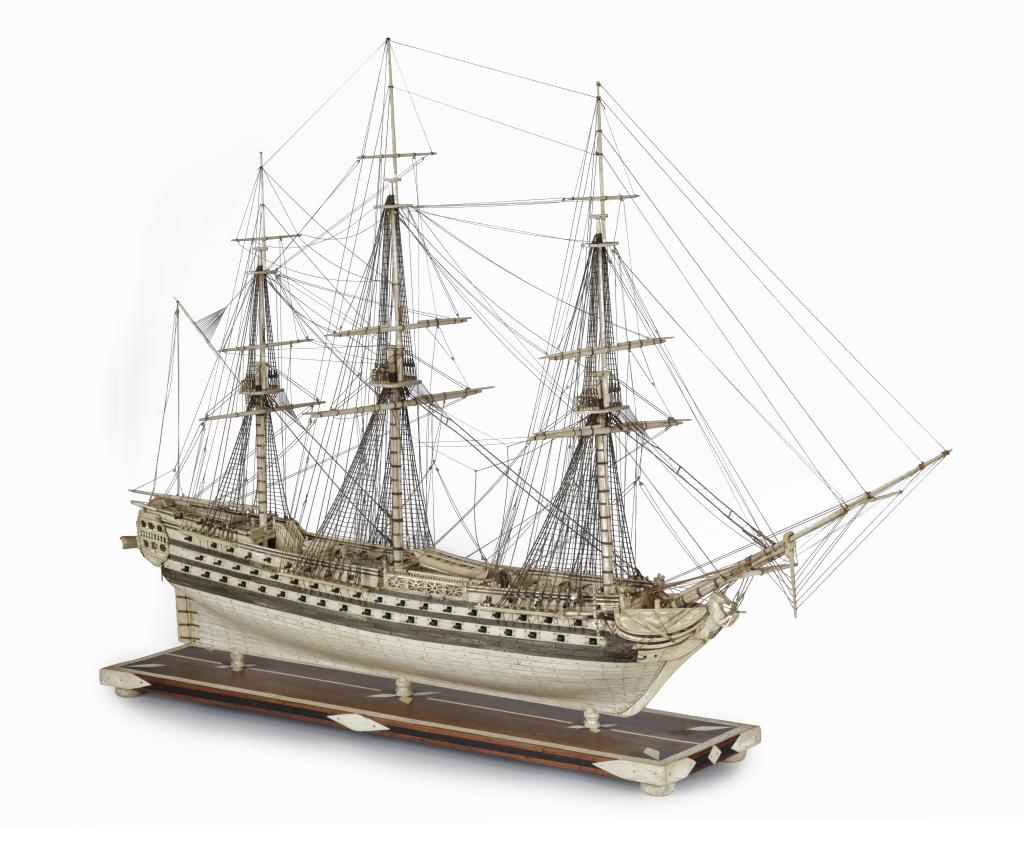
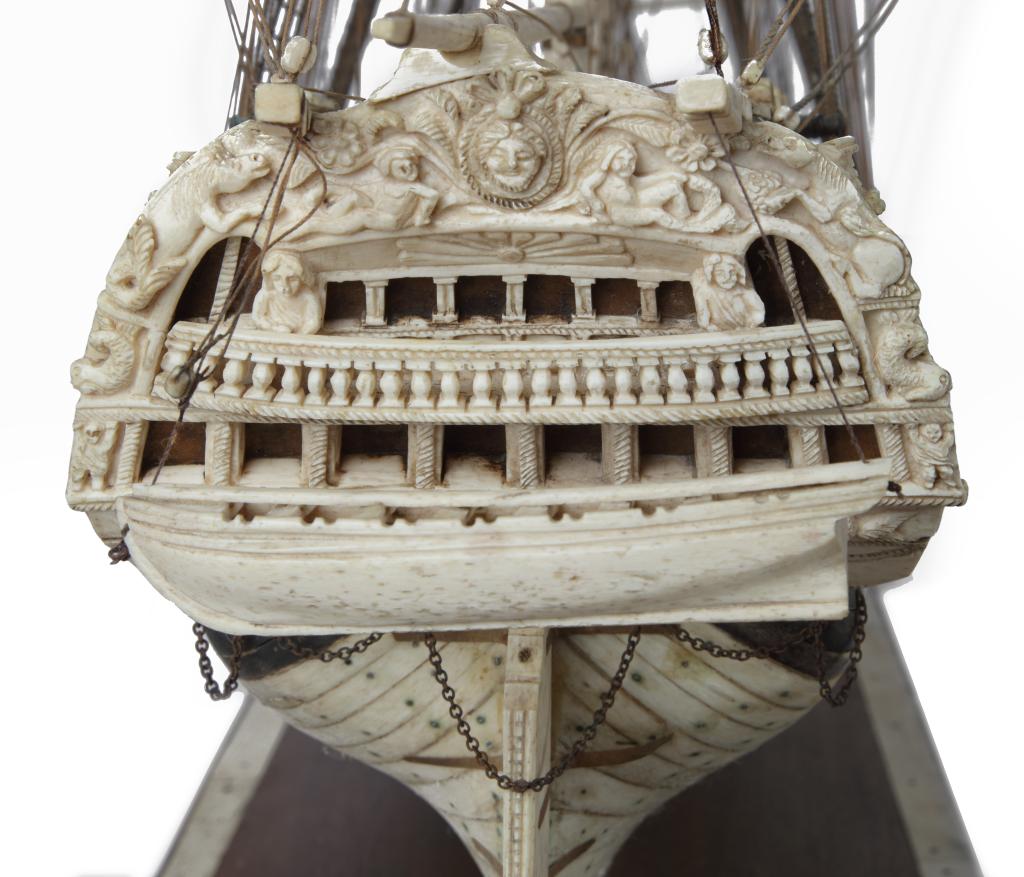
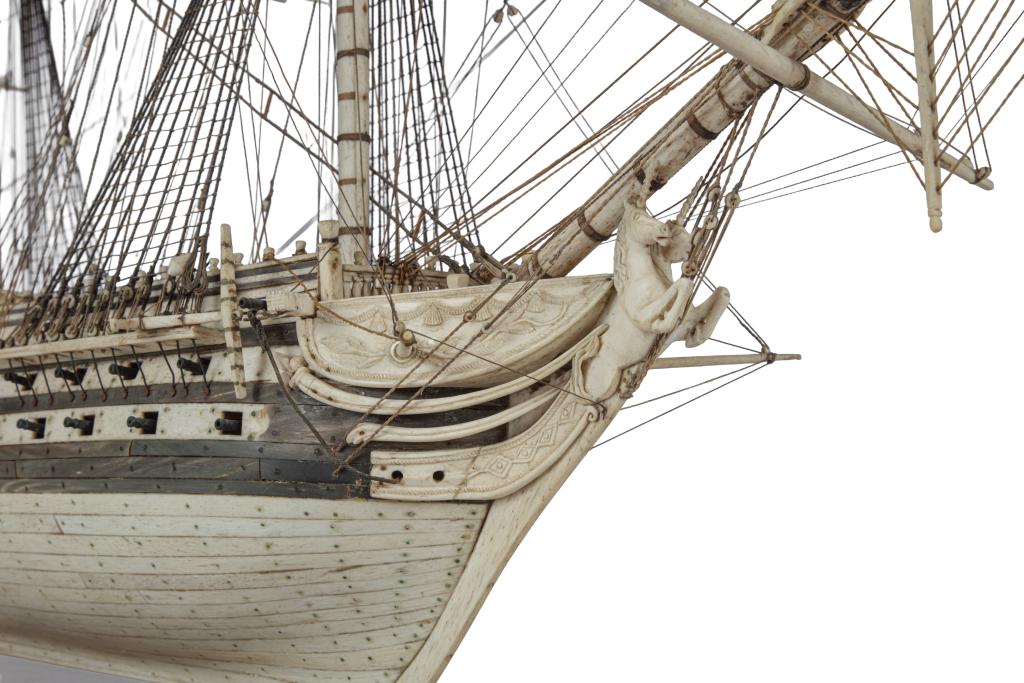
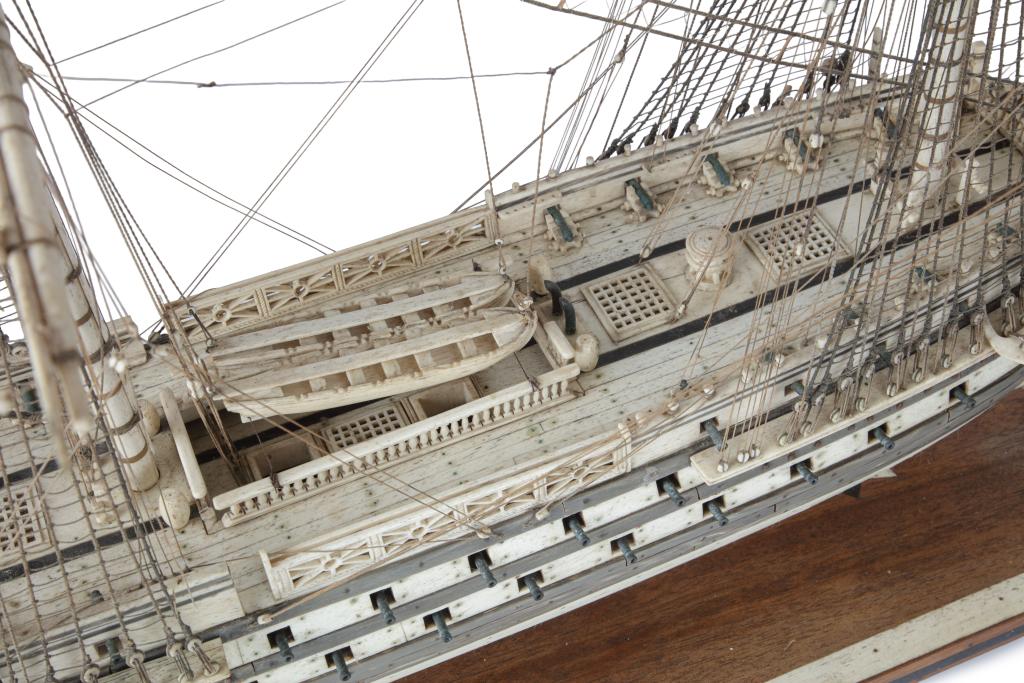
Large and finely worked bone ship model of a three-masted Royal Navy frigate with planked and pinned hull, two tiers of gunports fitted with metal cannon, and an elaborately carved stern gallery with balustrade and classical ornament. The bow with a rearing unicorn figurehead beneath carved trailboards. The decks fitted with boats, gratings and naval fittings, the masts fully rigged with yards and extensive standing and running rigging. Mounted on bone supports on a marquetry-inlaid base.
H. 91.5 × L. 132 cm
Provenance
Christie’s, South Kensington, Maritime Sale, 15 October 1992, lot 320
Private collection, United Kingdom
Ship models carved from bone were produced by French prisoners held in Britain during the Revolutionary and Napoleonic Wars (1793–1815). Using bone from rationed meat, prisoners-many of them trained seamen - created highly sophisticated maritime models which were sold to guards and visitors. The carved unicorn figurehead corresponds to ships bearing the name Unicorn, a traditional name within the British Royal Navy. The best-known example is the 38-gun frigate H.M.S. Unicorn launched in 1824, a vessel of the Leda class and one of the last surviving wooden sailing warships, now preserved at Dundee. As with many prisoner-of-war models, the present work is likely a generalised representation of a Royal Navy frigate, rather than an exact portrait of this specific vessel. By repute, this particular model functioned as a shop-sign outside a ship chandler’s shop in San Francisco and was cleaned and restored. However, it is more likely that it functioned as such in a glass casing of some sort.
Large and finely worked bone ship model of a three-masted Royal Navy frigate with planked and pinned hull, two tiers of gunports fitted with metal cannon, and an elaborately carved stern gallery with balustrade and classical ornament. The bow with a rearing unicorn figurehead beneath carved trailboards. The decks fitted with boats, gratings and naval fittings, the masts fully rigged with yards and extensive standing and running rigging. Mounted on bone supports on a marquetry-inlaid base.
H. 91.5 × L. 132 cm
Provenance
Christie’s, South Kensington, Maritime Sale, 15 October 1992, lot 320
Private collection, United Kingdom
Ship models carved from bone were produced by French prisoners held in Britain during the Revolutionary and Napoleonic Wars (1793–1815). Using bone from rationed meat, prisoners-many of them trained seamen - created highly sophisticated maritime models which were sold to guards and visitors. The carved unicorn figurehead corresponds to ships bearing the name Unicorn, a traditional name within the British Royal Navy. The best-known example is the 38-gun frigate H.M.S. Unicorn launched in 1824, a vessel of the Leda class and one of the last surviving wooden sailing warships, now preserved at Dundee. As with many prisoner-of-war models, the present work is likely a generalised representation of a Royal Navy frigate, rather than an exact portrait of this specific vessel. By repute, this particular model functioned as a shop-sign outside a ship chandler’s shop in San Francisco and was cleaned and restored. However, it is more likely that it functioned as such in a glass casing of some sort.
Related objects
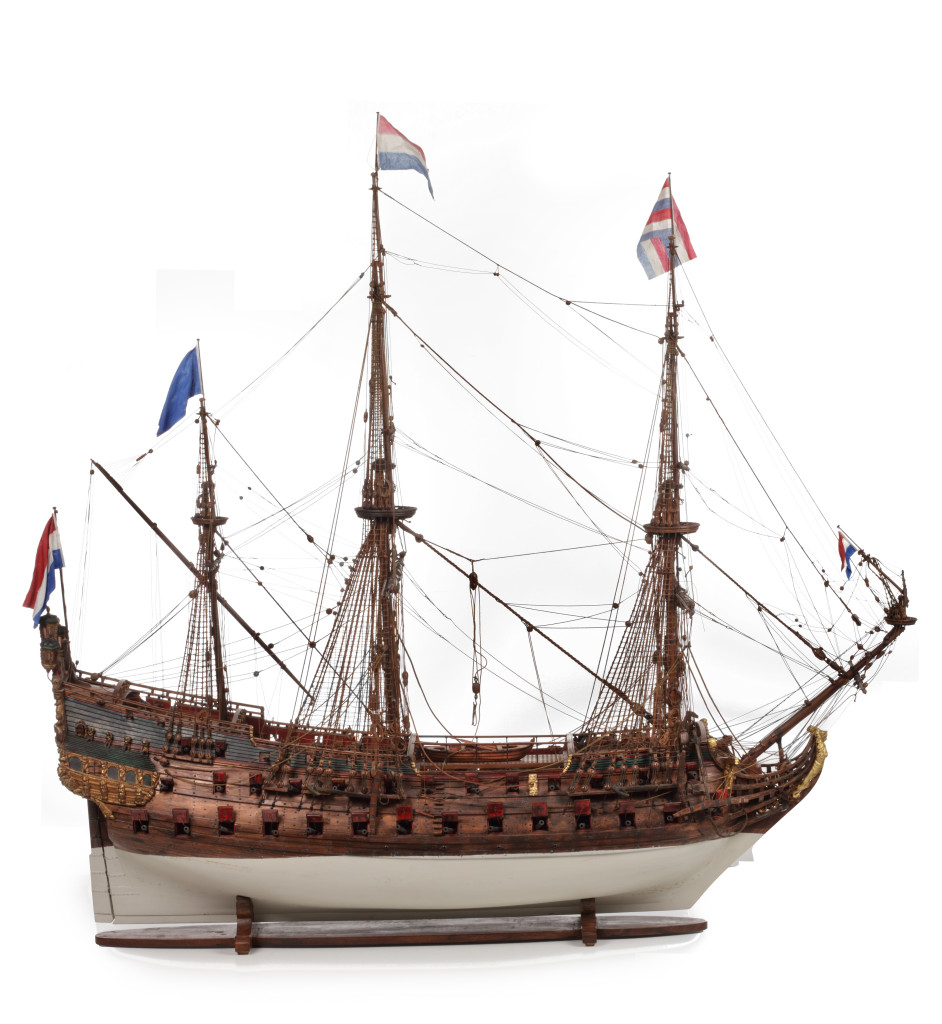
A detailed ship’s model of the Dutch 'tweedekker fregat', biplane frigate, the ‘Hohenzollern’
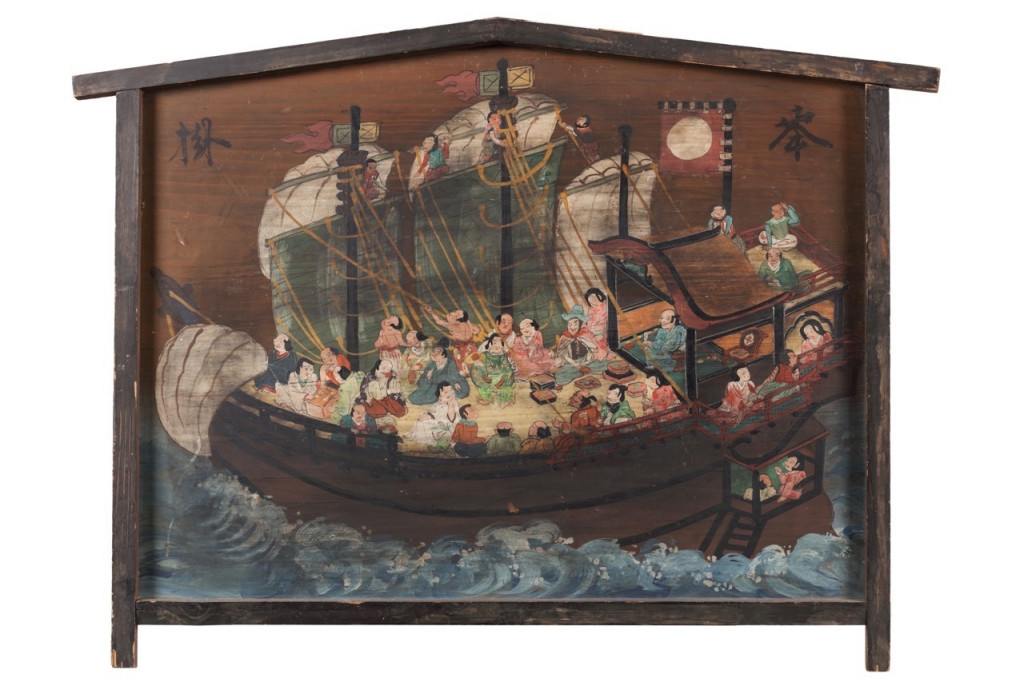
A large exceptional Japanese ema, or painted wood wishing board, depicting a ship
An ema is a votive plaque people hang in a 'dedication area’, at a Shinto shrine, with their wish to the gods. Wishes usually would revolve around health, love, career, prosperity, and academic achievement, but in this case a wish for a safe sea voyage.