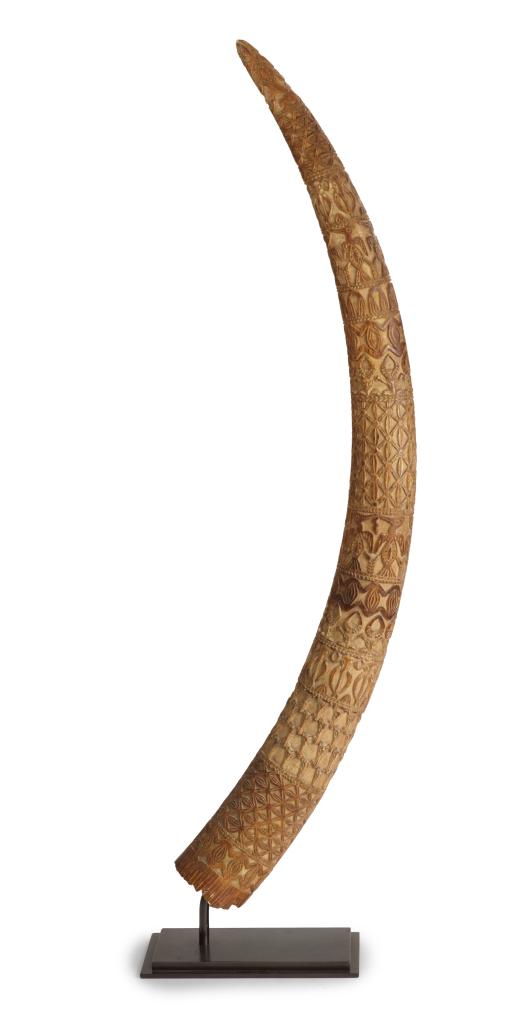
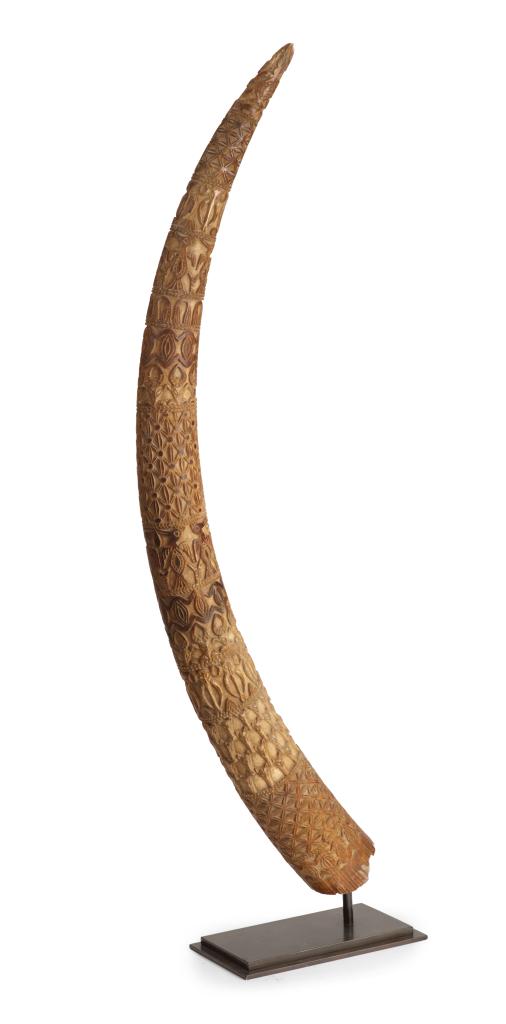
A royal Babanki carved elephant tusk
Cameroon, Babanki kingdom, Bamileke People, early 19th century
Richly decorated in horizontal bands in compartments, with animal and bird motifs such as kudus and elephants, interspersed with waffle patterns. The piece is in very good condition for an object of its type and age. It displays fine hairline age cracks and some chipping along the lower edge. The ivory has developed a rich, varied cream-coloured patina over time, with the raised areas of the relief carving showing darker toning in places. The tusk is permanently mounted on a modern metal base.
L. approx. 104-102 cm / Diam. 8 cm
Weight 3,95 kilograms
Provenance:
Collection Humblet Brussels
Private collection, Brussels
The Babanki elephant tusks are among the foremost royal prestige regalia, carrying both symbolic and economic significance. Traditionally, elephant tusks flank the royal stool or are positioned so that the Fon (king) may rest his feet upon them, signifying exclusive royal privilege. Ivory, as a precious material, has long been associated with prestige; when intricately carved, the elephant tusk becomes one of the most powerful visual expressions of kingship.
Richly decorated in horizontal bands in compartments, with animal and bird motifs such as kudus and elephants, interspersed with waffle patterns. The piece is in very good condition for an object of its type and age. It displays fine hairline age cracks and some chipping along the lower edge. The ivory has developed a rich, varied cream-coloured patina over time, with the raised areas of the relief carving showing darker toning in places. The tusk is permanently mounted on a modern metal base.
L. approx. 104-102 cm / Diam. 8 cm
Weight 3,95 kilograms
Provenance:
Collection Humblet Brussels
Private collection, Brussels
The Babanki elephant tusks are among the foremost royal prestige regalia, carrying both symbolic and economic significance. Traditionally, elephant tusks flank the royal stool or are positioned so that the Fon (king) may rest his feet upon them, signifying exclusive royal privilege. Ivory, as a precious material, has long been associated with prestige; when intricately carved, the elephant tusk becomes one of the most powerful visual expressions of kingship.
Part of the Africa collection.
Related objects
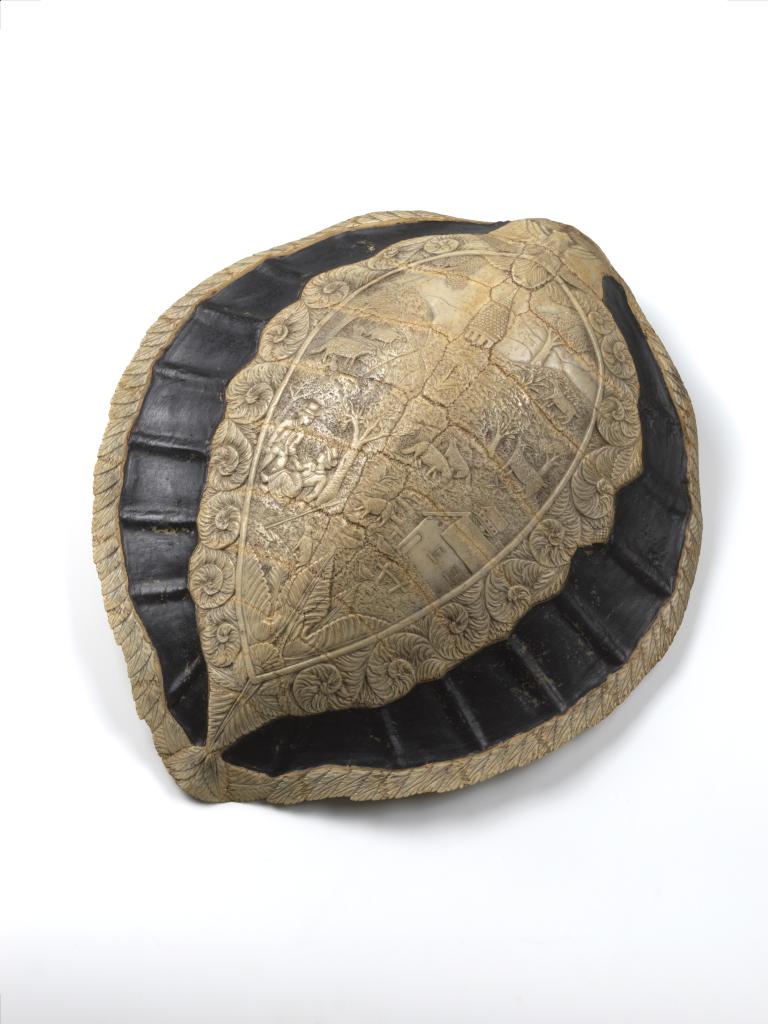
A carved seaturtle carapace
_Atlantic Islands, 18th-19th century_ _H. 46.7 x W. 41.5 cm_
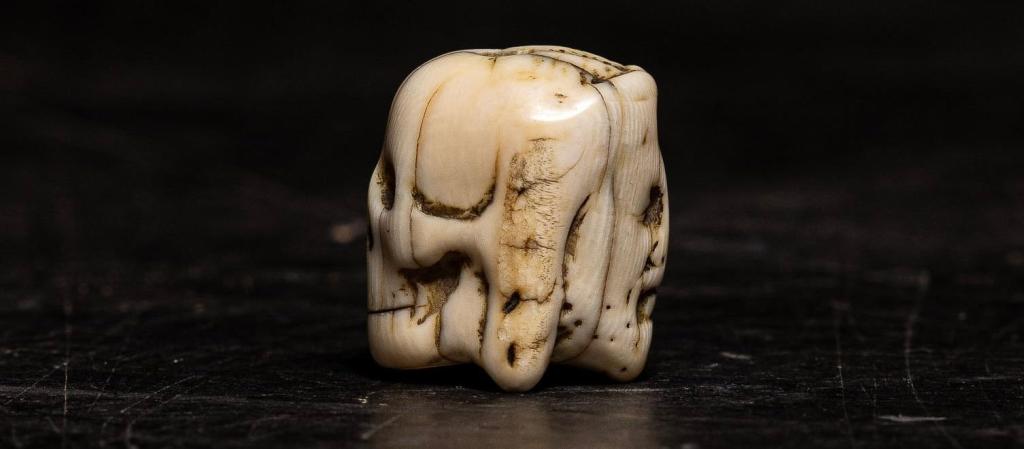
A Flemish carved ivory Janus-faced Vanitas Paternoster Rosary bead
_Flanders, Belgium, 17th century_ _H. 2 x W. 2 x D. 2 cm_
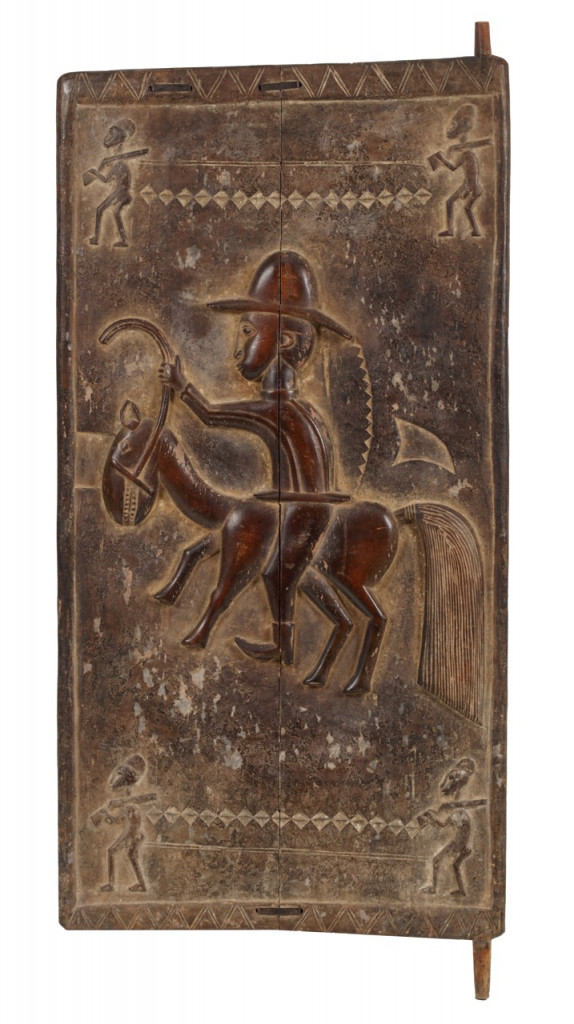
A Yoruba carved wooden 'colon' door
Depicted on the door is an English military man on horseback with four Yoruba soldiers with guns over their shoulders. The Yorubas worked with a wide array of materials in their art, including: bronze, leather, terracotta, ivory, textiles, copper, stone, carved wood, brass, ceramics and glass. A unique feature of Yoruba art is striking realism that, unlike most African art, chose to create human images that are based on reality, rather than the divine or spiritual.