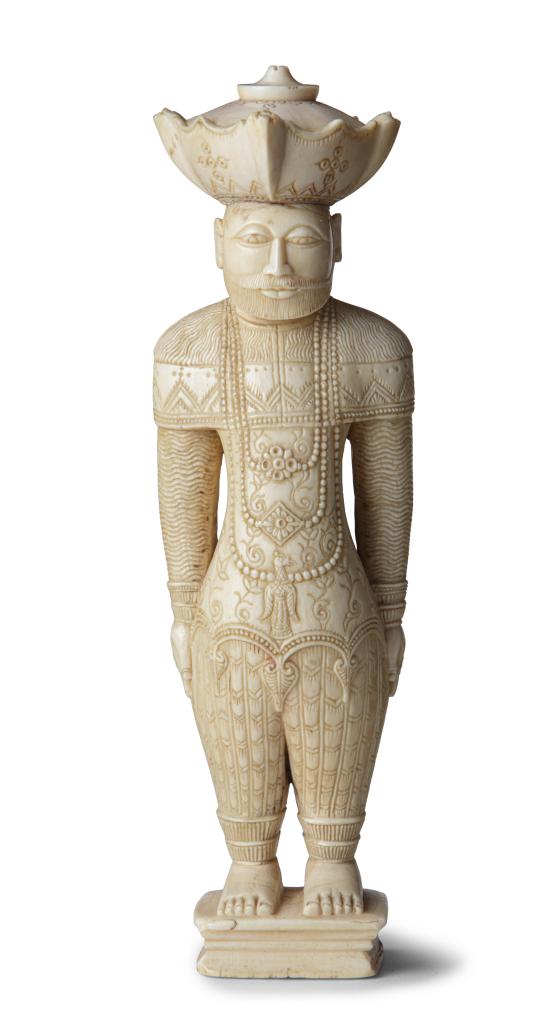
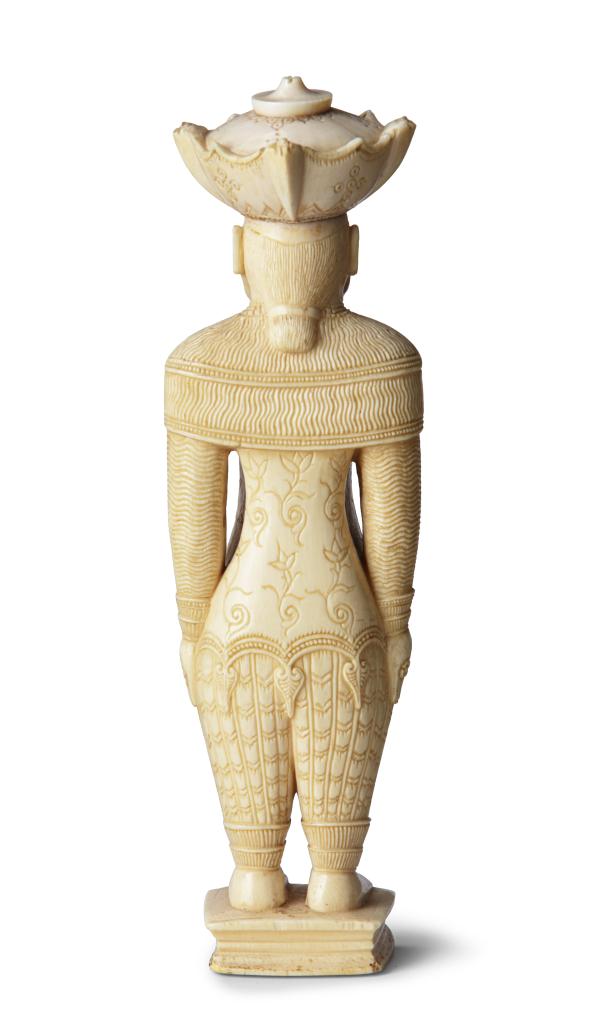
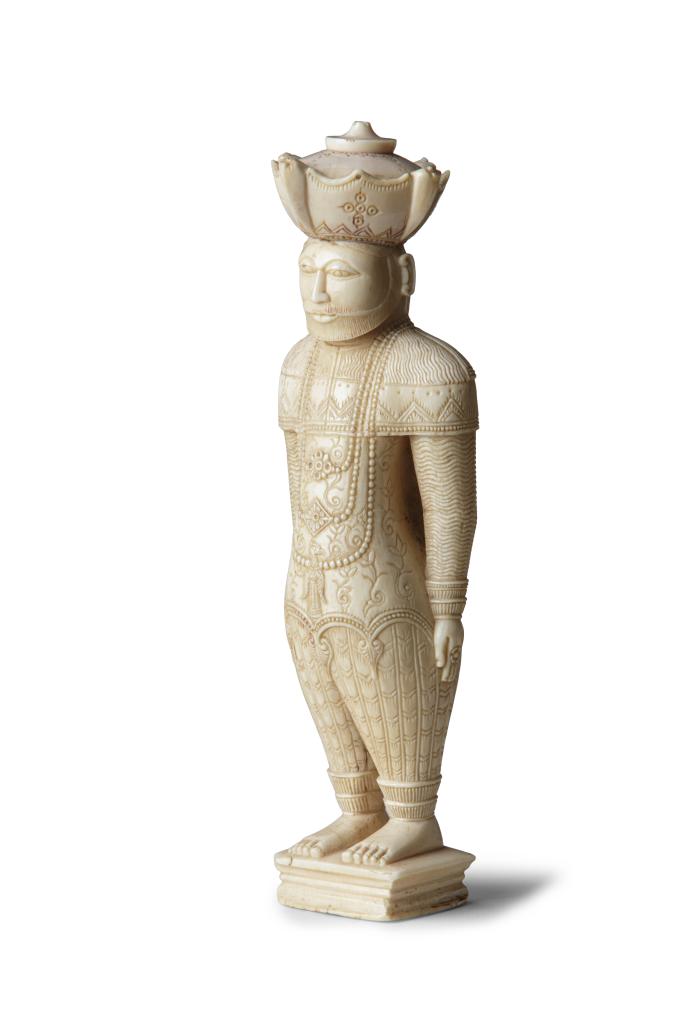
A rare Sinhalese ivory figure of a king or high nobleman
Sri Lanka, Kindom of Kandy, 18th century
H. 19 cm
Provenance:
- Private collection, The Netherlands
- Private collection, Porto
An intricately carved ivory figure of the king or a high nobleman of the Kingdom of Kandy. Figures like this one are very rare, and were probably made as gifts for visiting diplomats. (1)
The “Lion-King” of Kandy
There is a strong possibility that this figure depicts one of the last kings of Kandy, namely Kirti Sri Rajasinha, the second king of the Nakaya dynasty, who ruled from 1747 to 1782. First however, it must be noted that nobility and royalty were difficult to tell apart in those days, especially when it comes to a stylized figure like this one. The traditional ceremonial Mul Anduma costume, incorporating golden necklaces and the wide suduweda toppiya (white hat), were worn by high administrators or nobleman and the king alike. (2) It could therefore also be the case that this figure depicts a Maha Dissava (province governor) or Maha Adigar (prime minister) of the Kingdom of Kandy, who held great administrative power. Conversely, the extended points of the headpiece seem more like a royal crown like the one of Kirti Sri Rajasinha than like a regular suduweda toppiya. In addition, the figure with all its intricate details, like the elaborate necklaces and the ornaments thereon, the bands around the wrists and ankles, the ceremonial clothes with decorations of flowery vines, the bearded face, and the length of his hair are nearly identical to other depictions of this particular king. A frescoe which was identified as Kirti Sri Rajasinha is found in the Dadanthale Raja Maha Vihara temple, and another depiction of this king in a different temple complex depicts him wearing a headpiece that looks very similar as well. (3)(4) Furthermore, there is a life-size statue of King Kirti Sri Rajasinha in the Dambulla temple complex. This statue seems to be a nearly identical (yet enlarged) version of the present figure. (5)(6) Other depictions of Kirti Sri’s six-pointed crown seem to correspond to the present figure’s headpiece as well, further cementing this figure’s identity as one of the last kings of Kandy, before the British colonization of the whole of “Ceylon” became complete in 1815. (7) Kirti Sri Rajasinha’s name literally translates to ‘Glorious Prosperous Lion-King’.
Symbols of Power and Enlightenment
When looking at its garments and regalia, this figure displays distinct symbols of both spiritual and governmental power. On his hands, a typically stylized Sinhalese Lotus can be seen: a symbol of administrative authority. Hanging from his upper garments are heart-shaped leaves, most probably bo-potleaves, the leaves of the sacred Bodhi tree: a symbol of religious authority. It is said that the Buddha attained Enlightenment under the Bodhi tree. (8) Keeping this Buddhist symbolism in mind when regarding this figure’s feet: walking barefoot meant being pious. Even today, not a single person is allowed to wear shoes in a Buddhist temple. Being barefooted might therefore symbolize the Buddhist piety of this figure, further indicating that this is in fact the Buddhist-revivalist king Kirti Sri Rajasinha. It was this very Kirti Sri Rajasinha who commissioned the thorough restauration and expansion of the Dambulla temple complex and initiated a Buddhist revival in the Kingdom of Kandy, hence his veneration with a life-size statue in the same temple complex, and his enduring popularity in Sri Lankan iconography and historical consciousness. Lastly, the bird on his lower belly may be a peacock or a Hamsa bird, both symbols of divinity in Hinduist-Buddhist tradition. However, it is most likely the Kurulu Padakkama (“Bird Pendant”). This stylized depiction of a mythical bird was notably worn by Kirti Sri Rajasinha as part of his regalia, and it is also depicted in the aforementioned frescoe in the Dadanthale Raja Maha Vihara temple. (9)(3)
The Kingdom of Kandy and the VOC raid
Kirti Sri Rajasinha’s rule was marked by a revival and celebration of Singalese culture and opposition against the Dutch colonial rule along the Sri Lankan coast. In 1761, Kirti Sri Rajasinha led a massive revolt from the Sri Lankan heartland, conquering numerous Dutch forts. The Dutch response was ruthless. In 1765, the VOC army, led by Governor Lubbert Jan van Eck, undertook a military expedition, laying siege to the Kingdom of Kandy. This resulted in the looting of the city of Kandy, along with Kirti Sri Rajasinha’s palace. The booty was extensive, consisting of all kinds of treasures: gold, silver, jewelry, and kastanes inlaid with precious gems. One of the most notorious pieces of loot is the – both famous and infamous – canon of the king of Kandy, which is currently still on display in the Rijksmuseum, but was returned as property to the republic of Sri Lanka in 2023, along with other objects, such as the Gold State Sword. (10)(11)(12) There exists a possibility that the ivory figure in question was part of the loot of 1765 as well. However, it is known that figures like this one – while very rare – were produced to present as gifts to diplomats. It is therefore more plausible that it was used as a peace offering in the fruitless negotiations preceding the raid of Kandy, or in a previous governmental encounter, or that it was made in the years following the event. Notably, when looking at the details on the figure’s garment, there is a strong visual resemblance to the details on the aforementioned canon, which also include a stylized bird and curling vines in the same vein as that on the ivory figure in question. (13)
Sinhalese ivory craftmanship
The figure is made of ivory of the Asian elephant, which is native to the island of Sri Lanka. Ivory craftmanship has a long tradition in Sri Lanka, dating back to the third century B.C. In the Kandyan era – especially under the patronage of king Kirti Sri Rajasinha – ivory craftmanship entered its golden age. (14)
Similar objects
A comparable ivory figure from Sri Lanka in the same period is in the collection of the Rijksmuseum ([inv.no](http://inv.no). NG-2016-10) (15), and another very similar one, depicting the last king of Kandy, Sri Vikrama Rajasinha, is in possession of The Metropolitan Museum of Art in New York City ([inv.no](http://inv.no). 2010.142). (1) The Los Angeles County Museum of Art also holds a stucco figure similar to this one, although presumably from a later date, which is identified as the Maha Adigar named Ehelapola Nilame (1773-1829) ([inv.no](http://inv.no). M.86.140). (16)
Sources
(1) [https://www.metmuseum.org/art/collection/search/75586](https://www.metmuseum.org/art/collection/search/75586)
(2) [https://www.sothebys.com/en/museums/los-angeles-county-museum-of-art/exhibitions/the-jeweled-isle-art-from-sri-lanka](https://www.sothebys.com/en/museums/los-angeles-county-museum-of-art/exhibitions/the-jeweled-isle-art-from-sri-lanka)
(3) [https://devalayah.com/attractions/dodanthale-raja-maha-vihara/](https://devalayah.com/attractions/dodanthale-raja-maha-vihara/)
(4) [https://www.alamy.com/the-degaldoruwa-buddhist-temple-is-a-cave-temple-and-was-built-originally-in-1771-ce-by-king-kirti-sri-rajasinha-1747-1782-a-member-of-the-madurai-royal-family-the-beautiful-frescoes-painted-by-the-samanera-unordained-monk-devaragamapola-silvatenna-in-1771-72-capture-18th-century-kandyan-life-with-amazing-detail-and-vivaciousness-some-paintings-depict-the-king-and-the-royal-family-the-artist-monk-started-a-trend-and-the-dambulla-caves-were-subsequently-redecorated-in-the-same-style-as-were-other-temples-kandy-is-sri-lankas-second-biggest-city-with-a-population-of-around-170000-image344269866.html?imageid=56DF7C6E-FE42-4790-A8EA-84CA5458914D&pn=1&searchId=2e441d4301608acf7d2a2a7f38cc9f92&searchtype=0](https://www.alamy.com/the-degaldoruwa-buddhist-temple-is-a-cave-temple-and-was-built-originally-in-1771-ce-by-king-kirti-sri-rajasinha-1747-1782-a-member-of-the-madurai-royal-family-the-beautiful-frescoes-painted-by-the-samanera-unordained-monk-devaragamapola-silvatenna-in-1771-72-capture-18th-century-kandyan-life-with-amazing-detail-and-vivaciousness-some-paintings-depict-the-king-and-the-royal-family-the-artist-monk-started-a-trend-and-the-dambulla-caves-were-subsequently-redecorated-in-the-same-style-as-were-other-temples-kandy-is-sri-lankas-second-biggest-city-with-a-population-of-around-170000-image344269866.html?imageid=56DF7C6E-FE42-4790-A8EA-84CA5458914D&pn=1&searchId=2e441d4301608acf7d2a2a7f38cc9f92&searchtype=0)
(5) [https://www.alamy.com/stock-image-dambulla-sri-lanka-dambulla-cave-temples-cave-3-maha-alut-viharaya-160654278.html](https://www.alamy.com/stock-image-dambulla-sri-lanka-dambulla-cave-temples-cave-3-maha-alut-viharaya-160654278.html)
(6) [https://whc.unesco.org/document/171630?utm](https://whc.unesco.org/document/171630?utm) - page 26
(7) [https://www.semanticscholar.org/paper/cultural-amalgamation%3A-headgears-of-the-kings-and-Ranathunga/620852febcb40d2601aa886f37b60a72c991d6cc/figure/0](https://www.semanticscholar.org/paper/cultural-amalgamation%3A-headgears-of-the-kings-and-Ranathunga/620852febcb40d2601aa886f37b60a72c991d6cc/figure/0)
(8) [https://hubert-herald.nl/SriLankaKandy.htm](https://hubert-herald.nl/SriLankaKandy.htm)
(9) [https://www.globalinch.org/craft/gold-silver-jewellery-products/](https://www.globalinch.org/craft/gold-silver-jewellery-products/)
(10) [https://www.jaffnaroyalfamily.org/kingdomkandyhistory.html](https://www.jaffnaroyalfamily.org/kingdomkandyhistory.html)
(11) [https://historiek.net/het-kanon-van-de-koning-van-kandy-10/18808/](https://historiek.net/het-kanon-van-de-koning-van-kandy-10/18808/)
(12) [https://www.rijksmuseum.nl/nl/pers/persberichten/zes-objecten-uit-rijksmuseum-gaan-terug-naar-sri-lanka](https://www.rijksmuseum.nl/nl/pers/persberichten/zes-objecten-uit-rijksmuseum-gaan-terug-naar-sri-lanka)
(13 [https://www.volkskrant.nl/kijkverder/2022/ons-koloniale-verleden/dit-kanon-staat-symbool-voor-de-nederlandse-overheersing-en-roof-in-sri-lanka~v546016/](https://www.volkskrant.nl/kijkverder/2022/ons-koloniale-verleden/dit-kanon-staat-symbool-voor-de-nederlandse-overheersing-en-roof-in-sri-lanka~v546016/)
(14) [https://www.archaeology.lk/records-of-ivory-craftsmanship-in-ancient-sri-lanka/](https://www.archaeology.lk/records-of-ivory-craftsmanship-in-ancient-sri-lanka/)
(15) [https://www.rijksmuseum.nl/nl/collectie/object/Maha-Modliaar--f12e37cb46341a8dee5d0d8a6b485a98?tab=data](https://www.rijksmuseum.nl/nl/collectie/object/Maha-Modliaar--f12e37cb46341a8dee5d0d8a6b485a98?tab=data))
(16) [https://collections.lacma.org/object/54919](https://collections.lacma.org/object/54919)
Part of the Indian Ocean collection.
Related objects
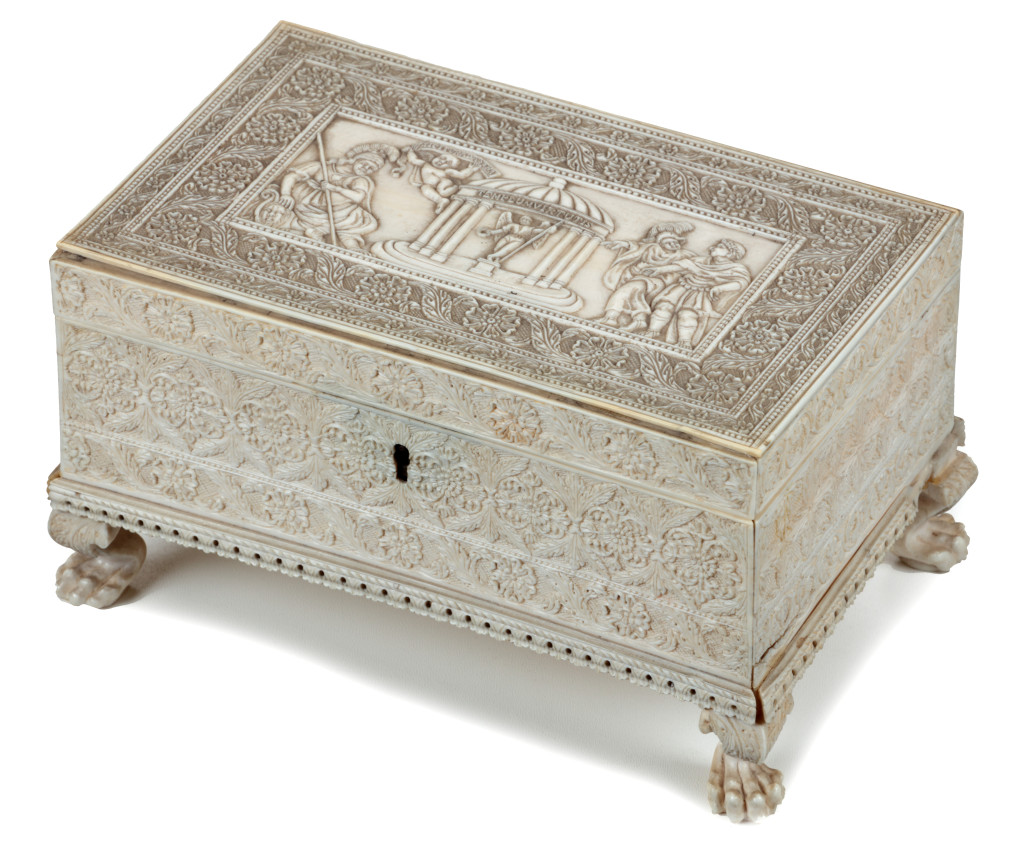
An Indian ivory casket with carvings after European prints
Indian Ivory casket European prints
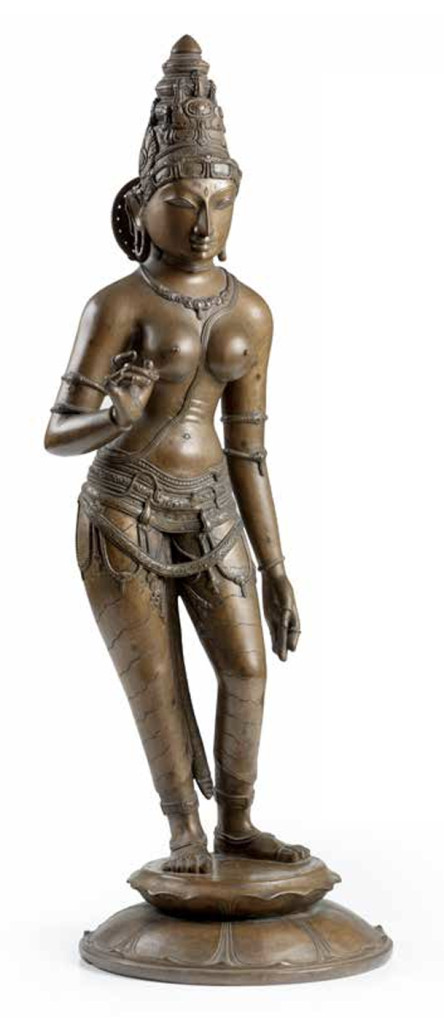
An impressive large Indian bronze figure of the Goddess Parvati
Parvati in her beautiful womanly form is standing in an elegant tribhanga on a lotus base. A transparent dhoti clings in wavy folds to her legs.Her hips are adorned with numerous belts and pearl strings hanging on her thighs. Her arms, writs, fingers, ankles and even toes are decorated with numerous bands and rings. Her hair is pinned up high and embellished with jewels and pearls. Her youthful body is shown in all its sensuous beauty.
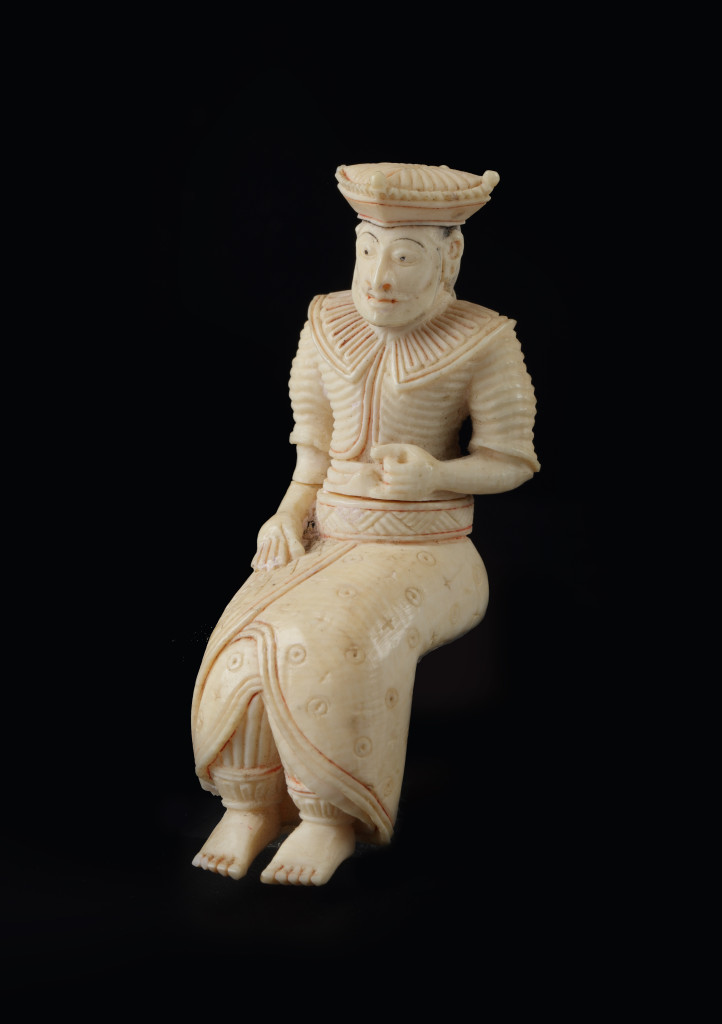
A small ivory sculpture of a seated Sri Lankan king
Extremely rare ebony carved child's chair