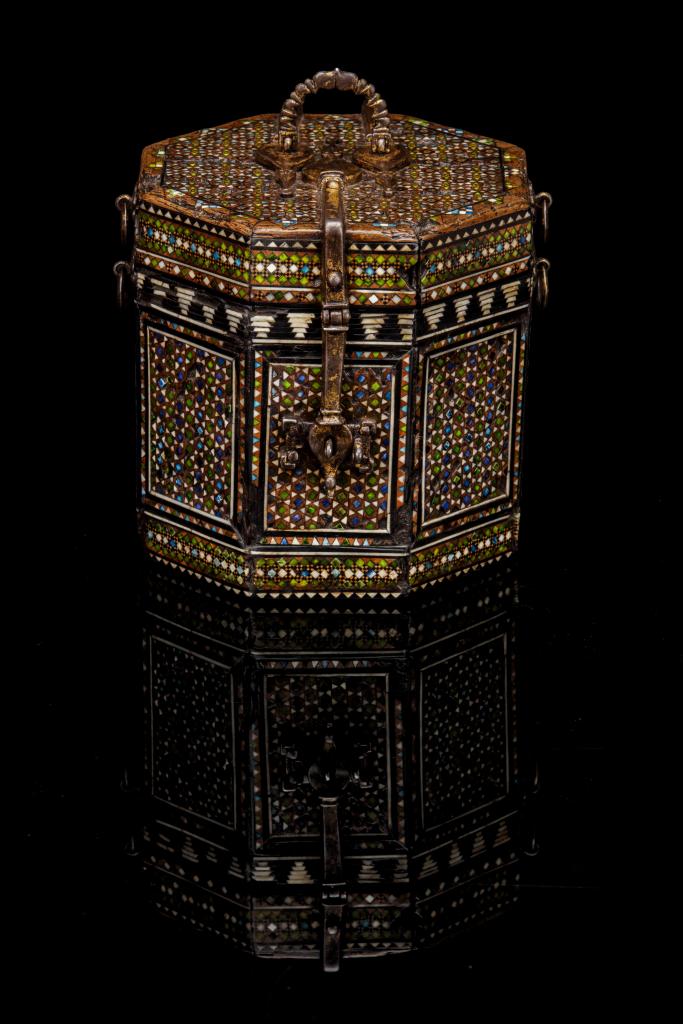
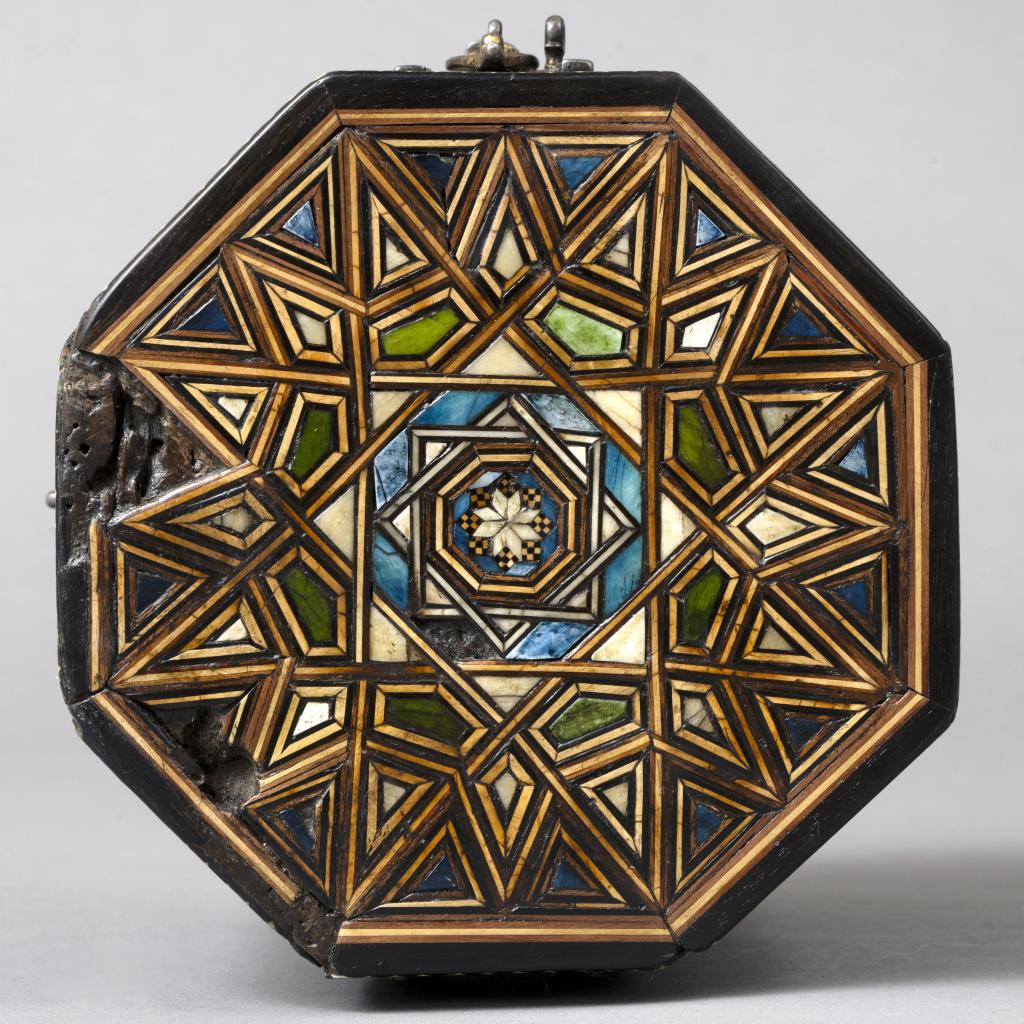
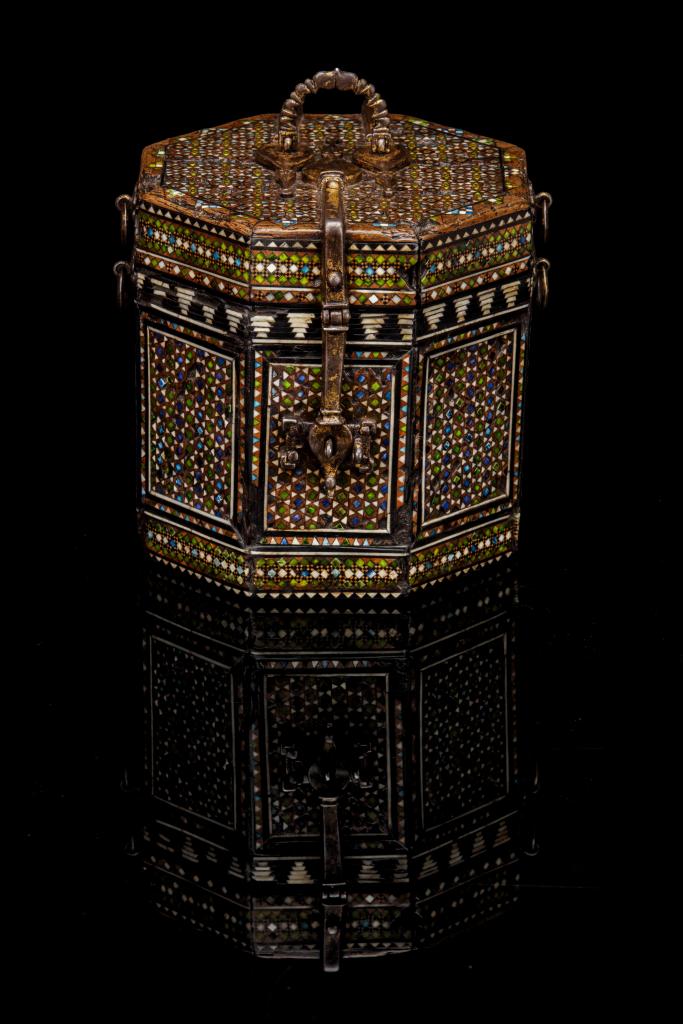
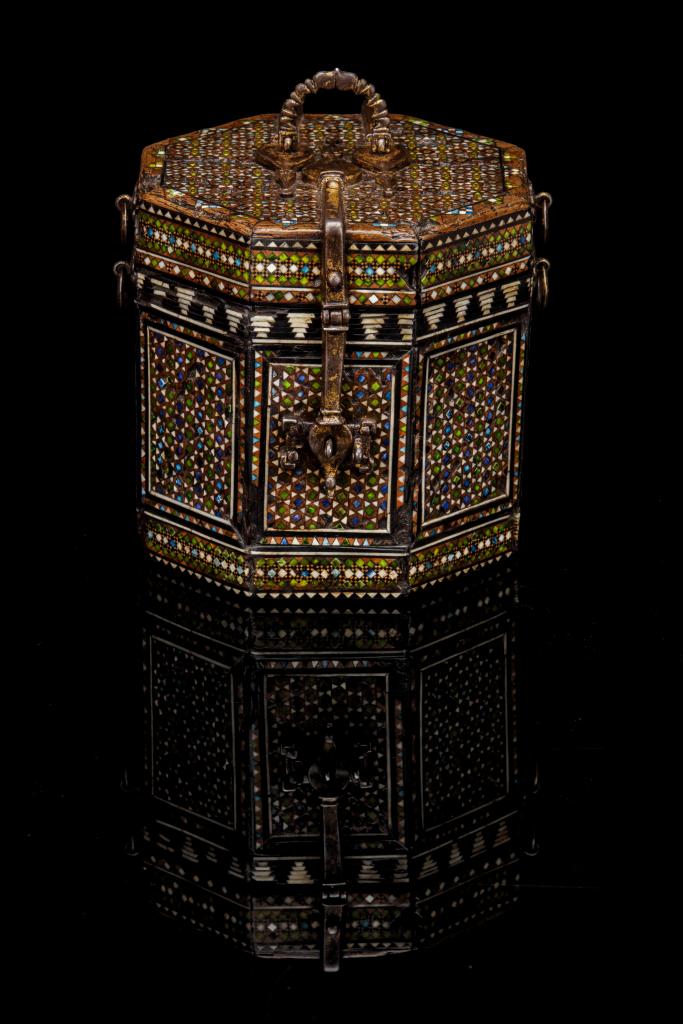
A Nasrid wood and bone-inlaid pyxis
Spain, Andalusia 14th/15th century
H. 16 x W. 16 cm
Pyxides are small luxury caskets, used for storing perfumes and cosmetics, and also exchanged as prestigious gifts.
This pyxis belongs to a small, coherent group of Andalusian boxes, recognised through close similarities in scale, materials and technique. They form part of a broader tradition of Andalusian woodwork defined by taracea, from the Arabic tarsi‘, “to stud, to inlay”, in which contrasting woods are combined with minute bone tesserae, sometimes dyed green or blue, to create dense geometric surfaces, as seen here. Although rarely dated, such objects were long placed in the fourteenth or fifteenth century, in part through comparison with celebrated taracea cupboard doors in the Museo de la Alhambra, Granada, made for a princely context in the early fifteenth century (see Al-Andalus, 1992, cat. 118, p. 373; Granada, 1995, pp. 379–380, cat. 143).
Surviving pyxides of this type broadly fall into two groups. One combines geometric inlay with carved openwork panels and marquetry to the base. The other, represented by the present example, dispenses with openwork plaques in favour of continuous taracea across the sides. The shared design logic across the group suggests production within closely related Andalusian workshops.
Provenance:
Formerly in a Flemish private collection, first half 20th century
H. 16 x W. 16 cm
Pyxides are small luxury caskets, used for storing perfumes and cosmetics, and also exchanged as prestigious gifts.
This pyxis belongs to a small, coherent group of Andalusian boxes, recognised through close similarities in scale, materials and technique. They form part of a broader tradition of Andalusian woodwork defined by taracea, from the Arabic tarsi‘, “to stud, to inlay”, in which contrasting woods are combined with minute bone tesserae, sometimes dyed green or blue, to create dense geometric surfaces, as seen here. Although rarely dated, such objects were long placed in the fourteenth or fifteenth century, in part through comparison with celebrated taracea cupboard doors in the Museo de la Alhambra, Granada, made for a princely context in the early fifteenth century (see Al-Andalus, 1992, cat. 118, p. 373; Granada, 1995, pp. 379–380, cat. 143).
Surviving pyxides of this type broadly fall into two groups. One combines geometric inlay with carved openwork panels and marquetry to the base. The other, represented by the present example, dispenses with openwork plaques in favour of continuous taracea across the sides. The shared design logic across the group suggests production within closely related Andalusian workshops.
Provenance:
Formerly in a Flemish private collection, first half 20th century
Part of the Europe collection.
Related objects
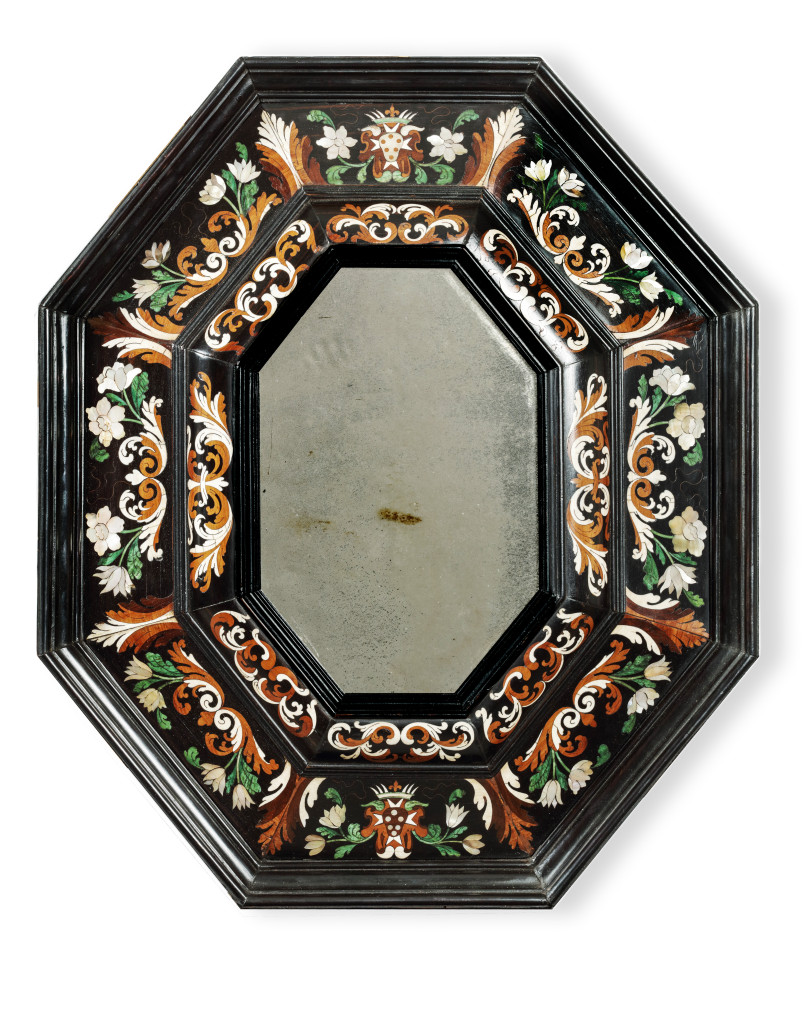
A bone, mother-of-pearl, and various wood inlaid ebony mirror with the Medici coats-of-arms by Leonardo van der Vinne (act. 1659-1713)
_Florence, late 17th-century_ _H. 49 x W. 42 cm_ Provenance: Noble collection, Belgium
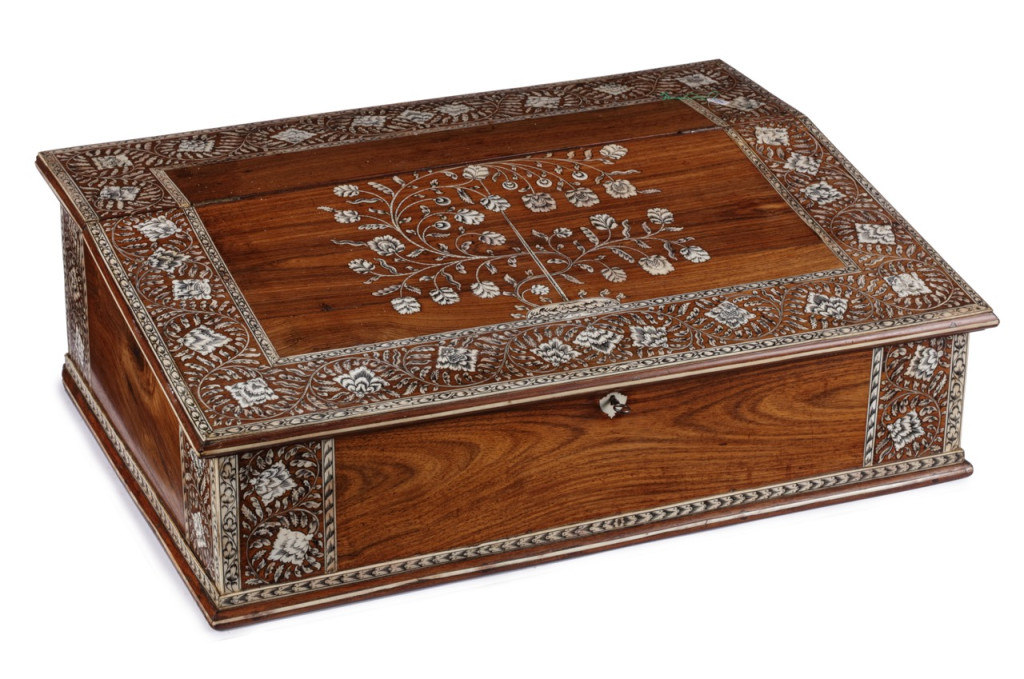
A fine 'Vizagapatam' pen-engraved bone inlaid rosewood writing box
India, Vizagapatam, mid-18th century
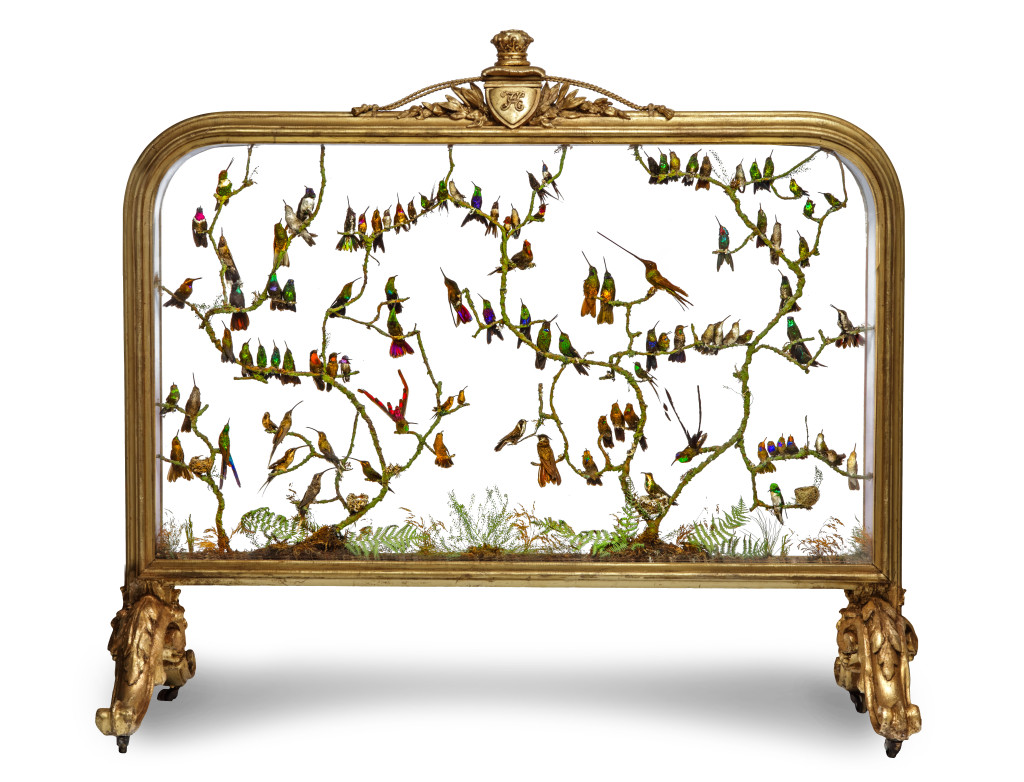
An exceptional and extremely rare victorian gilt-wood fire screen with taxidermy hummingbirds by and labelled for Henry Ward (1812-1878)
Taxidermy Hummingbird Fire Screen Henry Ward