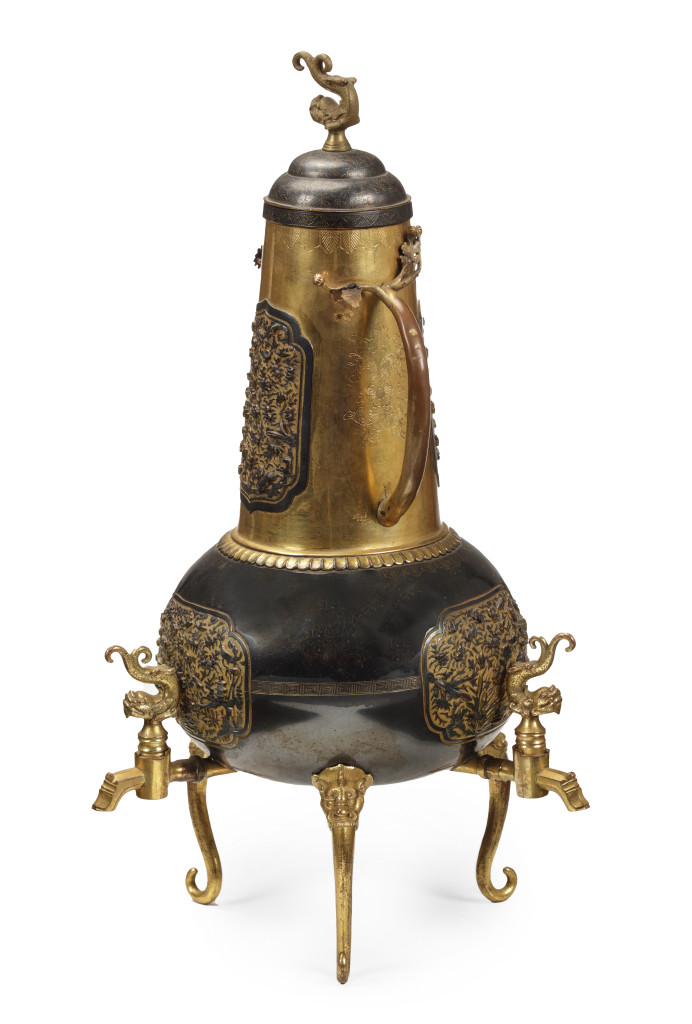
A large Japanese sawasa hot water urn or ‘kraantjeskan’
Nagasaki, or Vietnam, Tonkin, 1st half 18th century
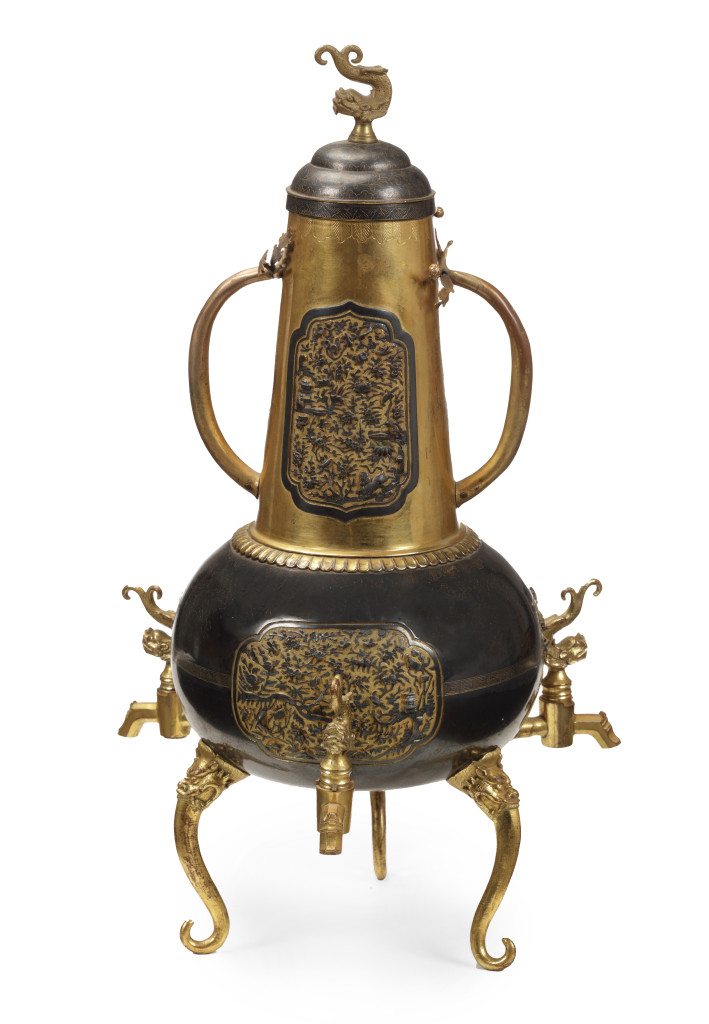
The urn stands on three gilt legs stemming from a karashishi-head, with three gilt taps with stoppers in the form of mythical fish and two gilt handles with gilt sculptured foliage twisted around the body. The body consists of a black lacquered bulbous lower part and a gilt conical upper part. They are decorated with five cartouches in black lacquered high relief designs on a granulated background depicting typical Chinese landscape scenes with trees, pagodes, birds, and karashishi (Chinese lions). The remaining surfaces on the body are engraved with gilt scrolling foliage and lotus borders. On top is a detachable domed lid with gilt engraved foliage scrolls and lotus borders on a black lacquered background, and on top is a finial in the form of a mythical fish.
H. 38.5 x W. 20 cm / Weight 2100 grams
Provenance:
- With A.C. Beeling Antiquairs, Leeuwarden
- Collection Prof. Dr. Jean Henri Pierre Jonxis (1907-1995), purchased from the above in1955; thence by by descent to Ms. Willemien L. Reinking-Jonxis
Literature:
For a comparable 'kraantjeskan' see: Rijksmuseum Amsterdam, Sawasa / Japanese export art in black and gold 1650-1800 , Zwolle, Uitgeverij WBOOKS, 1998 (ill. cover)
Sawasa is a metal alloy consisting of copper, silver, zinc, arsenic, gold, nickel, tin, lead, and chromium. Typical sawasa ware was made for the European market and ordered from about 1690 till the late 18th century by the Dutch from their establishment on the small artificial island Deshima in the bay of Nagasaki. Initially, sawasa was made in small quantities in Nagasaki for the Dutch and later probably also in Tonkin, Cochin, and perhaps even in Batavia (Jakarta). Japanese and Chinese lived all over Asia; moreover, the Chinese junk trade between Japan and the rest of Asia was much larger than the Dutch-Asian trade. Nevertheless, the demand for sawasaware was mainly from the Dutch in Batavia.
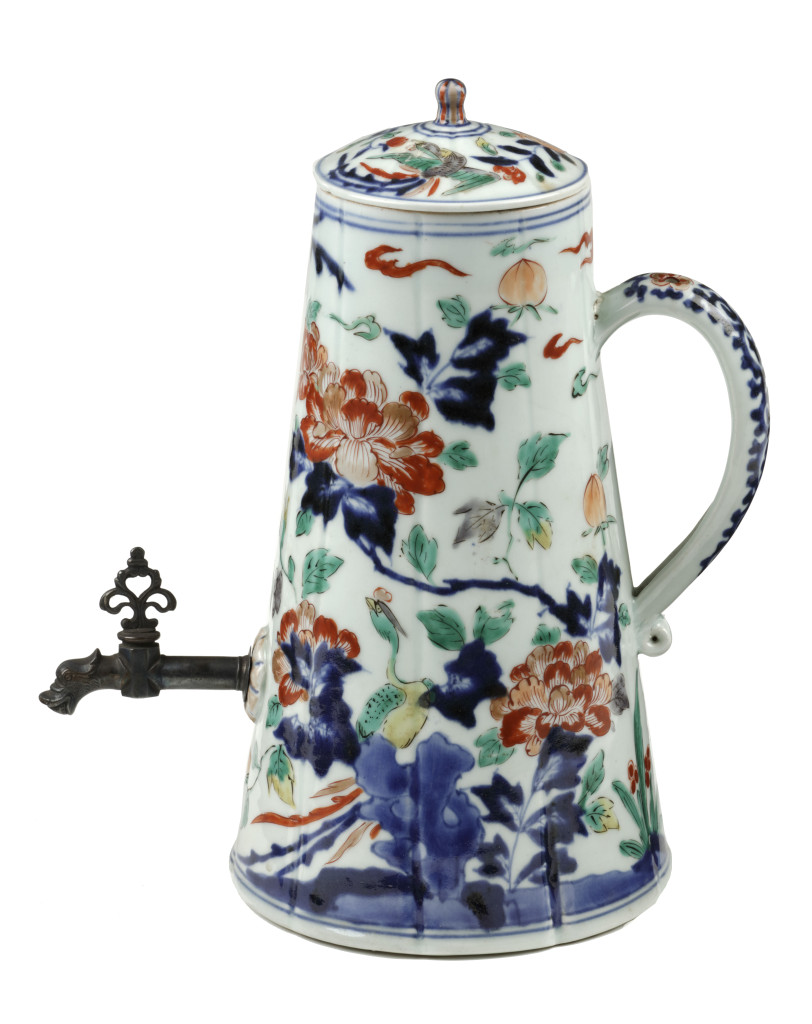
The kraantjeskan is a typical Dutch design used for hot water, tea, coffee, or chocolate, and a kraantjeskan from Holland must have been taken to Deshima as an example for Japanese workers to copy in sawasa. There are also known examples of the kraantjeskan in porcelain from the same period, of which one is in our collection. For instance, a rare imari example ([inv.no. 69.2023.22.6.15.29](https://zebregsroell.com/product/japanese-imari-coffeepot)). For a blue-and-white Arita porcelain example sold by us, see the collection of the Museum of Fine Art in Houston ([obj.no. 2022.111.A,.B](https://emuseum.mfah.org/objects/154432/coffee-pot-with-cover?ctx=71c12e58c60bc856ccc77a59bcff0c19f9d24767&idx=0)).
The urn stands on three gilt legs stemming from a karashishi-head, with three gilt taps with stoppers in the form of mythical fish and two gilt handles with gilt sculptured foliage twisted around the body. The body consists of a black lacquered bulbous lower part and a gilt conical upper part. They are decorated with five cartouches in black lacquered high relief designs on a granulated background depicting typical Chinese landscape scenes with trees, pagodes, birds, and karashishi (Chinese lions). The remaining surfaces on the body are engraved with gilt scrolling foliage and lotus borders. On top is a detachable domed lid with gilt engraved foliage scrolls and lotus borders on a black lacquered background, and on top is a finial in the form of a mythical fish.
H. 38.5 x W. 20 cm / Weight 2100 grams
Provenance:
- With A.C. Beeling Antiquairs, Leeuwarden
- Collection Prof. Dr. Jean Henri Pierre Jonxis (1907-1995), purchased from the above in1955; thence by by descent to Ms. Willemien L. Reinking-Jonxis
Literature:
For a comparable 'kraantjeskan' see: Rijksmuseum Amsterdam, Sawasa / Japanese export art in black and gold 1650-1800 , Zwolle, Uitgeverij WBOOKS, 1998 (ill. cover)
Sawasa is a metal alloy consisting of copper, silver, zinc, arsenic, gold, nickel, tin, lead, and chromium. Typical sawasa ware was made for the European market and ordered from about 1690 till the late 18th century by the Dutch from their establishment on the small artificial island Deshima in the bay of Nagasaki. Initially, sawasa was made in small quantities in Nagasaki for the Dutch and later probably also in Tonkin, Cochin, and perhaps even in Batavia (Jakarta). Japanese and Chinese lived all over Asia; moreover, the Chinese junk trade between Japan and the rest of Asia was much larger than the Dutch-Asian trade. Nevertheless, the demand for sawasaware was mainly from the Dutch in Batavia.
The kraantjeskan is a typical Dutch design used for hot water, tea, coffee, or chocolate, and a kraantjeskan from Holland must have been taken to Deshima as an example for Japanese workers to copy in sawasa. There are also known examples of the kraantjeskan in porcelain from the same period, of which one is in our collection. For instance, a rare imari example ([inv.no. 69.2023.22.6.15.29](https://zebregsroell.com/product/japanese-imari-coffeepot)). For a blue-and-white Arita porcelain example sold by us, see the collection of the Museum of Fine Art in Houston ([obj.no. 2022.111.A,.B](https://emuseum.mfah.org/objects/154432/coffee-pot-with-cover?ctx=71c12e58c60bc856ccc77a59bcff0c19f9d24767&idx=0)).
Part of the Japan collection.