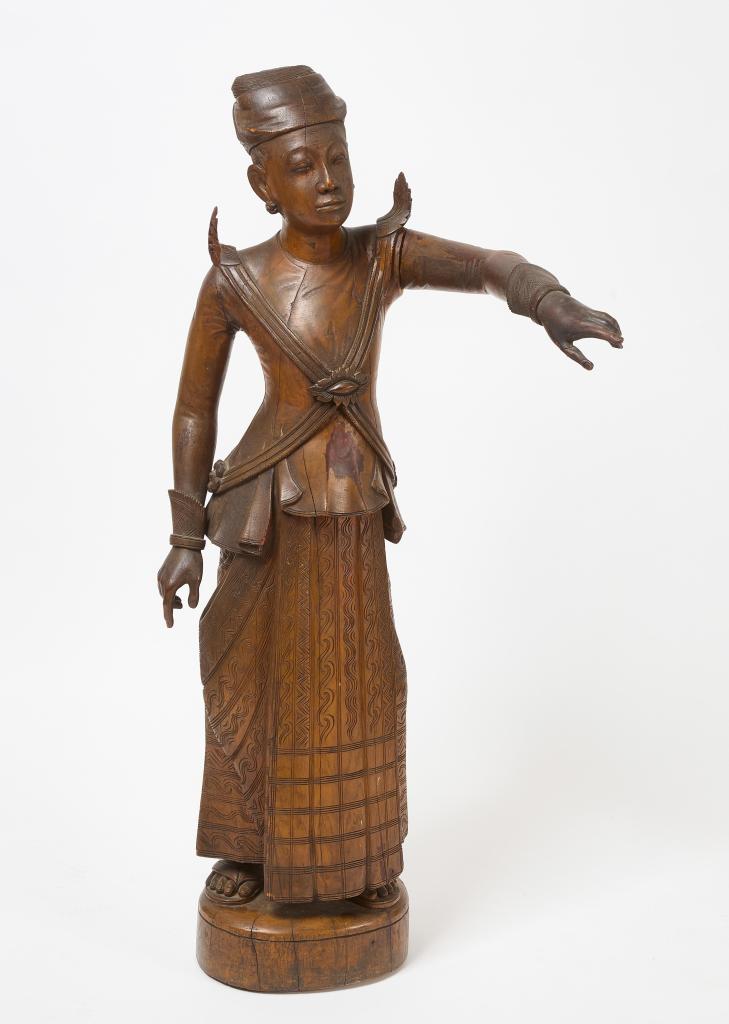
A large Mandalay teakwood altar sculpture of a guardian attendant
Analysis of a 19th-Century Burmese Nobleman Sculpture
Wooden sculpture of a Burmese nobleman (19th century), carved from teak. The figure stands about 125 cm tall, wearing ornate court dress with upturned wing-like shoulder flanges and a salwe (ceremonial chest chain). Remnants of paint and gilding are visible on the carved surface (user-provided image).
Origin and Identification as Burmese
All evidence indicates that this sculpture is of Burmese (Myanmar) origin, rather than from another Southeast Asian tradition. The attire and attributes depicted are characteristic of 19th-century Burmese courtly style. Notably, the figure wears a pah-soe (male wraparound skirt) with a zig-zag or wave pattern, a fitted jacket with elaborate trim, and prominent “winged” shoulder epaulettes. Across the chest it bears a salwe, which is a ceremonial chain of office or rank insignia in Burmese royal costume . These elements – the flared shoulder ornaments and the salwe – are distinct markers of Burmese aristocratic dress. In neighboring countries like Thailand or Cambodia, sculptural figures from the 19th century do not typically display this exact combination of costume features. The British Museum notes that in Burmese art of the 18th–19th centuries, images of the Buddha and other figures were often depicted in royal attire with a “mass of winged elements” at shoulders, elbows, knees, etc., and the distinctive salwe chest chains . This confirms that such winged shoulder flanges and body chains were especially popular in Burma during that period . Given these iconographic clues, the sculpture is almost certainly Burmese. The auction description of what appears to be this very piece also identifies it as a “Colonial Burmese” life-size teak wood statue of a nobleman . No attributes suggest another region – for example, a Thai or Lao figure would have different crown and costume styles, and likely would not be carved from a single teak log at this scale. The use of teakwood itself points to Burma (Myanmar), where teak was plentiful and commonly used for large carvings. In summary, the sculpture’s dress and materials firmly attribute it to 19th-century Burma, not elsewhere in Southeast Asia.
Regional Characteristics Within Burma
If we accept a Burmese origin, we can further ask which region or artistic tradition within Myanmar it might belong to. Burma had several cultural regions (Upper Burma/Mandalay, Lower Burma, Shan states, Arakan, etc.) with some variation in artistic styles. The courtly attire depicted – including the high quality of carving, the winged shoulder decorations, and what appears to have once been lavish gilding or polychrome – suggests it was produced in a major Burmese art center, most likely the Mandalay court style. The Mandalay style, prevalent during the Konbaung Dynasty (19th century), is characterized by richly ornamented figures, gilded lacquer, and glass inlay on wood. Indeed, comparable figures from the mid-19th century attributed to Mandalay show similar features: one art expert notes a pair of gilded wooden figures (likely from Mandalay, c.1850s) adorned with thayo lacquer, mirrored glass, and winged metal epaulettes . Our sculpture in its current state has only paint remnants, but it very likely was originally gilded and maybe had inset glass or mirror detailing as well, consistent with Mandalay workmanship.
Other regions in Burma (e.g. Shan or Arakanese carving) sometimes have a slightly different aesthetic – Shan Buddha figures, for instance, have distinctive facial features and often simpler attire, and Shan woodcarvers made many smaller nat statues but not typically life-size courtly figures with salwe chains. By contrast, the Royal Mandalay workshops in the 19th century did produce life-size or near life-size figures for palaces and temples, including not just Buddhas but also attendant figures and spirit (nat) figures. The provenance of similar pieces supports a central Burmese origin: for example, an almost identical teak statue of a Burmese nobleman (49.5 inches tall) was sold at auction and was described simply as “Burma (Myanmar)” . Furthermore, the Mandalay Palace and capital region (Ava/Amarapura/Mandalay) was a hub for such large-scale wood sculptures – the British seized many lavish wood carvings from Mandalay and Upper Burma in the late 19th century. Museum records show Burmese carvings from the Mandalay Palace shrines acquired after 1885. Unless there is evidence of Shan script or a specific local provenance, the safest attribution is Mandalay (central Burma). In summary, the figure likely hails from the Burmese heartland, reflecting the Konbaung court artistic conventions. This aligns with the dating (19th century) and the fact that “Mandalay-style” gilded wooden sculptures of donors, disciples, or deities were common in that era .
Dating Within the 19th Century
The sculpture is broadly described as 19th century, but we can narrow the date range based on style and historical context. The court dress style with winged shoulders and salwe chains was in use mainly in the Konbaung Dynasty (1752–1885), especially in its later half. As noted by scholars, the concept of dressing sacred figures in royal garb and adding flamboyant ornamentation peaked in popularity in the 18th–19th centuries in Burma . By the mid-19th century, during the reigns of King Mindon and King Thibaw in Mandalay, this style was highly developed. We might reasonably place the sculpture circa mid to late 19th century (c.1850–1880).
A few clues support this range: The “zig-zag” patterned pah-soe mentioned is likely the luntaya acheik pattern – a wave or zigzag textile design that was especially popular in the Mandalay court in the mid/late 1800s. Additionally, the sculpture shows a mix of traditional Burmese craftsmanship with possibly some colonial-era influence (the auction catalogue even labeled it “Colonial Burmese” ). After the British annexation of Upper Burma in 1885, the royal workshops were disbanded, though craftsmen continued to produce religious art. The quality and traditional iconography here suggest it was made before or not long after the fall of the monarchy, rather than, say, a much later 19th-century copy for tourists. Radiocarbon tests on comparable wooden temple figures have confirmed dates in the late 19th century. For instance, a pair of life-size carved wood figures from Burma (depicting an old man and a sick man in a temple tableau) were scientifically dated to the late 19th–early 20th century, corroborating that such large sculptures were indeed being made around that time . Our nobleman statue was likely carved in the second half of the 19th century, with a slight possibility of early 20th century if it remained a continued practice. However, stylistically it fits best in the pre-1900 Mandalay period. Therefore, a plausible date would be circa 1850s–1890s, with the heart of that range (approximately 1870s) being very likely. This range captures the high point of Burmese court art and the early colonial period when many such pieces were produced and later dispersed.
Function: Temple Donor, Guardian, or Cultic Role?
The original function of this sculpture is an important question. While it portrays a nobleman or court figure, it was probably not meant as a mere portrait of a lay donor; rather, it likely had a ritual or protective role in a Buddhist context – either as an attendant to a Buddha image, a guardian figure, or possibly as a representation of a divinity (such as one of the 37 nats or a Hindu deity adapted into Buddhist lore). There are several possibilities:
- Temple Donor Effigy: In some cultures, donors are depicted in statues, but in Burmese practice donors more often appear in murals or as tiny kneeling figures, not usually life-size stand-alone statues in lavish court dress. It would be somewhat unusual for a donor to be portrayed with the regalia of a prince or deity (including a salwe and crown-like attire). Moreover, if it were an actual donor portrait, we might expect an inscription naming the donor. In one known example, life-size wood figures of the “Four Encounters” (old man, sick man, etc.) in a Burmese temple did carry the donor’s name inscribed on the base – but those figures were narrative, not portraits of the donor himself. Thus, while a wealthy donor likely commissioned and donated this sculpture to a monastery or temple, the figure itself almost certainly represents an idealized or mythic personage, not the donor’s own likeness.
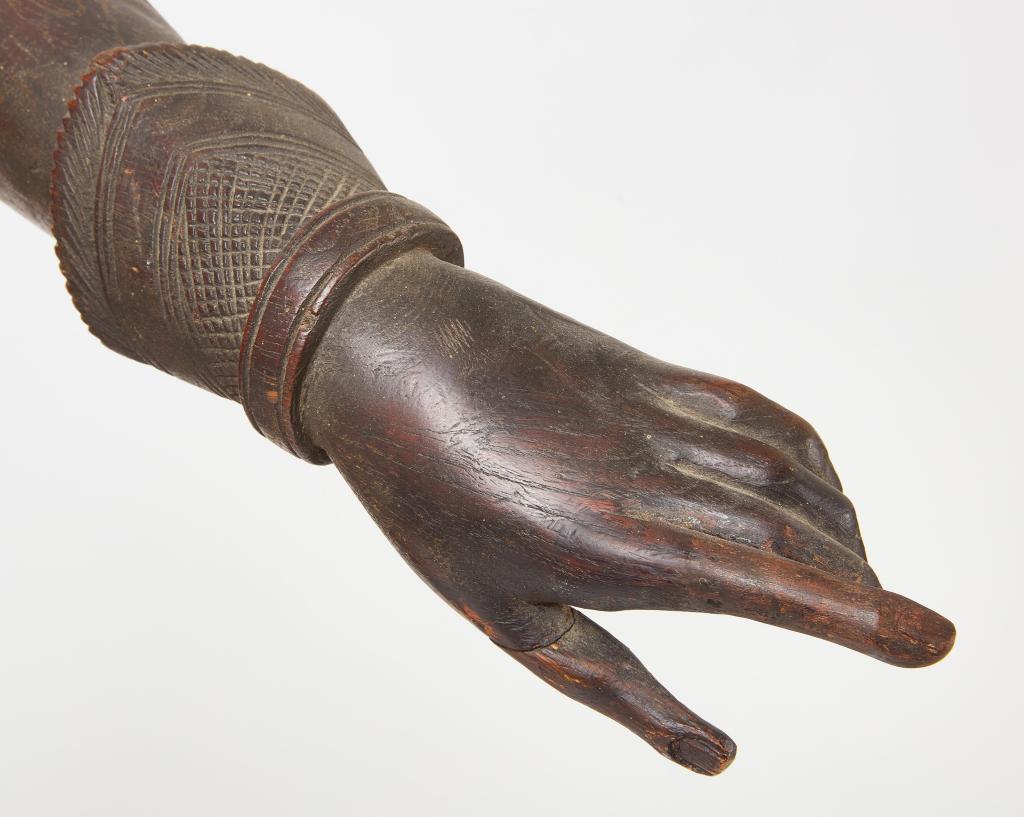
- Shrine Attendant / Deva Figure: The most plausible role is that the noble figure was an attendant or guardian in a Buddhist shrine (hpaya khan). Burmese shrines often included flanking figures that are neither Buddha nor monks, but rather royal or celestial beings who pay homage or serve a protective function. Art historians have noted that mid-19th c. Burmese shrines sometimes feature figures identified as Indra (Sakka) or Brahma – the two Hindu deities who, in Buddhist stories, attended the Buddha. According to curator J. Lowry (1974), such figures, dressed in royal attire and often holding objects, could represent Indra or Brahma, both of whom appear in the Buddha’s life (for example, Brahma and Indra beseech the Buddha to teach after his Enlightenment) . It is also possible they were seen more generally as nat spirit guardians. In the Victoria and Albert Museum in London, there is a spectacular 19th-century carved wooden shrine from Mandalay which is flanked by at least one such figure – the V&A’s attendant holds aloft a European glass oil-lamp in his hands . This indicates these attendant statues could have a practical role (illuminating the altar) in addition to symbolic meaning. Our figure’s left hand was found detached (and re-pinned) , which suggests it was originally extended – possibly to hold something like a lamp, staff, or ritual implement. Indeed, a similar Burmese carved figure has a left hand shaped to hold a rod, which likely supported a lamp or parasol, and the V&A example’s lamp corroborates this functionality . Thus, it is very plausible this nobleman statue was meant to stand guard or serve at a temple altar, perhaps holding a lantern or offering.
- Nat or Deity for Veneration: Another possibility is that the figure represents one of the 37 Nat spirits in Burmese tradition. Many of the 37 official Nats were historical figures who met violent deaths and are often depicted in royal dress. For example, Min Mahagiri (Lord of the Great Mountain) is a famed Nat often shown in a princely garb, hands in prayer. However, our figure’s pose (likely with one arm outstretched rather than palms joined) doesn’t immediately suggest the classical prayerful pose of a Nat statue. Also, nat statues usually appear in nat shrines or at the base of pagodas (such as at Mount Popa) specifically for nat worship, and they often come in male-female pairs or sets. If this were a Nat, one might expect identifying attributes (Min Mahagiri sometimes is shown with a blacksmith’s hammer since he was a blacksmith in life, etc., which we do not see here). It could be a generic nat or local spirit representation placed as a guardian at a shrine. That said, scholars have sometimes used the term “nat-like figure” for these shrine attendants because they are human in form and lavishly dressed . Whether worshippers specifically venerated this figure is uncertain – more likely it stood to the side of a main Buddha image, as a part of the overall sacred tableau, rather than being the primary cult object itself.
Considering these points, the most likely function of this sculpture was as a guardian/attendant figure in a Buddhist temple or monastery shrine. It probably flanked a Buddha altar or stood at an entrance, symbolically protecting the space or serving the Buddha. Its noble, almost divine attire would convey that even kings and devas pay homage to the Buddha. If it indeed held a lamp or offering tray, it physically illuminated the Buddha image or offered light – a common devotional act. We have precedents for large wooden figures illustrating parts of the Buddha’s story or serving ritual roles in 19th-century Burma: for instance, the life-size “Four Encounters” figures (old man, sick man, etc.) mentioned earlier were set up in a temple to educate viewers on Buddhist teachings . Our figure’s role would have been similarly integrative – not an isolated artwork, but part of a spiritual narrative or protective scheme. In summary, it likely functioned as a life-sized donor-funded devotional statue, portraying a royal or divine attendant, rather than a portrait of an actual person. It straddles the line between secular court imagery and religious iconography, embodying a lay protector or deity in service of the Buddhist faith.
Comparable Examples in Museums and Collections
Sculptures of this type, while rare, do have parallels in museum collections and documented sales, which help contextualize their style and purpose:
- Victoria & Albert Museum (London): The V&A holds a renowned 19th-century Burmese shrine from Mandalay which includes elaborately carved figures. One published example is a figure (mid-19th c.) identified as Brahma holding a lamp, which was part of a larger shrine ensemble . This figure is gilded wood with inlaid glass, very much like what our nobleman would have looked like when new. As noted, Lowry (1974) surmised that such attendant statues represent Brahma or Indra in Burmese Buddhist art . The presence of a European glass lamp in the V&A figure’s hands is particularly interesting – it suggests that by the late 19th century, Burmese artisans were incorporating imported objects (like glass lanterns) into religious displays. Our figure may well have served the same shrine-illumination function. The V&A also has gilded wooden disciples (such as the Buddha’s disciples Moggallana and Sariputta) from 19th-c Myanmar , which, while iconographically different (monks, not nobles), show the Burmese mastery of wood sculpture and lacquer at life-size scale.
- British Museum (London): The British Museum acquired many Burmese objects during and after the Anglo-Burmese wars. While their collection is rich in Buddha images, they also have a few large attendant figures. One example described in their records is a “magnificently gilt and colored” wooden figure illustrating the quality of 19th-century Burmese sculpture . Another entry (museum no. 1919,0717.1) is a dry-lacquer crowned Buddha nearly life-size, which we cited earlier to illustrate the costume; its existence in the BM since 1825 (brought by Captain Marryat after the First Anglo-Burmese War) attests that the Burmese were making grand-scale sacred figures even in the early 19th century . Although that one is a Buddha, not an attendant, it shows that whole ensembles of royal-costumed figures were part of Burmese art. Unfortunately, specific nobleman attendant statues from Burma are less common in Western museums – likely because many perished or remained in situ. However, photographs and archives from the Mandalay Palace (circa 1885) indicate that the throne hall and royal monasteries were populated with carved wood figures, some possibly representing ministers or mythical beings. The BM’s exhibition Burma to Myanmar (2023) included some of these lesser-known pieces .
- Asian Art Museum (San Francisco) & Other Museums: The Asian Art Museum in SF and museums like the Metropolitan Museum often have Burmese Buddha images and sometimes nat figures or throne fragments, but a search did not reveal an exact match to our statue. The Asian Art Museum, for instance, has a famous set of much earlier (8th-century) Indian-influenced statues of Brahma and Indra (from Japan) in its collection – not directly related, but highlighting how these attendant deities are a pan-Buddhist theme. For 19th-century Burma, the most closely related items tend to be nat statues. The museum in Yangon (National Museum of Myanmar) and local pagoda museums in Myanmar do preserve wooden nat figures (often smaller). Our figure’s size and material would make it a prized piece in any collection today, and indeed several have appeared on the art market rather than in public museums.
- Art Market and Auction Records: A number of private collections and dealers have handled similar pieces, which helps compare stylistic details. For example, the New England Auctions sale (March 2025) of “An Unusual Colonial Burmese Carved Life-Size Teak Wood Statue of a Noble Man” is almost certainly the same type as our sculpture, if not the very piece . Its description matches ours word-for-word, confirming the Burmese origin, 19th-century date, and costume details. Additionally, specialist dealers like Michael Backman in London have sold mid-19th c. Burmese nat figures and attendant figures. Backman’s catalog of a crouching nat figure (46 cm high, mid-19th c.) shows a smaller but similarly winged-costume figure with one hand raised in a teaching gesture . He also documented a pair of mirror-image kneeling figures with winged ornaments, which were likely shrine adornments; he notes these were probably made in Mandalay and compares them to the V&A lamp-bearing figure . Such sources highlight that polychrome and gilded teak figures of attendants/nats were indeed produced in 19th-century Burma, though surviving examples are scarce outside of Myanmar. On the popular market, one also finds smaller statues labeled as “antique Burmese nat” – usually gilded wooden figures 50 cm tall, often in prayer pose or holding an offering. These are often dated to the 19th century and share elements like the crown (mahagiri headdress) and ornate dress . For instance, a dealer in the Netherlands offered a pair of 19th c. Burmese nat statues (60 cm, gilded wood with inlaid eyes) described as Mandalay style with winged costumes . All these comparables reinforce that our 125 cm figure belongs to a known genre of Burmese devotional sculpture – typically depicting royal or spiritual figures that are not Buddhas themselves but serve supportive roles in the religious milieu.
In summary, museum and auction examples confirm the Burmese nobleman statue is not an isolated curiosity but part of a broader artistic tradition. The V&A’s shrine figure, the British Museum’s notes on 19th-c Burmese wood sculpture, and multiple art-market pieces of nats/attendants collectively illustrate the typical features we see: teak wood construction, original gilding and paint, glass mosaic embellishments, elaborate dress with winged shoulders and crowns, and a function tied to Buddhist worship (either as part of a narrative or as a shrine guardian). Our sculpture stands firmly within that context.
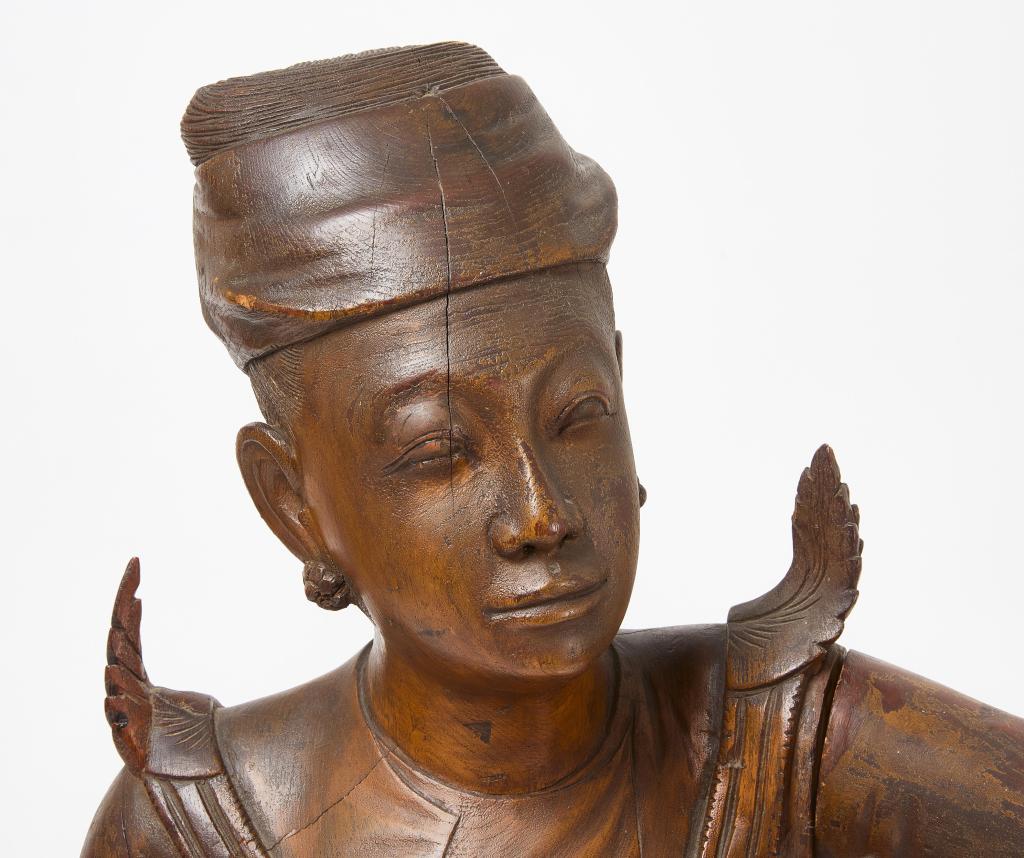
Figure 2: Detail of the carved teak figure, showing the wing-like shoulder ornaments and layered jewelry. Such stylistic features are hallmarks of 19th-century Burmese court style, seen on statues of nats, Brahma/Indra figures, and even crowned Buddha images . The courtly chains (salwe) across the torso indicated high rank and were often gilded . The expressive carving of the face and dynamic posture reflect the craftsmanship of Mandalay artisans.
Conclusion: Likely Original Purpose and Cultural Context
Bringing together the above points, this wooden nobleman sculpture was most likely created in 19th-century Burma (Myanmar), probably in the Mandalay region, as a devotional/ritual figure in a Buddhist temple or palace shrine. Its iconography – a lay noble with majestic attire – suggests it represents a worldly being in service of the Buddha, rather than the Buddha himself or a monk. It might personify a celestial guardian (deva) or a deified royal figure integrated into Buddhist worship (such as Indra, Brahma, or a prominent Nat spirit). The probable scenario is that it stood flanking a central Buddha image, possibly holding a lamp or offering, thereby illuminating and honoring the Enlightened One . In this role, the figure would have been respected as part of the sacred space, though not worshipped independently like a Buddha statue – more like an honored attendant or protective spirit watching over the shrine.
Culturally, the piece reflects the syncretism of Burmese Buddhism in the 19th century: the Buddha was revered by kings, and in turn Buddhist iconography freely incorporated images of kings and heavenly beings paying homage. The lush costume of our statue mirrors what actual Burmese royalty wore, implying that even royalty bows to the Dharma. In a temple setting, such a statue could also serve a didactic purpose – reminding viewers of the stories where mighty kings (or gods) acknowledge the Buddha’s supremacy (as in the Jambupati legend, or Brahma’s entreaty to Buddha). If it represents a Nat, it underscores how pre-Buddhist spirits were incorporated into the Buddhist fold, guarding the temple but remaining subservient to the Buddha .
From a material standpoint, the use of teak wood and the remnants of polychrome/gilding tell us it was a high-quality piece, likely commissioned by a wealthy donor or by the royal court for a significant religious site. The donor’s role would have been to gain merit; indeed, at least one comparable figure had the donor’s name inscribed on its base, linking the act of commissioning art to pious merit-making . Thus, our sculpture can be seen as a form of meritorious donation (dāna) – a lavish gift to the monastery, beautifying it and symbolically protecting it.
In the colonial and post-colonial journey of such objects, many were removed from their original contexts. The example of Captain Marryat sending huge Burmese figures to the British Museum in 1825 , or the dispersal of Mandalay Palace artifacts in 1885, gives a sense that by the early 20th century, numerous sculptures like this left Myanmar. This particular statue’s resurfacing (e.g. in a recent auction) is part of that legacy. However, when we reconstruct its original purpose, we find a vivid image: a dimly lit Burmese shrine hall, with a large gilded Buddha in the center, and flanking that Buddha are richly dressed teak guardians – perhaps our nobleman on one side and a counterpart on the other – holding up oil lamps or offerings while wearing benevolent expressions. In that original cultural context, the sculpture was not an isolated artwork but an integral piece of a spiritual tableau meant to inspire reverence and convey the majesty of the Buddhist faith supported by worldly powers.
In conclusion, the sculpture is very likely Burmese (Myanmar) from the mid/late 19th century, carved in the Mandalay style, and served as a life-size attendant or guardian figure in a Buddhist temple or royal monastery. Its role was probably to depict a noble or divine being offering devotion – possibly one of the Nat spirits or a representation of Indra/Brahma – thereby enhancing the sacred atmosphere and narrative of the shrine. Comparisons with known museum pieces and documented sales confirm the authenticity of its style and suggest it was originally one of a pair or group adorning a significant religious site. Today, stripped of its gold and context, it still conveys a sense of the rich cultural tapestry of 19th-century Burma, where kings became devotees and artisans gave wood the form of piety and power.
Sources: Burmese nobleman statue description ; British Museum and V&A records on 19th-c Burmese shrine figures ; Michael Backman gallery notes on Mandalay figures ; Artemis Gallery auction of temple figures ; Proantic catalog of Nat figure .
Burma (Myanmar), 19th century
H. 128 cm
Wearing traditional court garb, with a woven silk pah-soe, with zig-zag design, and a tight long sleeve jacket made of velvet, silk, brocade or satin trimmed with gold braid, with upturned wing-like shoulders; across the chest a salwe, a courtly chain ornament indicating his rank.
Wooden sculpture of a Burmese nobleman (19th century), carved from teak. The figure stands about 125 cm tall, wearing ornate court dress with upturned wing-like shoulder flanges and a salwe (ceremonial chest chain). Remnants of paint and gilding are visible on the carved surface (user-provided image).
Origin and Identification as Burmese
All evidence indicates that this sculpture is of Burmese (Myanmar) origin, rather than from another Southeast Asian tradition. The attire and attributes depicted are characteristic of 19th-century Burmese courtly style. Notably, the figure wears a pah-soe (male wraparound skirt) with a zig-zag or wave pattern, a fitted jacket with elaborate trim, and prominent “winged” shoulder epaulettes. Across the chest it bears a salwe, which is a ceremonial chain of office or rank insignia in Burmese royal costume . These elements – the flared shoulder ornaments and the salwe – are distinct markers of Burmese aristocratic dress. In neighboring countries like Thailand or Cambodia, sculptural figures from the 19th century do not typically display this exact combination of costume features. The British Museum notes that in Burmese art of the 18th–19th centuries, images of the Buddha and other figures were often depicted in royal attire with a “mass of winged elements” at shoulders, elbows, knees, etc., and the distinctive salwe chest chains . This confirms that such winged shoulder flanges and body chains were especially popular in Burma during that period . Given these iconographic clues, the sculpture is almost certainly Burmese. The auction description of what appears to be this very piece also identifies it as a “Colonial Burmese” life-size teak wood statue of a nobleman . No attributes suggest another region – for example, a Thai or Lao figure would have different crown and costume styles, and likely would not be carved from a single teak log at this scale. The use of teakwood itself points to Burma (Myanmar), where teak was plentiful and commonly used for large carvings. In summary, the sculpture’s dress and materials firmly attribute it to 19th-century Burma, not elsewhere in Southeast Asia.
Regional Characteristics Within Burma
If we accept a Burmese origin, we can further ask which region or artistic tradition within Myanmar it might belong to. Burma had several cultural regions (Upper Burma/Mandalay, Lower Burma, Shan states, Arakan, etc.) with some variation in artistic styles. The courtly attire depicted – including the high quality of carving, the winged shoulder decorations, and what appears to have once been lavish gilding or polychrome – suggests it was produced in a major Burmese art center, most likely the Mandalay court style. The Mandalay style, prevalent during the Konbaung Dynasty (19th century), is characterized by richly ornamented figures, gilded lacquer, and glass inlay on wood. Indeed, comparable figures from the mid-19th century attributed to Mandalay show similar features: one art expert notes a pair of gilded wooden figures (likely from Mandalay, c.1850s) adorned with thayo lacquer, mirrored glass, and winged metal epaulettes . Our sculpture in its current state has only paint remnants, but it very likely was originally gilded and maybe had inset glass or mirror detailing as well, consistent with Mandalay workmanship.
Other regions in Burma (e.g. Shan or Arakanese carving) sometimes have a slightly different aesthetic – Shan Buddha figures, for instance, have distinctive facial features and often simpler attire, and Shan woodcarvers made many smaller nat statues but not typically life-size courtly figures with salwe chains. By contrast, the Royal Mandalay workshops in the 19th century did produce life-size or near life-size figures for palaces and temples, including not just Buddhas but also attendant figures and spirit (nat) figures. The provenance of similar pieces supports a central Burmese origin: for example, an almost identical teak statue of a Burmese nobleman (49.5 inches tall) was sold at auction and was described simply as “Burma (Myanmar)” . Furthermore, the Mandalay Palace and capital region (Ava/Amarapura/Mandalay) was a hub for such large-scale wood sculptures – the British seized many lavish wood carvings from Mandalay and Upper Burma in the late 19th century. Museum records show Burmese carvings from the Mandalay Palace shrines acquired after 1885. Unless there is evidence of Shan script or a specific local provenance, the safest attribution is Mandalay (central Burma). In summary, the figure likely hails from the Burmese heartland, reflecting the Konbaung court artistic conventions. This aligns with the dating (19th century) and the fact that “Mandalay-style” gilded wooden sculptures of donors, disciples, or deities were common in that era .
Dating Within the 19th Century
The sculpture is broadly described as 19th century, but we can narrow the date range based on style and historical context. The court dress style with winged shoulders and salwe chains was in use mainly in the Konbaung Dynasty (1752–1885), especially in its later half. As noted by scholars, the concept of dressing sacred figures in royal garb and adding flamboyant ornamentation peaked in popularity in the 18th–19th centuries in Burma . By the mid-19th century, during the reigns of King Mindon and King Thibaw in Mandalay, this style was highly developed. We might reasonably place the sculpture circa mid to late 19th century (c.1850–1880).
A few clues support this range: The “zig-zag” patterned pah-soe mentioned is likely the luntaya acheik pattern – a wave or zigzag textile design that was especially popular in the Mandalay court in the mid/late 1800s. Additionally, the sculpture shows a mix of traditional Burmese craftsmanship with possibly some colonial-era influence (the auction catalogue even labeled it “Colonial Burmese” ). After the British annexation of Upper Burma in 1885, the royal workshops were disbanded, though craftsmen continued to produce religious art. The quality and traditional iconography here suggest it was made before or not long after the fall of the monarchy, rather than, say, a much later 19th-century copy for tourists. Radiocarbon tests on comparable wooden temple figures have confirmed dates in the late 19th century. For instance, a pair of life-size carved wood figures from Burma (depicting an old man and a sick man in a temple tableau) were scientifically dated to the late 19th–early 20th century, corroborating that such large sculptures were indeed being made around that time . Our nobleman statue was likely carved in the second half of the 19th century, with a slight possibility of early 20th century if it remained a continued practice. However, stylistically it fits best in the pre-1900 Mandalay period. Therefore, a plausible date would be circa 1850s–1890s, with the heart of that range (approximately 1870s) being very likely. This range captures the high point of Burmese court art and the early colonial period when many such pieces were produced and later dispersed.
Function: Temple Donor, Guardian, or Cultic Role?
The original function of this sculpture is an important question. While it portrays a nobleman or court figure, it was probably not meant as a mere portrait of a lay donor; rather, it likely had a ritual or protective role in a Buddhist context – either as an attendant to a Buddha image, a guardian figure, or possibly as a representation of a divinity (such as one of the 37 nats or a Hindu deity adapted into Buddhist lore). There are several possibilities:
- Temple Donor Effigy: In some cultures, donors are depicted in statues, but in Burmese practice donors more often appear in murals or as tiny kneeling figures, not usually life-size stand-alone statues in lavish court dress. It would be somewhat unusual for a donor to be portrayed with the regalia of a prince or deity (including a salwe and crown-like attire). Moreover, if it were an actual donor portrait, we might expect an inscription naming the donor. In one known example, life-size wood figures of the “Four Encounters” (old man, sick man, etc.) in a Burmese temple did carry the donor’s name inscribed on the base – but those figures were narrative, not portraits of the donor himself. Thus, while a wealthy donor likely commissioned and donated this sculpture to a monastery or temple, the figure itself almost certainly represents an idealized or mythic personage, not the donor’s own likeness.
- Shrine Attendant / Deva Figure: The most plausible role is that the noble figure was an attendant or guardian in a Buddhist shrine (hpaya khan). Burmese shrines often included flanking figures that are neither Buddha nor monks, but rather royal or celestial beings who pay homage or serve a protective function. Art historians have noted that mid-19th c. Burmese shrines sometimes feature figures identified as Indra (Sakka) or Brahma – the two Hindu deities who, in Buddhist stories, attended the Buddha. According to curator J. Lowry (1974), such figures, dressed in royal attire and often holding objects, could represent Indra or Brahma, both of whom appear in the Buddha’s life (for example, Brahma and Indra beseech the Buddha to teach after his Enlightenment) . It is also possible they were seen more generally as nat spirit guardians. In the Victoria and Albert Museum in London, there is a spectacular 19th-century carved wooden shrine from Mandalay which is flanked by at least one such figure – the V&A’s attendant holds aloft a European glass oil-lamp in his hands . This indicates these attendant statues could have a practical role (illuminating the altar) in addition to symbolic meaning. Our figure’s left hand was found detached (and re-pinned) , which suggests it was originally extended – possibly to hold something like a lamp, staff, or ritual implement. Indeed, a similar Burmese carved figure has a left hand shaped to hold a rod, which likely supported a lamp or parasol, and the V&A example’s lamp corroborates this functionality . Thus, it is very plausible this nobleman statue was meant to stand guard or serve at a temple altar, perhaps holding a lantern or offering.
- Nat or Deity for Veneration: Another possibility is that the figure represents one of the 37 Nat spirits in Burmese tradition. Many of the 37 official Nats were historical figures who met violent deaths and are often depicted in royal dress. For example, Min Mahagiri (Lord of the Great Mountain) is a famed Nat often shown in a princely garb, hands in prayer. However, our figure’s pose (likely with one arm outstretched rather than palms joined) doesn’t immediately suggest the classical prayerful pose of a Nat statue. Also, nat statues usually appear in nat shrines or at the base of pagodas (such as at Mount Popa) specifically for nat worship, and they often come in male-female pairs or sets. If this were a Nat, one might expect identifying attributes (Min Mahagiri sometimes is shown with a blacksmith’s hammer since he was a blacksmith in life, etc., which we do not see here). It could be a generic nat or local spirit representation placed as a guardian at a shrine. That said, scholars have sometimes used the term “nat-like figure” for these shrine attendants because they are human in form and lavishly dressed . Whether worshippers specifically venerated this figure is uncertain – more likely it stood to the side of a main Buddha image, as a part of the overall sacred tableau, rather than being the primary cult object itself.
Considering these points, the most likely function of this sculpture was as a guardian/attendant figure in a Buddhist temple or monastery shrine. It probably flanked a Buddha altar or stood at an entrance, symbolically protecting the space or serving the Buddha. Its noble, almost divine attire would convey that even kings and devas pay homage to the Buddha. If it indeed held a lamp or offering tray, it physically illuminated the Buddha image or offered light – a common devotional act. We have precedents for large wooden figures illustrating parts of the Buddha’s story or serving ritual roles in 19th-century Burma: for instance, the life-size “Four Encounters” figures (old man, sick man, etc.) mentioned earlier were set up in a temple to educate viewers on Buddhist teachings . Our figure’s role would have been similarly integrative – not an isolated artwork, but part of a spiritual narrative or protective scheme. In summary, it likely functioned as a life-sized donor-funded devotional statue, portraying a royal or divine attendant, rather than a portrait of an actual person. It straddles the line between secular court imagery and religious iconography, embodying a lay protector or deity in service of the Buddhist faith.
Comparable Examples in Museums and Collections
Sculptures of this type, while rare, do have parallels in museum collections and documented sales, which help contextualize their style and purpose:
- Victoria & Albert Museum (London): The V&A holds a renowned 19th-century Burmese shrine from Mandalay which includes elaborately carved figures. One published example is a figure (mid-19th c.) identified as Brahma holding a lamp, which was part of a larger shrine ensemble . This figure is gilded wood with inlaid glass, very much like what our nobleman would have looked like when new. As noted, Lowry (1974) surmised that such attendant statues represent Brahma or Indra in Burmese Buddhist art . The presence of a European glass lamp in the V&A figure’s hands is particularly interesting – it suggests that by the late 19th century, Burmese artisans were incorporating imported objects (like glass lanterns) into religious displays. Our figure may well have served the same shrine-illumination function. The V&A also has gilded wooden disciples (such as the Buddha’s disciples Moggallana and Sariputta) from 19th-c Myanmar , which, while iconographically different (monks, not nobles), show the Burmese mastery of wood sculpture and lacquer at life-size scale.
- British Museum (London): The British Museum acquired many Burmese objects during and after the Anglo-Burmese wars. While their collection is rich in Buddha images, they also have a few large attendant figures. One example described in their records is a “magnificently gilt and colored” wooden figure illustrating the quality of 19th-century Burmese sculpture . Another entry (museum no. 1919,0717.1) is a dry-lacquer crowned Buddha nearly life-size, which we cited earlier to illustrate the costume; its existence in the BM since 1825 (brought by Captain Marryat after the First Anglo-Burmese War) attests that the Burmese were making grand-scale sacred figures even in the early 19th century . Although that one is a Buddha, not an attendant, it shows that whole ensembles of royal-costumed figures were part of Burmese art. Unfortunately, specific nobleman attendant statues from Burma are less common in Western museums – likely because many perished or remained in situ. However, photographs and archives from the Mandalay Palace (circa 1885) indicate that the throne hall and royal monasteries were populated with carved wood figures, some possibly representing ministers or mythical beings. The BM’s exhibition Burma to Myanmar (2023) included some of these lesser-known pieces .
- Asian Art Museum (San Francisco) & Other Museums: The Asian Art Museum in SF and museums like the Metropolitan Museum often have Burmese Buddha images and sometimes nat figures or throne fragments, but a search did not reveal an exact match to our statue. The Asian Art Museum, for instance, has a famous set of much earlier (8th-century) Indian-influenced statues of Brahma and Indra (from Japan) in its collection – not directly related, but highlighting how these attendant deities are a pan-Buddhist theme. For 19th-century Burma, the most closely related items tend to be nat statues. The museum in Yangon (National Museum of Myanmar) and local pagoda museums in Myanmar do preserve wooden nat figures (often smaller). Our figure’s size and material would make it a prized piece in any collection today, and indeed several have appeared on the art market rather than in public museums.
- Art Market and Auction Records: A number of private collections and dealers have handled similar pieces, which helps compare stylistic details. For example, the New England Auctions sale (March 2025) of “An Unusual Colonial Burmese Carved Life-Size Teak Wood Statue of a Noble Man” is almost certainly the same type as our sculpture, if not the very piece . Its description matches ours word-for-word, confirming the Burmese origin, 19th-century date, and costume details. Additionally, specialist dealers like Michael Backman in London have sold mid-19th c. Burmese nat figures and attendant figures. Backman’s catalog of a crouching nat figure (46 cm high, mid-19th c.) shows a smaller but similarly winged-costume figure with one hand raised in a teaching gesture . He also documented a pair of mirror-image kneeling figures with winged ornaments, which were likely shrine adornments; he notes these were probably made in Mandalay and compares them to the V&A lamp-bearing figure . Such sources highlight that polychrome and gilded teak figures of attendants/nats were indeed produced in 19th-century Burma, though surviving examples are scarce outside of Myanmar. On the popular market, one also finds smaller statues labeled as “antique Burmese nat” – usually gilded wooden figures 50 cm tall, often in prayer pose or holding an offering. These are often dated to the 19th century and share elements like the crown (mahagiri headdress) and ornate dress . For instance, a dealer in the Netherlands offered a pair of 19th c. Burmese nat statues (60 cm, gilded wood with inlaid eyes) described as Mandalay style with winged costumes . All these comparables reinforce that our 125 cm figure belongs to a known genre of Burmese devotional sculpture – typically depicting royal or spiritual figures that are not Buddhas themselves but serve supportive roles in the religious milieu.
In summary, museum and auction examples confirm the Burmese nobleman statue is not an isolated curiosity but part of a broader artistic tradition. The V&A’s shrine figure, the British Museum’s notes on 19th-c Burmese wood sculpture, and multiple art-market pieces of nats/attendants collectively illustrate the typical features we see: teak wood construction, original gilding and paint, glass mosaic embellishments, elaborate dress with winged shoulders and crowns, and a function tied to Buddhist worship (either as part of a narrative or as a shrine guardian). Our sculpture stands firmly within that context.
Figure 2: Detail of the carved teak figure, showing the wing-like shoulder ornaments and layered jewelry. Such stylistic features are hallmarks of 19th-century Burmese court style, seen on statues of nats, Brahma/Indra figures, and even crowned Buddha images . The courtly chains (salwe) across the torso indicated high rank and were often gilded . The expressive carving of the face and dynamic posture reflect the craftsmanship of Mandalay artisans.
Conclusion: Likely Original Purpose and Cultural Context
Bringing together the above points, this wooden nobleman sculpture was most likely created in 19th-century Burma (Myanmar), probably in the Mandalay region, as a devotional/ritual figure in a Buddhist temple or palace shrine. Its iconography – a lay noble with majestic attire – suggests it represents a worldly being in service of the Buddha, rather than the Buddha himself or a monk. It might personify a celestial guardian (deva) or a deified royal figure integrated into Buddhist worship (such as Indra, Brahma, or a prominent Nat spirit). The probable scenario is that it stood flanking a central Buddha image, possibly holding a lamp or offering, thereby illuminating and honoring the Enlightened One . In this role, the figure would have been respected as part of the sacred space, though not worshipped independently like a Buddha statue – more like an honored attendant or protective spirit watching over the shrine.
Culturally, the piece reflects the syncretism of Burmese Buddhism in the 19th century: the Buddha was revered by kings, and in turn Buddhist iconography freely incorporated images of kings and heavenly beings paying homage. The lush costume of our statue mirrors what actual Burmese royalty wore, implying that even royalty bows to the Dharma. In a temple setting, such a statue could also serve a didactic purpose – reminding viewers of the stories where mighty kings (or gods) acknowledge the Buddha’s supremacy (as in the Jambupati legend, or Brahma’s entreaty to Buddha). If it represents a Nat, it underscores how pre-Buddhist spirits were incorporated into the Buddhist fold, guarding the temple but remaining subservient to the Buddha .
From a material standpoint, the use of teak wood and the remnants of polychrome/gilding tell us it was a high-quality piece, likely commissioned by a wealthy donor or by the royal court for a significant religious site. The donor’s role would have been to gain merit; indeed, at least one comparable figure had the donor’s name inscribed on its base, linking the act of commissioning art to pious merit-making . Thus, our sculpture can be seen as a form of meritorious donation (dāna) – a lavish gift to the monastery, beautifying it and symbolically protecting it.
In the colonial and post-colonial journey of such objects, many were removed from their original contexts. The example of Captain Marryat sending huge Burmese figures to the British Museum in 1825 , or the dispersal of Mandalay Palace artifacts in 1885, gives a sense that by the early 20th century, numerous sculptures like this left Myanmar. This particular statue’s resurfacing (e.g. in a recent auction) is part of that legacy. However, when we reconstruct its original purpose, we find a vivid image: a dimly lit Burmese shrine hall, with a large gilded Buddha in the center, and flanking that Buddha are richly dressed teak guardians – perhaps our nobleman on one side and a counterpart on the other – holding up oil lamps or offerings while wearing benevolent expressions. In that original cultural context, the sculpture was not an isolated artwork but an integral piece of a spiritual tableau meant to inspire reverence and convey the majesty of the Buddhist faith supported by worldly powers.
In conclusion, the sculpture is very likely Burmese (Myanmar) from the mid/late 19th century, carved in the Mandalay style, and served as a life-size attendant or guardian figure in a Buddhist temple or royal monastery. Its role was probably to depict a noble or divine being offering devotion – possibly one of the Nat spirits or a representation of Indra/Brahma – thereby enhancing the sacred atmosphere and narrative of the shrine. Comparisons with known museum pieces and documented sales confirm the authenticity of its style and suggest it was originally one of a pair or group adorning a significant religious site. Today, stripped of its gold and context, it still conveys a sense of the rich cultural tapestry of 19th-century Burma, where kings became devotees and artisans gave wood the form of piety and power.
Sources: Burmese nobleman statue description ; British Museum and V&A records on 19th-c Burmese shrine figures ; Michael Backman gallery notes on Mandalay figures ; Artemis Gallery auction of temple figures ; Proantic catalog of Nat figure .
Burma (Myanmar), 19th century
H. 128 cm
Wearing traditional court garb, with a woven silk pah-soe, with zig-zag design, and a tight long sleeve jacket made of velvet, silk, brocade or satin trimmed with gold braid, with upturned wing-like shoulders; across the chest a salwe, a courtly chain ornament indicating his rank.
Part of the Indian Ocean collection.
Related objects
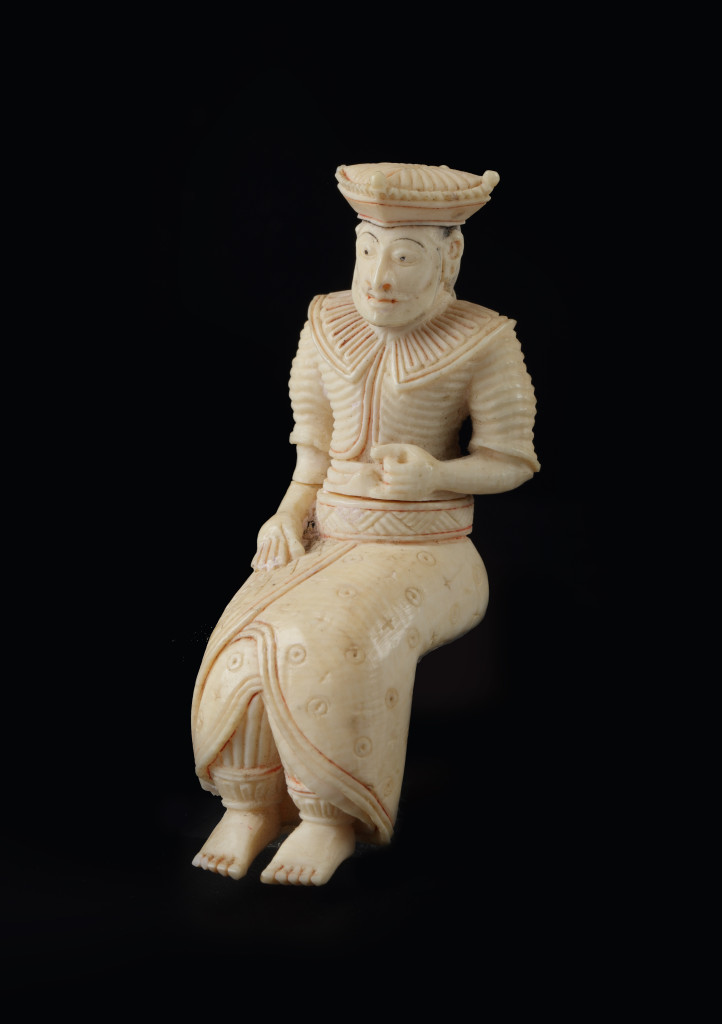
A small ivory sculpture of a seated Sri Lankan king
Extremely rare ebony carved child's chair
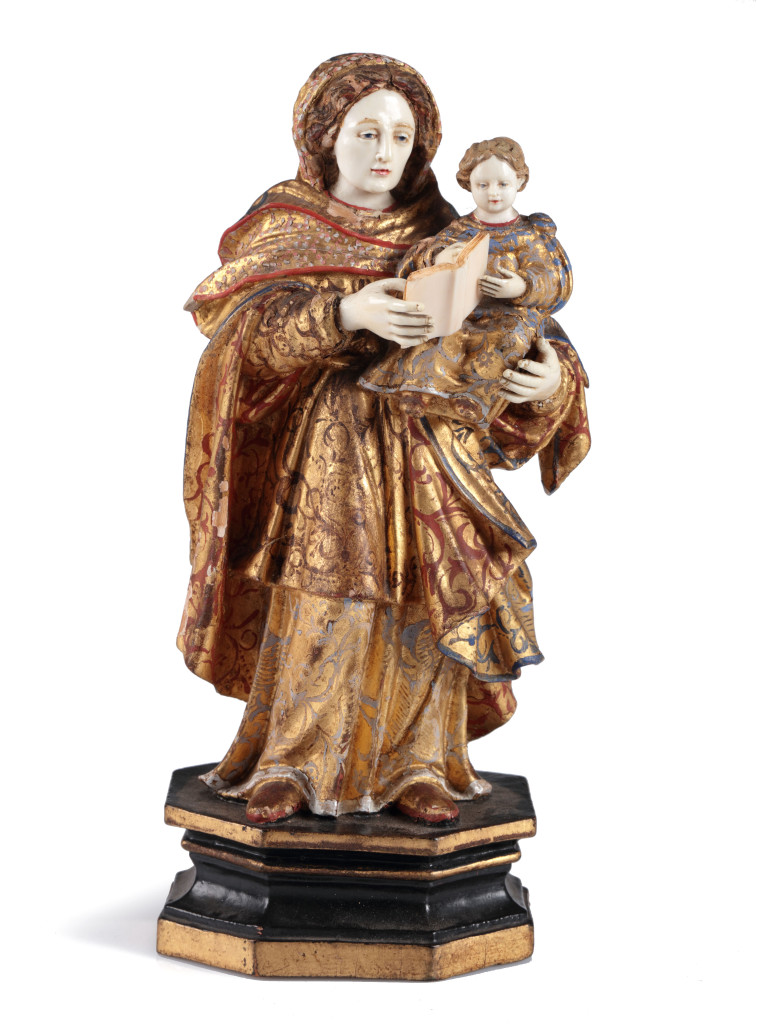
An Indian-Portuguese sculpture of the Holy Virgin holding the child Jesus on her arm, giving him reading lessons
Indian-Portuguese sculpure Maria Jesus
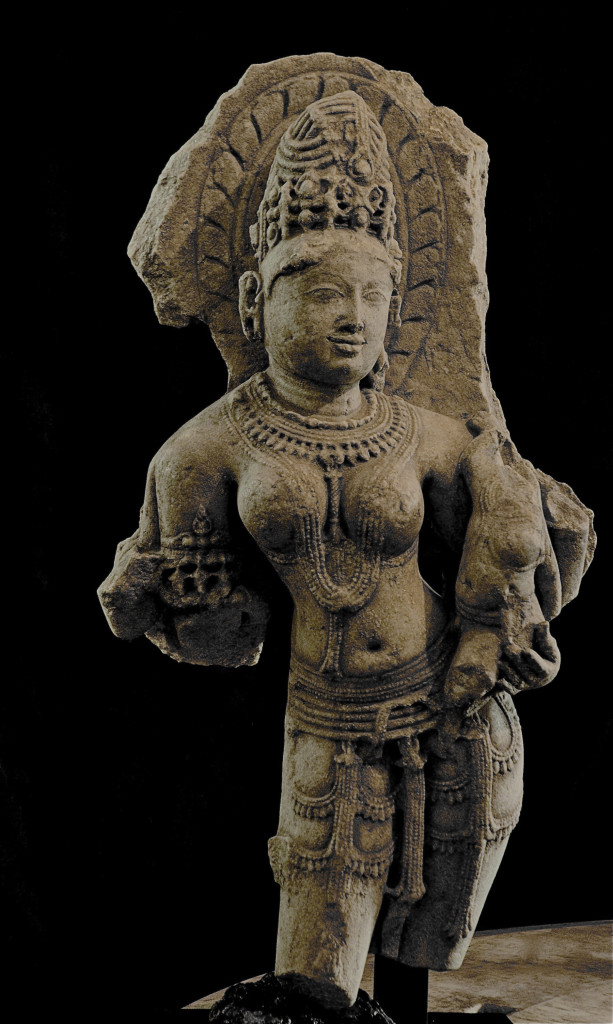
An Indian white marble sculpture of 'Ambika', the Great Goddess
Indian 12th century Godess sculpture