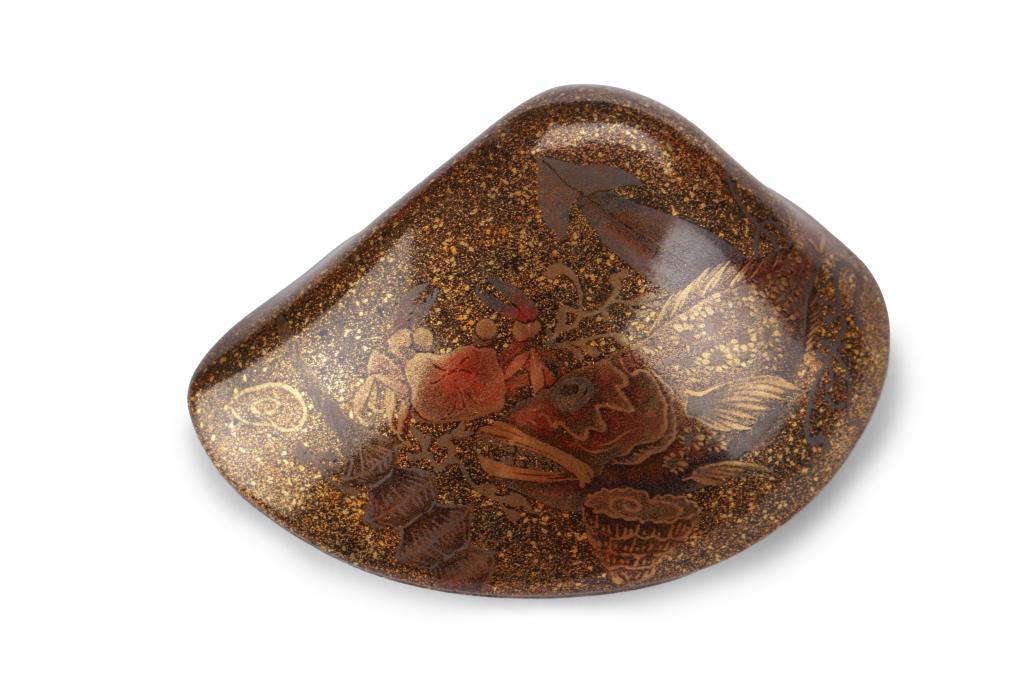
A large and highly refined lacquer netsuke of a clam signed Ozan
A large and highly refined lacquer manjue-form netsuke modelled as a clam (hamaguri), the bivalve shown closed with its two valves swelling gently to a soft triangular silhouette and tapering to the hinge. The wood core is lacquered overall in dense nashiji (“pear-skin” ground) of warm brown tone, generously sprinkled with irregular, deliberately oversized gold flakes that catch the light unevenly and give the surface its mottled, aqueous depth.
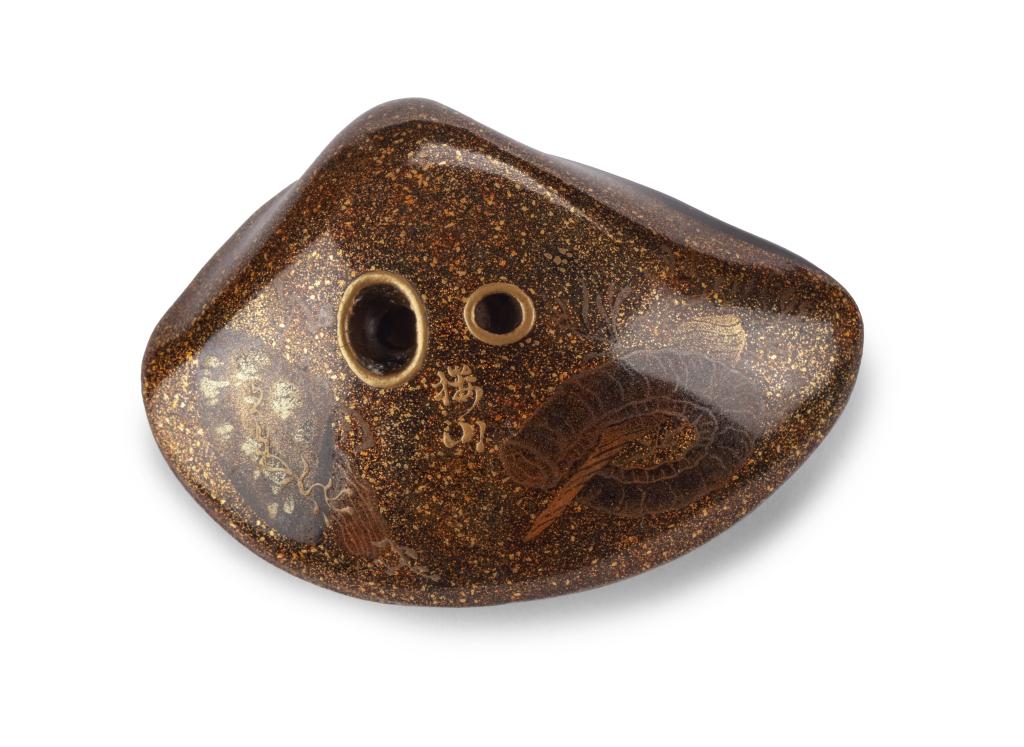
Both faces are decorated in togidashi-e (polished-out lacquer pictures) in gold, red, and silver hiramaki-e and takamaki-e, with fine kebori hairline detailing. One face presents a still-life arrangement of the sea’s bounty: a large fish (read as a tai or sea bream, though catalogued as koi), a crab with carefully rendered carapace and articulated legs, scattered shells, a basket or creel, leafy stems, and what appears to be a folded net or fishing tackle. The reverse continues the aquatic theme with a crab, a coiled or piled marine form, sprigs of seaweed and pine, and additional shellfish, all loosely scattered across the ground in the asymmetric Rinpa-derived manner.
The reverse carries the two himotoshi (cord-holes), unequal in size and asymmetrically placed, the larger ring with a raised metallic-gold lacquered rim, the smaller similarly lipped — a refined treatment confirming the cord channel was intended to be seen. Signed in gold hiramaki-e within a small reserve: OZAN (楙山 / 茂山).
L. 6.5 cm
On the form. This is a manju netsuke in the specific guise of a clam — a conceit perfectly suited to lacquer artists, since the smooth domed bivalve gives an uninterrupted ground for pictorial maki-e. The clam (hamaguri) is not a neutral choice. The matched pair of valves, each unique and fitting only its true partner, made the hamaguri the emblem of marital fidelity in Japan, which is why clam shells were the playing pieces of kai-awase, the aristocratic shell-matching game, and why painted shells appear in Heian and later marriage trousseaux. A netsuke in this form carries that auspicious nuptial association quietly within it.
On the imagery. The decoration belongs to the umi no sachi (“bounty of the sea”) tradition — fish, crab, shell, and net assembled as a celebration of abundance. The crab (kani) carries its own layered meaning: a homophone-rich emblem of protection and, through its hard carapace, of resilience. The sea bream (tai) puns on medetai, “auspicious,” and is the fish of celebration above all others. Read together with the clam form, the programme is thoroughly felicitous — a small object dense with good wishes, the sort of thing equally at home as a connoisseur’s accessory and a tactful gift.
On the technique. The piece is a showcase of the lacquerer’s full vocabulary rather than the carver’s. The nashiji ground with enlarged flakes is a deliberately rich, slightly archaising effect; the pictorial work is togidashi-e, in which the design is built up in coloured lacquers, covered over, and then painstakingly ground and polished back flush with the surface so the image lies within the lacquer rather than on top of it. This is among the most labour-intensive of maki-e methods and signals a luxury commission. The metallic-rimmed himotoshi is the detail that separates a serious lacquer netsuke from a merely decorative one.
On use and authorship. As a sagemono toggle the clam would have anchored the cords of an inrō or pouch at the obi, though objects of this refinement were as often handled and admired as worn. Ozan is recorded as a lacquer-netsuke artist of the late Edo period working in precisely this togidashi manner; the signature in gold maki-e (rather than incised) is consistent with a lacquer specialist rather than a wood carver, and with the period assigned.
This is, in short, a connoisseur’s lacquer netsuke: a clam that is also an emblem of fidelity, carrying the sea’s bounty across both faces in polished-out gold, red, and silver, executed in the most demanding maki-e technique and signed by a recorded master. The form is modest in the hand; the workmanship is not.
Related objects
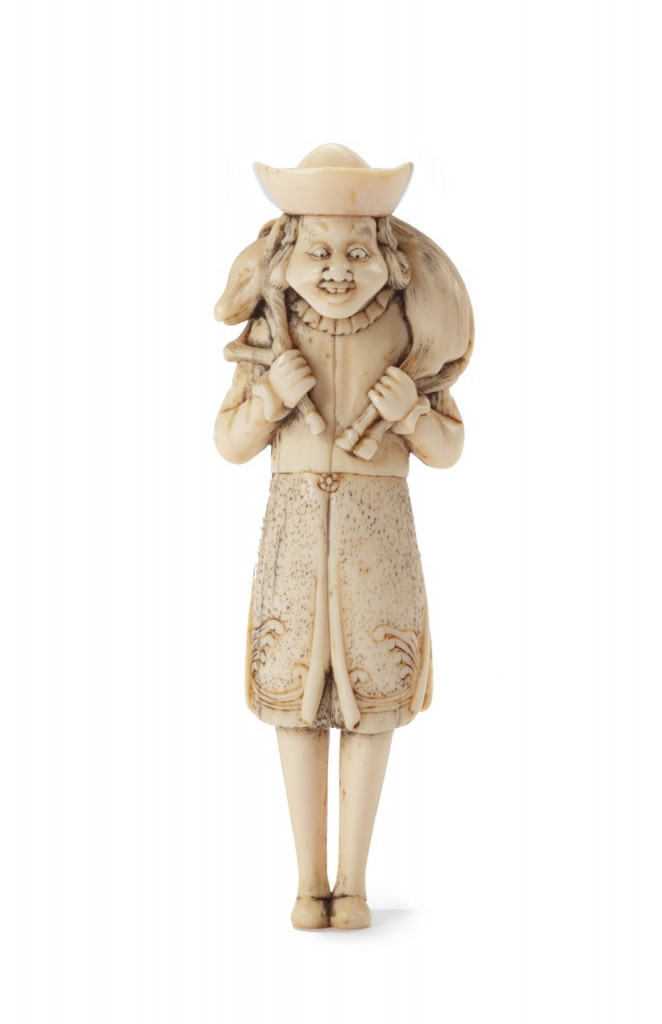
A superb Japanese ivory netsuke of a Dutchman carrying a boar slung over his shoulder
The proudly standing Dutchman, wearing a European hat and lozenge wig, carries the legs of the boar on his shoulder, the fur of the limp animal neatly incised. The Dutchman’s coat is finely spotted and engraved with crashing wave design.
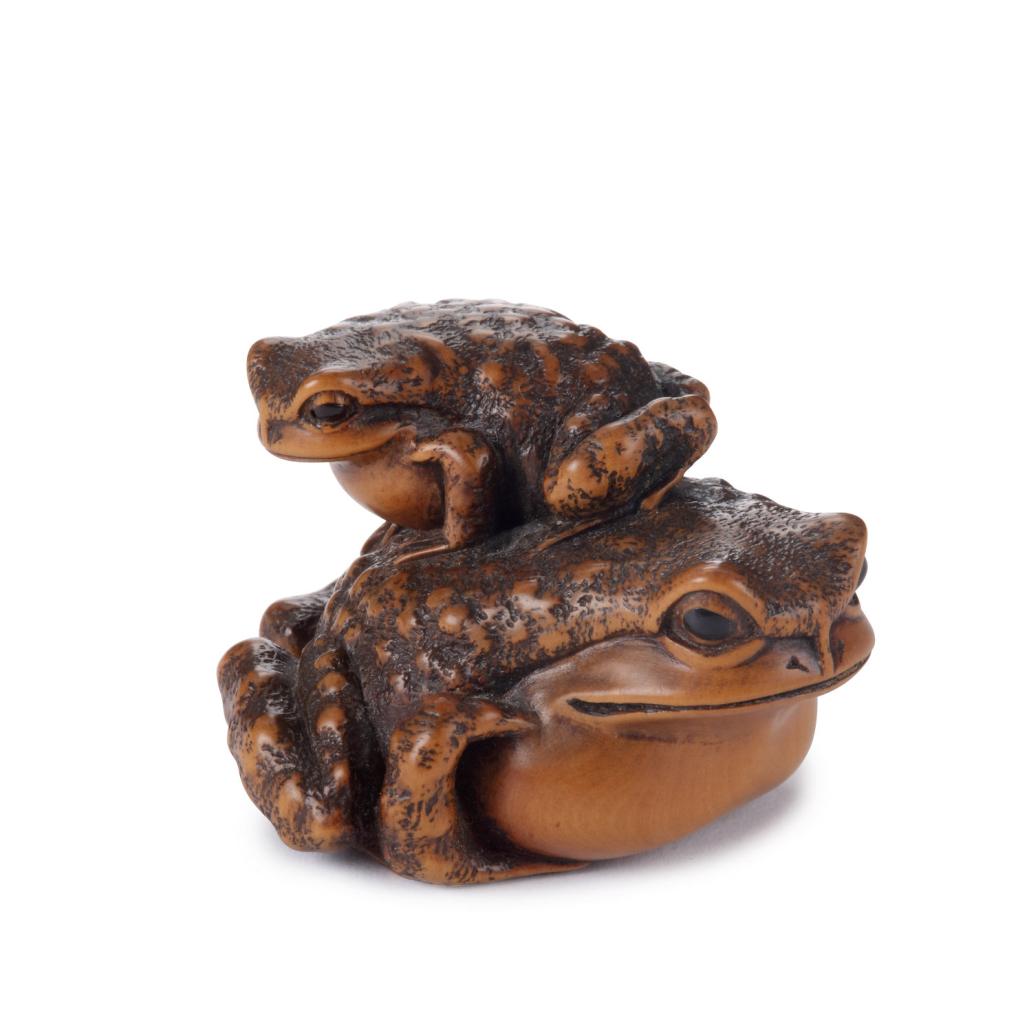
A kaki wood netsuke of a toad and its young by Masanao
_Ise province, Japan, circa 1850-1880_ _H. 3.6 cm_ Provenance: - Collection Van der Ploeg, Rotterdam - Amsterdam antiques trade, purchased in 2015 - Private collection, the Netherlands
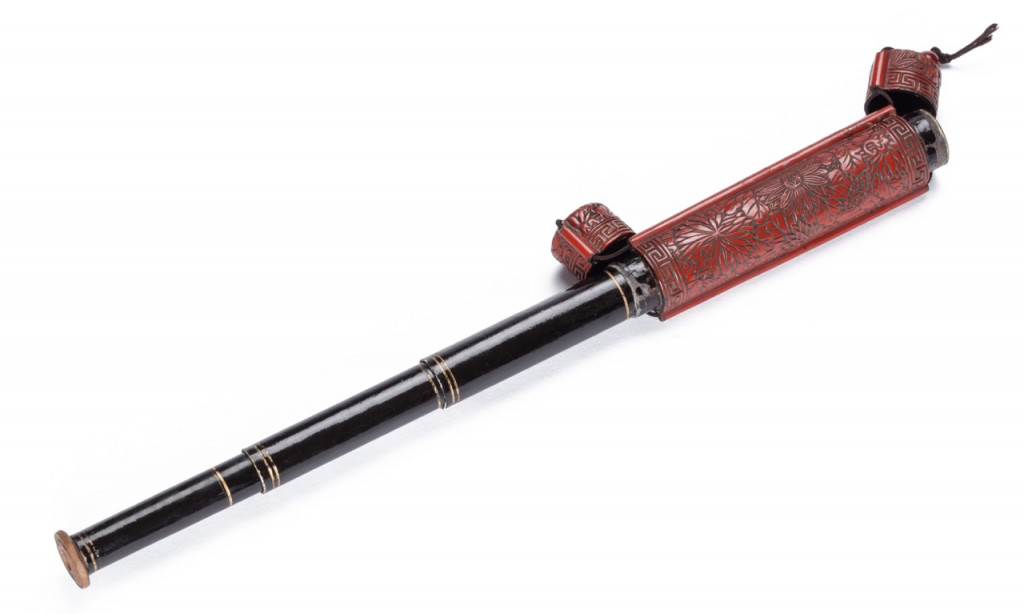
An exceptional Japanese carved red choshitsu lacquer telescope
An exceptional Japanese carved red chõshitsu lacquer telescope. In Japan, unlike in China, carved lacquer ware was rare. It involves carving patterns through layers of lacquer. This small telescope, with a chrysanthemum design, extending parts black lacquered paper-maché with wooden eye-piece, is reminiscent of the Chinese carved lacquer technique much admired, but only occasionally imitated in Japan. Spectacles arrived in Japan in the mid-16th century mainly through Jesuits from China.