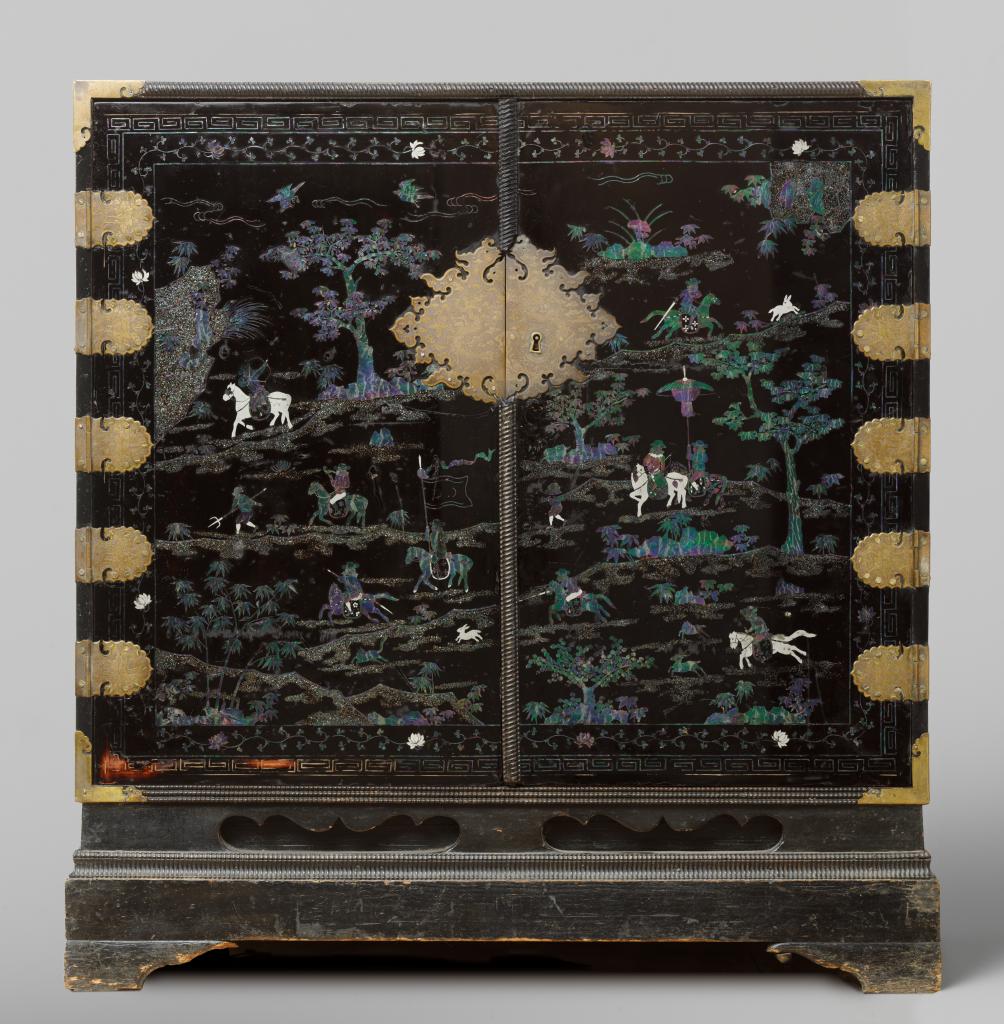
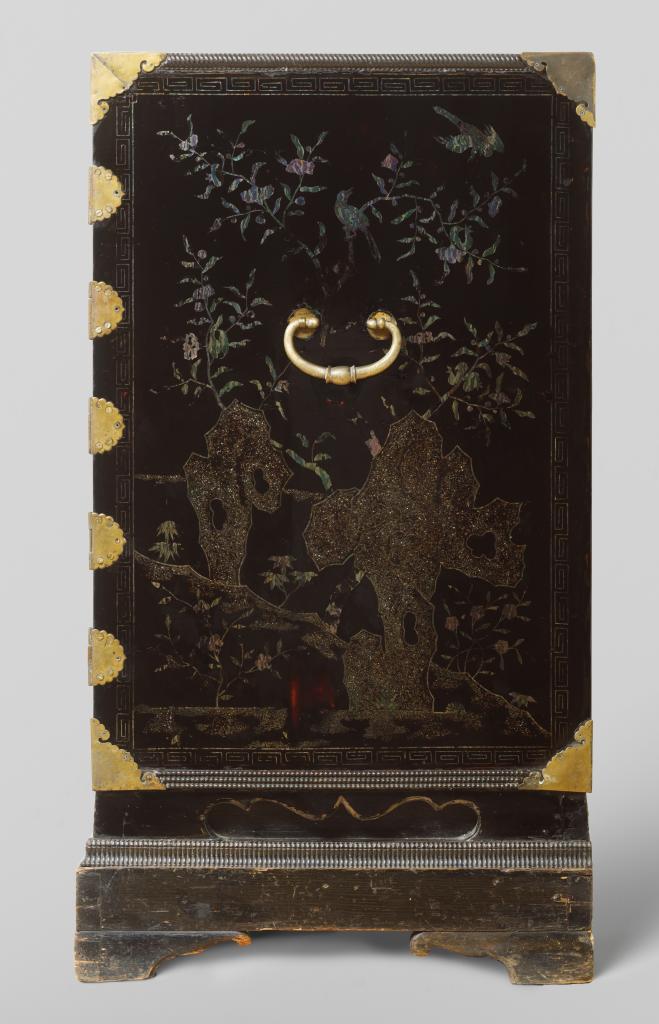
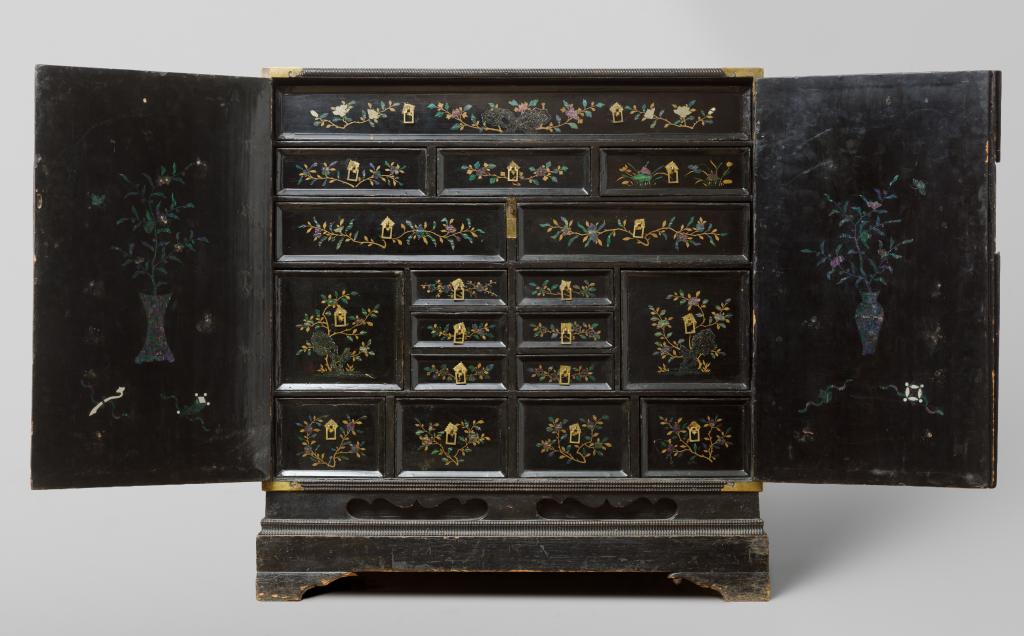
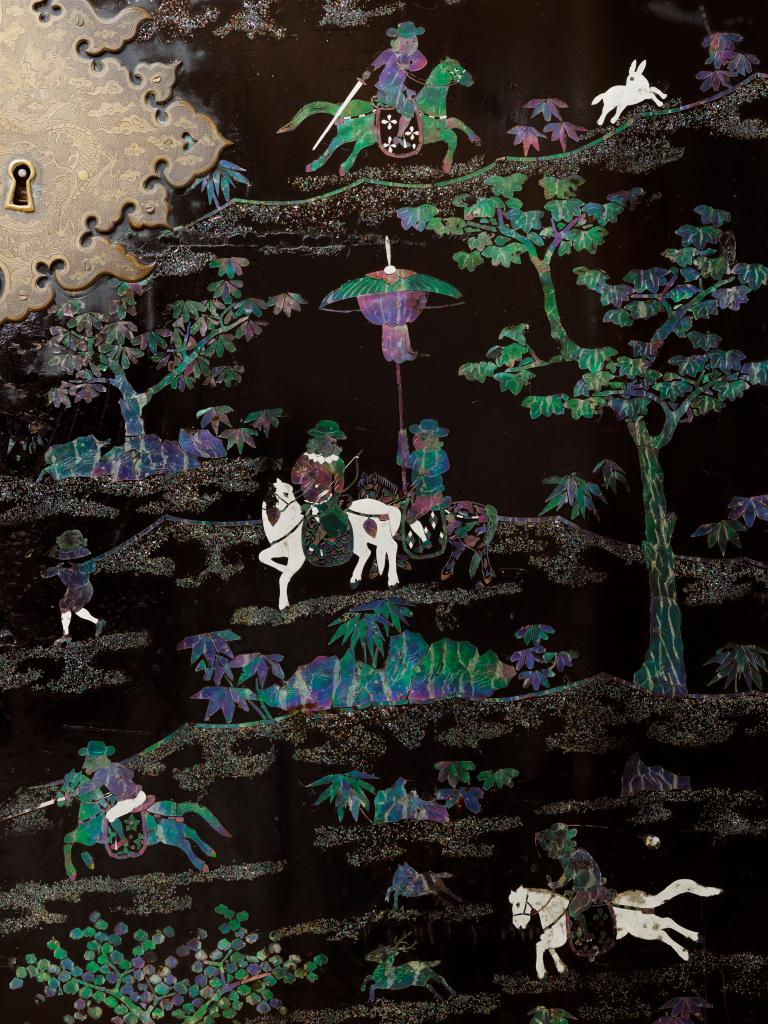
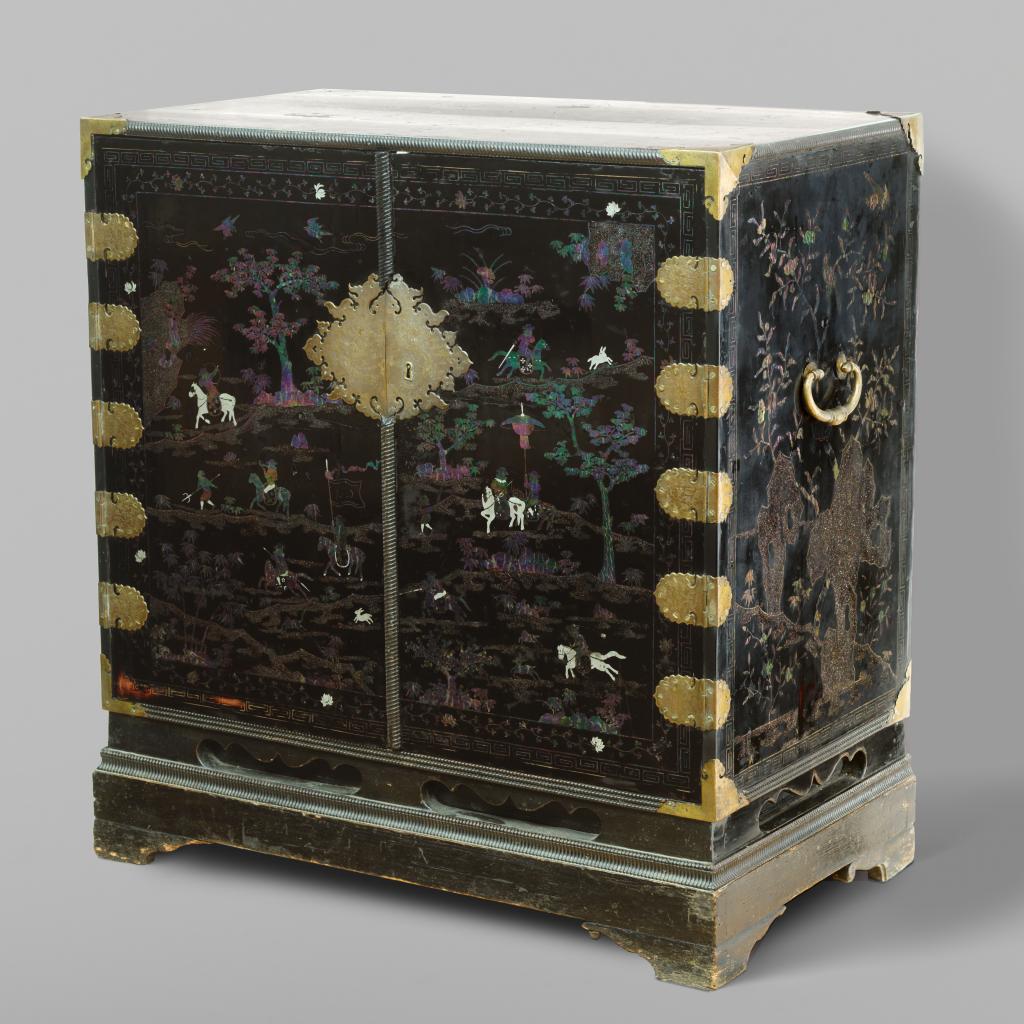
A Chinese mother-of-pearl and silver inlaid lacquered cabinet with depictions of Dutchmen
Qing dynasty, Kangxi period (1662-1722)
H. 75 x W. 89 x D. 51 cm
Although conceived for export to Europe, this cabinet draws upon a traditional Chinese prototype. Its structure follows the form of an apothecary’s cabinet (yaoxiang), with two hinged doors opening to reveal an array of drawers of varying sizes, designed to enable a physician to store and retrieve instruments and remedies efficiently. During the Ancien Régime, cabinets of this type were avidly collected in Europe. Lacquer examples were frequently produced in pairs, and it is possible that the present cabinet was originally conceived as part of such a set.
Chinese lacquer cabinets are documented in numerous seventeenth-century aristocratic collections, including those at the highest levels of the French state. An inventory of 1653 recording the possessions of Jules Mazarin describes “a cabinet from China made in the form of a temple, in the architectural manner of the country, varnished and painted with landscapes, animals and other things.” Likewise, the inventory of gifts presented by the Siamese embassy received at Palace of Versailles in 1686 lists several lacquer furnishings from China and Japan. Although many lacquer cabinets given to the French royal family appear to have been of Japanese origin, the Queen of Siam is recorded as having offered the Duke of Burgundy “three small cabinets made in Macao, capital of Japan (?) mounted in silver.” In reality, both Canton (Guangzhou) and Macao were major Chinese production centers for export lacquer, strategically positioned near the ports frequented by Western merchants.
A limited number of Chinese cabinets dating from the late seventeenth to early eighteenth century display decoration executed in a combination of techniques, as seen in the present example. This was a period of transition in China: as internal conflicts subsided, workshops increasingly adapted their production to meet Western tastes. The cabinet may thus be regarded as both rare and exceptional, reflecting experimentation within Chinese lacquer ateliers and distinguished by its unusual decoration of European hunting scenes.
Comparable works include a cabinet sold at Sotheby’s (6 November 2024) and another with European hunting decoration formerly offered by Galerie PAB. The Coromandel lacquer cabinet in the Victoria and Albert Museum (FE.39-1981) features closely related drawer handles. The hunting scenes also recall a screen of similar subject preserved in the Musée de la Compagnie des Indes (2016.4.1), as well as Japanese Namban screens. For Chinese and Japanese artisans alike, such imagery may have symbolized prosperity and auspicious fortune, much as the arrival of Western ships represented commercial opportunity. This decorative vocabulary supports a dating of the cabinet to the late seventeenth or early eighteenth century
H. 75 x W. 89 x D. 51 cm
Although conceived for export to Europe, this cabinet draws upon a traditional Chinese prototype. Its structure follows the form of an apothecary’s cabinet (yaoxiang), with two hinged doors opening to reveal an array of drawers of varying sizes, designed to enable a physician to store and retrieve instruments and remedies efficiently. During the Ancien Régime, cabinets of this type were avidly collected in Europe. Lacquer examples were frequently produced in pairs, and it is possible that the present cabinet was originally conceived as part of such a set.
Chinese lacquer cabinets are documented in numerous seventeenth-century aristocratic collections, including those at the highest levels of the French state. An inventory of 1653 recording the possessions of Jules Mazarin describes “a cabinet from China made in the form of a temple, in the architectural manner of the country, varnished and painted with landscapes, animals and other things.” Likewise, the inventory of gifts presented by the Siamese embassy received at Palace of Versailles in 1686 lists several lacquer furnishings from China and Japan. Although many lacquer cabinets given to the French royal family appear to have been of Japanese origin, the Queen of Siam is recorded as having offered the Duke of Burgundy “three small cabinets made in Macao, capital of Japan (?) mounted in silver.” In reality, both Canton (Guangzhou) and Macao were major Chinese production centers for export lacquer, strategically positioned near the ports frequented by Western merchants.
A limited number of Chinese cabinets dating from the late seventeenth to early eighteenth century display decoration executed in a combination of techniques, as seen in the present example. This was a period of transition in China: as internal conflicts subsided, workshops increasingly adapted their production to meet Western tastes. The cabinet may thus be regarded as both rare and exceptional, reflecting experimentation within Chinese lacquer ateliers and distinguished by its unusual decoration of European hunting scenes.
Comparable works include a cabinet sold at Sotheby’s (6 November 2024) and another with European hunting decoration formerly offered by Galerie PAB. The Coromandel lacquer cabinet in the Victoria and Albert Museum (FE.39-1981) features closely related drawer handles. The hunting scenes also recall a screen of similar subject preserved in the Musée de la Compagnie des Indes (2016.4.1), as well as Japanese Namban screens. For Chinese and Japanese artisans alike, such imagery may have symbolized prosperity and auspicious fortune, much as the arrival of Western ships represented commercial opportunity. This decorative vocabulary supports a dating of the cabinet to the late seventeenth or early eighteenth century
Part of the China collection.
Related objects
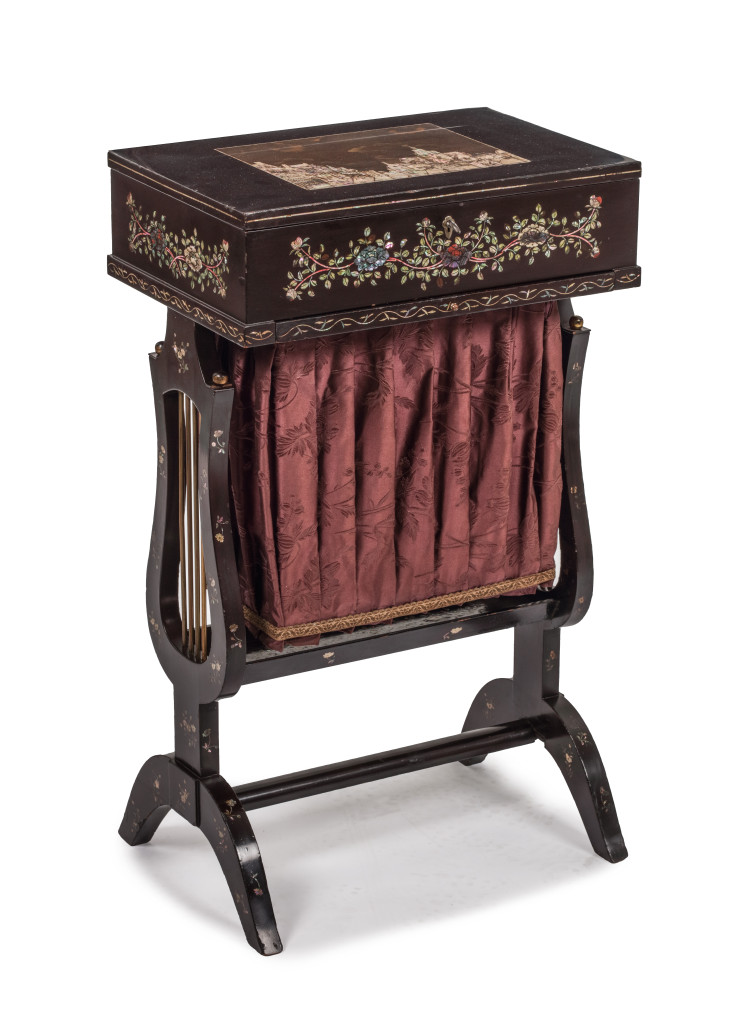
Japanese export laquer sewing table after a European Biedermeier example
_Nagasaki or Kyoto, Edo period, 1830-1840_ _H. 73 x W. 43 cm_
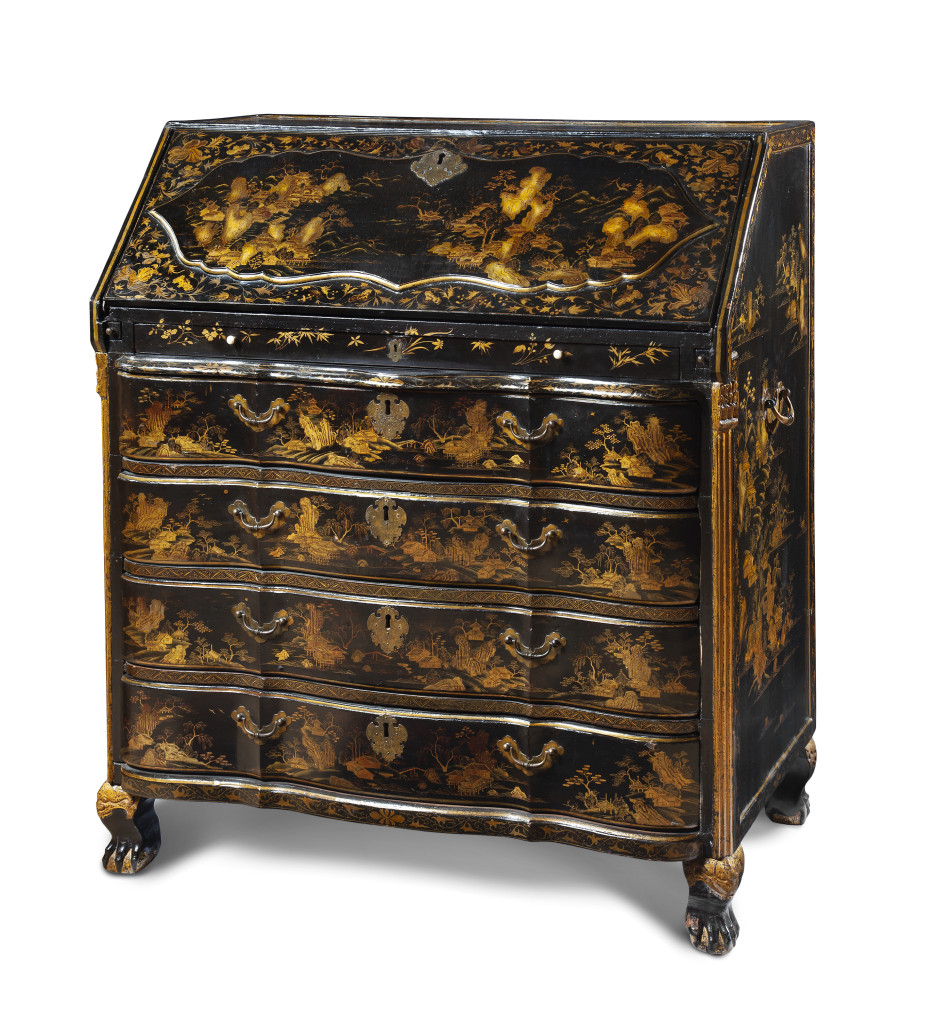
An extremely rare Chinese export lacquer bureau for the Dutch market
Canton, circa 1737
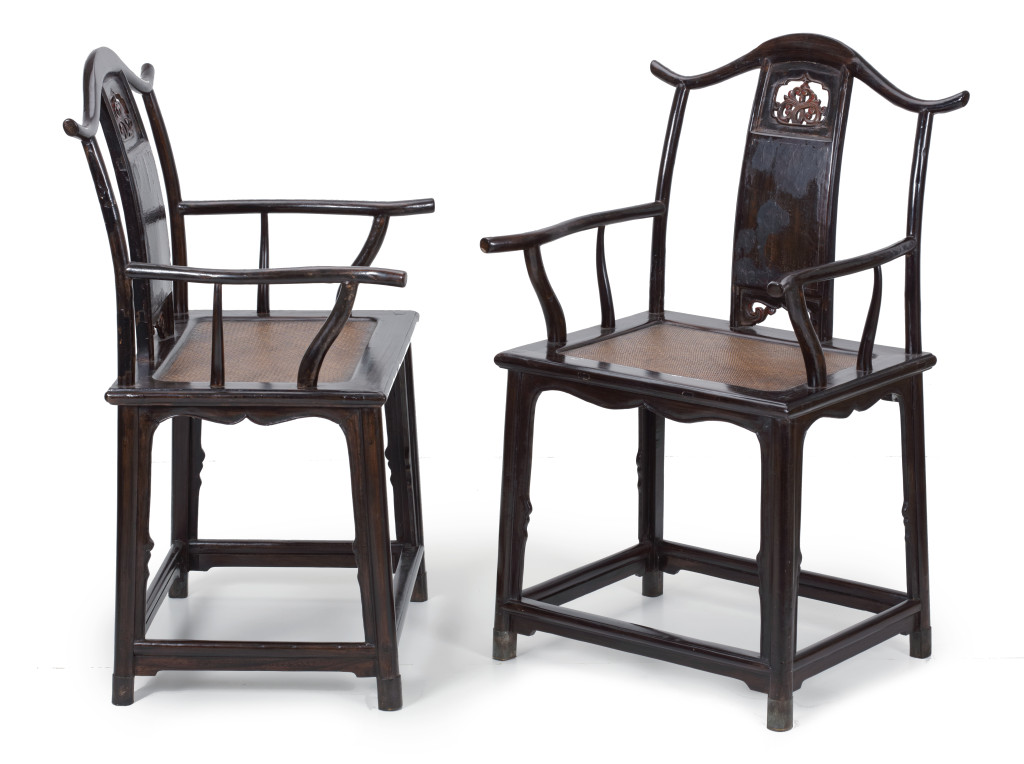
A pair of lacquered wood northern Chinese yoke-back chairs, Guan mao shi
Hebei Province, Qing Dynasty, early 18th century