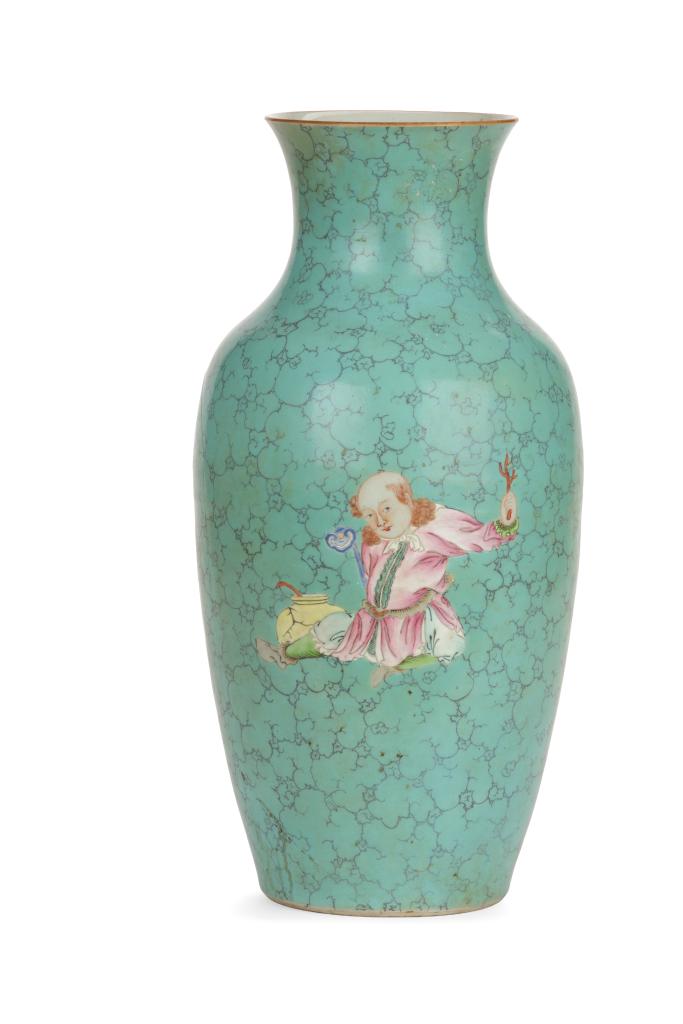
A Chinese export turquoise-ground ‘famille rose’ porcelain vase with depiction of a Dutchman
Late Qianlong period, 2nd half 18th century
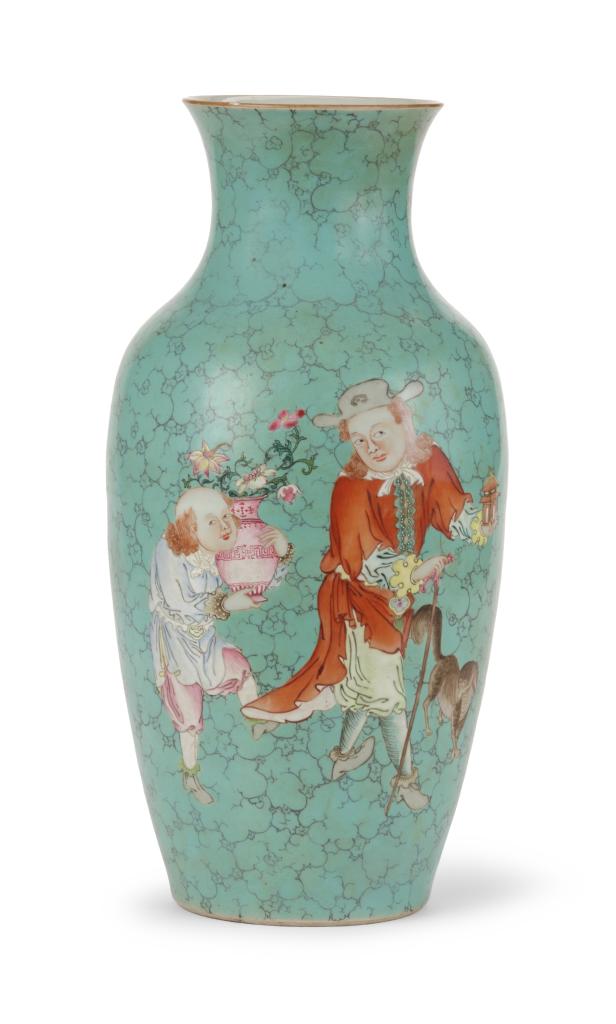
Of tall baluster form with a slightly spreading foot and a flaring neck, the mouthrim and footrim picked out in gilt. The exterior is covered in a turquoise ground painted with a black veined network, imitating the appearance of turquoise stone.
H. 40.5 cm
Provenance:
Private collection, France (since the 1920s)
The body is enamelled in the famille rose palette with a whimsical ‘European subject’ scene: a fashionable Dutch gentleman in a flowing red coat and broad-brimmed hat walks with a long staff, accompanied by a hound, while a companion - shown with a bald pate and side curls - offers a pink vase filled with flowering sprays. The slightly caricatural physiognomies and costume details are characteristic of Chinese renderings of Europeans made for export, where Western sitters and themes were filtered through Chinese workshop conventions rather than naturalistic portraiture.
From the first half of the 18th century onward, Chinese porcelain painters adapted forms and imagery to European demand; by the mid-century this included an appetite for explicitly European motifs and figures - often derived from prints and other circulated models - alongside the more familiar armorial and ‘mandarin’ subjects.
Related European-figure decoration on 18th century Chinese porcelain can be seen on an ovoid Chinese export vase in the Rijksmuseum, Amsterdam (inv. AK-NM-13365), dated c. 1740–1760, painted with a pipe-smoking Dutchman attended by a servant pouring him a drink. In an imperial register, the National Palace Museum, Taipei preserves Qianlong falangcai vases with European landscapes and figures framed in European-style cartouches, including a tubular-handled example featuring a Madonna-and-Child scene (acc. K1B017367) and a chi-dragon-handled vase painted with Western women and children (acc. K1B017600). The broader court fascination with Western pictorial idioms is also embodied by Guangzhou tribute painted enamels, such as the Palace Museum, Beijing painted-enamel begonia-form vase with cartouches of Western scenery and figures, Qianlong mark and period, H. 50.5 cm (collection no. 故00116624).
Sources:
– Jeffrey H. Munger & Alice Cooney Frelinghuysen, “East and West: Chinese Export Porcelain,” The Metropolitan Museum of Art (Heilbrunn Timeline of Art History)
– Helen Glaister, “Understanding European style Chinese export porcelain through the Ionides Collection,” in: Journal of International Ceramic Studies, 2025
Of tall baluster form with a slightly spreading foot and a flaring neck, the mouthrim and footrim picked out in gilt. The exterior is covered in a turquoise ground painted with a black veined network, imitating the appearance of turquoise stone.
H. 40.5 cm
Provenance:
Private collection, France (since the 1920s)
The body is enamelled in the famille rose palette with a whimsical ‘European subject’ scene: a fashionable Dutch gentleman in a flowing red coat and broad-brimmed hat walks with a long staff, accompanied by a hound, while a companion - shown with a bald pate and side curls - offers a pink vase filled with flowering sprays. The slightly caricatural physiognomies and costume details are characteristic of Chinese renderings of Europeans made for export, where Western sitters and themes were filtered through Chinese workshop conventions rather than naturalistic portraiture.
From the first half of the 18th century onward, Chinese porcelain painters adapted forms and imagery to European demand; by the mid-century this included an appetite for explicitly European motifs and figures - often derived from prints and other circulated models - alongside the more familiar armorial and ‘mandarin’ subjects.
Related European-figure decoration on 18th century Chinese porcelain can be seen on an ovoid Chinese export vase in the Rijksmuseum, Amsterdam (inv. AK-NM-13365), dated c. 1740–1760, painted with a pipe-smoking Dutchman attended by a servant pouring him a drink. In an imperial register, the National Palace Museum, Taipei preserves Qianlong falangcai vases with European landscapes and figures framed in European-style cartouches, including a tubular-handled example featuring a Madonna-and-Child scene (acc. K1B017367) and a chi-dragon-handled vase painted with Western women and children (acc. K1B017600). The broader court fascination with Western pictorial idioms is also embodied by Guangzhou tribute painted enamels, such as the Palace Museum, Beijing painted-enamel begonia-form vase with cartouches of Western scenery and figures, Qianlong mark and period, H. 50.5 cm (collection no. 故00116624).
Sources:
– Jeffrey H. Munger & Alice Cooney Frelinghuysen, “East and West: Chinese Export Porcelain,” The Metropolitan Museum of Art (Heilbrunn Timeline of Art History)
– Helen Glaister, “Understanding European style Chinese export porcelain through the Ionides Collection,” in: Journal of International Ceramic Studies, 2025
Part of the China collection.